Transport Across Membranes (SQA National 5 Biology): Exam Questions

Exam code: X807 75

18 mins9 questions
11 mark

Potato cylinders were placed into different concentrations of sucrose solution and any change in mass was recorded.

The table shows the initial sucrose concentrations inside the potato cells and the concentrations of the solutions they were placed in.

Which potato cylinder will gain the most mass?

Initial sucrose concentration inside potato cells (mol/dm3 )

Sucrose concentration of solution
(mol/dm3 )

A

0.31

0.45

B

0.35

0.35

C

0.31

0.25

D

0.35

0.21

    2a3 marks

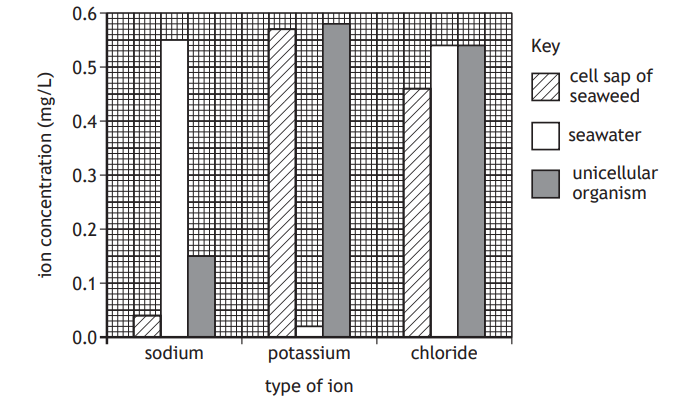
    The concentration of some ions within the cell sap of seaweed, the surrounding seawater, and a unicellular organism were measured.

    The results are shown in the bar chart.

    Bar chart comparing ion concentrations of sodium, potassium, and chloride in seawater, seaweed cell sap, and a unicellular organism up to 0.6 mg/L.

    (i) Name the ion that moves from the seaweed into the seawater by diffusion and give a reason for your choice.

    [2]

    Ion............................................................................................................................

    Reason.....................................................................................................................

    (ii) The unicellular organism must always have a sodium ion concentration below 0.25 mg/L.

    Name the process that moves excess sodium ions out of the unicellular organism.

    [1]

    2b1 mark

    The cell sap of the seaweed was tested to measure the concentration of each ion.

    Name the structure in seaweed cells that contains cell sap.

    31 mark

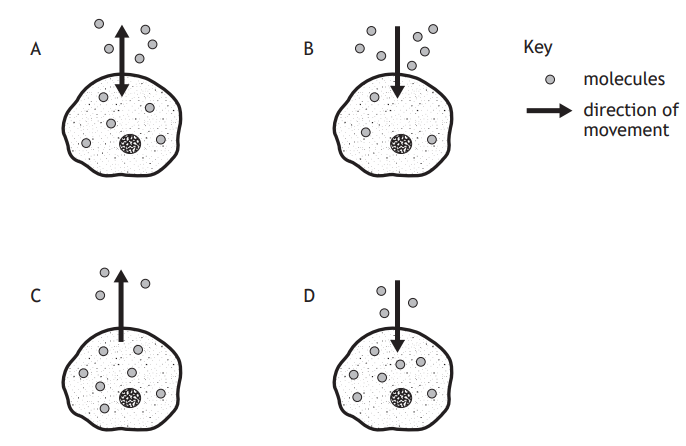
    The diagrams represent the movement of molecules across a cell membrane.

    Which cell would require the greatest number of mitochondria to allow the movement shown?

    Diagram showing four cells (A, B, C, D) with arrows indicating molecule movement. A and C arrows point outwards, B and D arrows point inwards. Key included.
      4a1 mark

      A group of students measured the mass of pieces of turnip tissue before placing them in different concentrations of salt solution. After one hour, the change in mass of the turnip tissue was recorded.

      The results are shown in the table.

      Concentration of salt solution
      (g/100 cm3 )

      Percentage change in mass
      (%)

      1

      +17

      3

      +11

      6

      −2

      8

      −9

      10

      −16

      Predict the percentage change in mass in a 2 g/100 cm3 salt solution.

      ...........................%

      4b1 mark

      Identify the salt solution where most of the turnip cells would be turgid.

      ...................................g/100 cm3

      4c
      Sme Calculator
      1 mark

      The pieces of turnip used in this investigation all had a starting mass of 6 g.

      Calculate the final mass of the piece of turnip in the 8 g/100 cm3 of salt solution.

      ................................................g

      51 mark

      Four equal sized cubes of potato were weighed and each placed into a different concentration of sugar solution. They were dried and weighed again after one hour.

      The results are shown in the table.

      Which solution had the highest sugar concentration?

      Solution

      Mass of potato at start
      (g)

      Mass of potato after one hour
      (g)

      A

      4.5

      3.9

      B

      4.5

      4.3

      C

      4.5

      4.5

      D

      4.5

      5.5

        6a2 marks

        Plants transport water and mineral ions from their roots to the leaves.

        Mineral ions can move from the soil to the root cells by active transport.

        Describe the process of active transport.

        6b3 marks

        Water enters a plant by osmosis, which is an example of passive transport.

        (i) State what this means in terms of the energy required for osmosis.

        [1]

        (ii) Name the vessels that transport water to the leaves.

        [1]

        (iii) When water enters a plant cell the vacuole fills and swells until no more water can enter.

        State the term used to describe a plant cell in this state.

        [1]

        71 mark

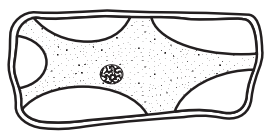
        The diagram shows a plant cell after being placed in a liquid for 30 minutes.

        Diagram of a biological cell with a central nucleus, surrounded by a dotted cytoplasm and bordered by an irregular cell membrane.

        This cell has become:

        • plasmolysed due to water loss

        • plasmolysed due to water gain

        • turgid due to water loss

        • turgid due to water gain

        81 mark

        The following statements relate to the transport of molecules across membranes:

        1. Energy is required.

        2. Molecules move from an area of high concentration to an area of low concentration.

        3. Membrane proteins are involved.

        Which of the statements apply to active transport?

        • 1 and 2 only

        • 1 and 3 only

        • 2 and 3 only

        • 1, 2 and 3

        91 mark

        In an investigation into the effects of different solutions on plant cells, a beetroot cylinder was dried with a paper towel, weighed, and placed in a concentrated salt solution.

        After 30 minutes, the beetroot cylinder was removed from the salt solution, dried and reweighed. It was then placed in water for 30 minutes, removed, dried and reweighed.

        Which row in the table shows the most likely results?

        Initial mass (g)

        Mass after 30 minutes in salt solution (g)

        Mass after 30 minutes in water (g)

        A

        2.5

        3.0

        3.5

        B

        3.0

        3.5

        2.5

        C

        3.0

        2.5

        3.5

        D

        3.5

        3.0

        2.5