1
1 mark
Which of the following structures would not be found in a typical plant cell?
Chloroplast
Cell membrane
Plasmid
Mitochondrion
Was this exam question helpful?
Exam code: X807 75
Which of the following structures would not be found in a typical plant cell?
Chloroplast
Cell membrane
Plasmid
Mitochondrion
Was this exam question helpful?
During mitosis, which of the following occurs immediately before the cytoplasm divides?
Nuclear membranes form.
Chromosomes line up at the equator.
Pairs of chromatids are separated.
Chromosomes shorten and thicken.
Was this exam question helpful?

The graph shows the growth of a foetus.
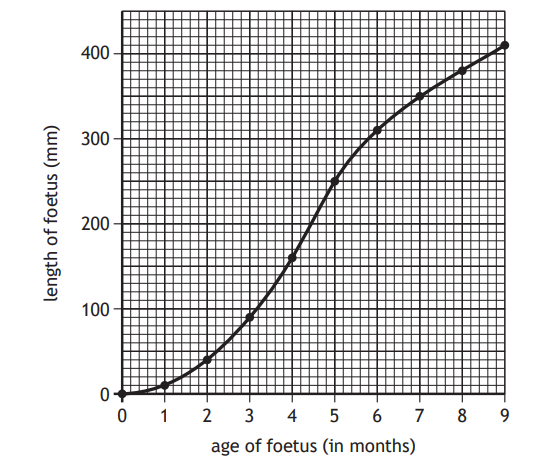
The average monthly increase in the length of the foetus from month 5 to month 9 is
32 mm
40 mm
160 mm
340 mm
Was this exam question helpful?
A chemical called colchicine stops cells from producing spindle fibres during mitosis, which prevents further stages occurring.
Which stage of mitosis would still occur when colchicine is present?
Chromosomes move to opposite poles of the cell.
Chromatids are pulled apart.
Chromosomes shorten and thicken.
Two diploid cells produced.
Was this exam question helpful?
A role of stem cells in the human body is to produce
antibodies for defence
new skin tissue to repair a cut
enzymes for digestion
hormones for communication.
Was this exam question helpful?
Tissue stem cells can be transplanted to replace blood cells.
Describe the feature of stem cells that allows them to be used in this way.
To successfully treat a blood disorder, between 2 million and 4 million stem cells per kilogram of the patient’s body mass are needed.
Calculate the minimum number of stem cells required to treat a patient with a mass of 78.5 kg.
........................million
The graph shows the survival rates of patients with a blood disorder who have received a stem cell transplant.
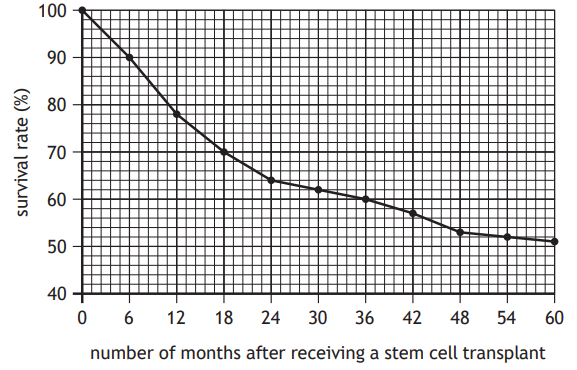
(i) Identify the survival rate of patients 24 months after receiving a stem cell transplant.
[1]
............................%
(ii) Describe the relationship between the number of months after receiving a stem cell transplant and the survival rate.
[1]
Other than tissue, name another type of stem cell.
Was this exam question helpful?
Two stages of mitosis are shown in the diagrams.
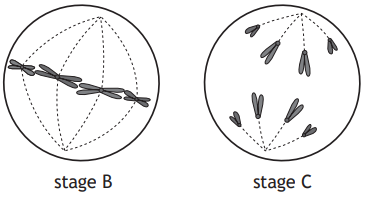
(i) Name the structures that pull the pairs of chromatids apart.
[1]
(ii) Describe what happens immediately after stage C.
[1]
Stem cells can divide in order to self-renew.
State the feature of stem cells that gives them the potential to develop into different types of cell.
Was this exam question helpful?