Transport Systems in Animals (SQA National 5 Biology): Exam Questions

Exam code: X807 75

37 mins14 questions
11 mark

The following sequence shows part of the blood flow through the body.

Flowchart showing the pathway from the right atrium to the left atrium, passing through stages E, F, lungs, and G, with directional arrows.

Which row in the table identifies E, F and G?

E

F

G

A

right ventricle

pulmonary artery

pulmonary vein

B

right ventricle

pulmonary vein

pulmonary artery

C

pulmonary artery

right ventricle

pulmonary vein

D

pulmonary vein

right ventricle

pulmonary artery

    21 mark

    Three students carried out an investigation into the effect of exercise on heart rate.

    Each student measured their heart rate after completing the same exercises.

    After each student’s heart rate returned to its resting rate, they repeated the investigation.

    Which of the following would improve the reliability of the results?

    • Increasing the rest period before repeating the exercise.

    • Completing the exercise in a different location.

    • Changing the type of exercise each time.

    • Increasing the number of students exercising.

    3a
    Sme Calculator
    2 marks

    The results of a blood count for two patients are shown.

    Component of blood count

    Normal range
    (units)

    Patient R
    (units)

    Patient S
    (units)

    White blood cell

    4.0–11.0

    6.5

    5.0

    Red blood cell

    4.5–5.5

    4.97

    4.01

    Haemoglobin

    130–170

    150

    115

    Platelets

    150–450

    330

    390

    (i) Which patient has all four components within the normal range?

    [1]

    Patient................................

    (ii) Four weeks later, both patients had their blood re-tested.

    The haemoglobin content of the blood of Patient S had increased by 20%.

    Calculate the number of units of haemoglobin in this second blood count.

    [1]

    ....................................units

    3b2 marks

    Other than containing haemoglobin, describe one way in which a red blood cell is specialised to carry out its function and explain the advantage of this specialisation.

    Description.....................................................................................................

    Explanation.....................................................................................................

    3c3 marks

    Two types of blood vessel are arteries and veins.

    Compare the structure of these two types of blood vessel.

    41 mark

    Haemoglobin’s ability to bind to oxygen is affected by the pH of the blood.

    The table shows the percentage of haemoglobin bound to oxygen at different pH levels.

    pH of blood

    Percentage of haemoglobin bound to oxygen

    7.1

    7.2

    60.0

    7.4

    69.0

    7.5

    73.5

    The percentage of haemoglobin bound to oxygen when the pH of blood is 7.1 is likely to be

    • 42.0

    • 51.0

    • 55.5

    • 59.9

    5a1 mark

    Coronavirus is a pathogen, which causes COVID‑19. Most people with COVID‑19 feel better within a few days or weeks of their first symptoms. Long COVID can be diagnosed when symptoms last longer.

    Symptoms of long COVID include extreme breathlessness, memory and concentration issues. In some cases, other organs can also be affected causing other health issues.

    A study monitored changes in the health of 500 patients with long COVID.

    Between the start and the end of the study, the percentage of patients with extreme breathlessness decreased from 38% to 30%, those with memory and concentration issues decreased from 48% to 38%, and those with other health issues decreased from 57% to 45%.

    At the end of the study, 10% had no organs affected, 65% of patients had only one organ affected and 25% had multiple organs affected.

    Name the type of white blood cell that produces antibodies against coronavirus.

    5b2 marks

    Using information from the passage, complete the table by adding:

    (i) a column heading

    [1]

    (ii) the relevant data.

    [1]

    Percentage of patients (%)

    Start of study

    End of study

    Extreme breathlessness

    Memory and concentration issues

    Other health issues

    5c
    Sme Calculator
    1 mark

    Calculate the simple whole number ratio of the percentage of long COVID patients who had multiple organs affected, to those with one organ affected, to those with no organs affected.

    .......................................... : ...................................... : .....................................
    multiple organs affected one organ affected no organs affected

    5d1 mark

    Suggest a reason why the study could be considered invalid.

    6a2 marks

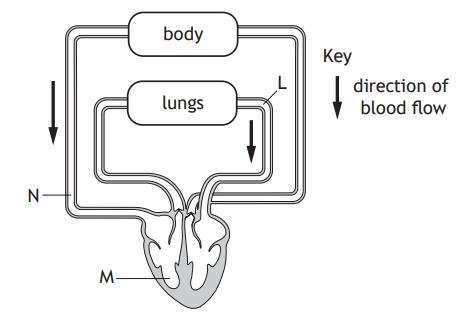
    The diagram represents part of the circulatory system in humans.

    Diagram of a double circulatory system, showing blood flow between heart, lungs, and body with arrows indicating direction. Key explains flow direction.

    (i) Name the heart chamber labelled M.

    [1]

    (ii) Compare the carbon dioxide concentrations in the blood travelling through blood vessels L and N.

    [1]

    6b3 marks

    The heart is composed of muscle tissue that requires its own blood supply.

    (i) Name the blood vessel that supplies the heart tissue with blood.

    [1]

    (ii) Explain why the heart muscle cells will stop contracting if this blood vessel becomes blocked.

    [2]

    71 mark

    Which row in the table describes some features of veins?

    Direction of blood flow

    Blood pressure in vein

    Width of central channel

    A

    away from the heart

    high

    narrow

    B

    towards the heart

    low

    wide

    C

    away from the heart

    high

    wide

    D

    towards the heart

    low

    narrow

      81 mark

      Three students carried out an investigation into the effect of exercise on heart rate.

      Each student measured their heart rate after completing the same exercises.

      After each student’s heart rate returned to its resting rate, they repeated the process.

      Which of the following would increase the reliability of the results?

      • Increase the time spent exercising.

      • Change the exercise location.

      • Change the type of exercise each time.

      • Increase the number of students exercising.

      9a
      Sme Calculator
      4 marks

      High altitude training is an important part of athlete preparation for endurance sports such as long‑distance running.

      As altitude increases the oxygen concentration of the air decreases.

      The table shows the effect of training at different altitudes on athletes’ red blood cell count.

      Altitude
      (km)

      Average red blood cell count
      (million/ml of blood)

      0

      4.4

      0.5

      5.0

      1.0

      5.6

      2.5

      6.2

      3.5

      7.4

      5.0

      8.8

      5.5

      9.4

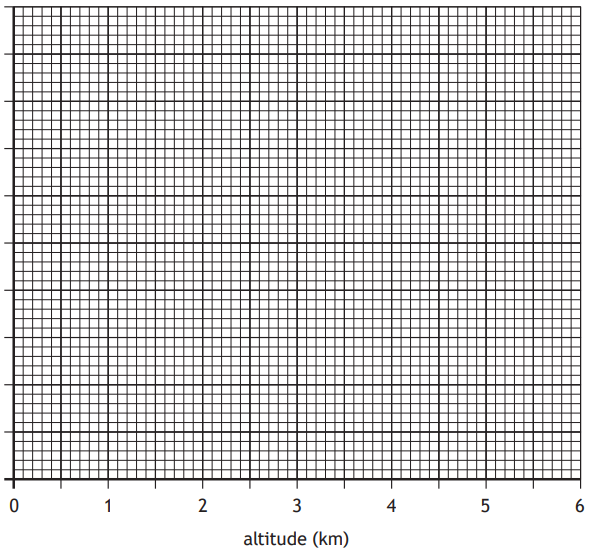
      (i) On the grid complete the vertical axis and plot a line graph to show the effect of altitude on average red blood cell count.

      [2]

      Grid chart with x-axis labelled "altitude (km)" ranging from 0 to 6, and y-axis unlabelled. Each axis has evenly spaced grid lines.

      (ii) Describe the relationship between altitude and red blood cell count.

      [1]

      (iii) Using information from the table, predict the average red blood cell count of an athlete training at an altitude of 3.0 km.

      [1]

      ..............................................million/ml of blood

      9b2 marks

      Red blood cells are important for transporting oxygen.

      (i) In what form is oxygen transported by red blood cells?

      [1]

      (ii) Give one structural feature of a red blood cell that allows it to carry out its function efficiently.

      [1]

      101 mark

      The human body can be defended against disease by:

      • lymphocytes producing phagocytes

      • phagocytes producing antibodies

      • antibodies producing lymphocytes

      • lymphocytes producing antibodies

      111 mark

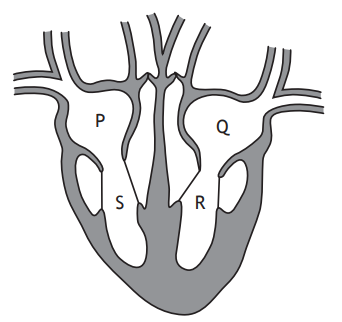
      The diagram represents the human heart.

      Diagram of a heart showing labelled sections: P and Q for upper chambers, S and R for lower chambers, with connecting vessels above and valves depicted.

      Starting where oxygenated blood first enters the heart, identify the order of blood flow through the heart.

      • Q rightwards arrowR rightwards arrowSrightwards arrowP

      • P rightwards arrowS rightwards arrowR rightwards arrowQ

      • Q rightwards arrowR rightwards arrowP rightwards arrowS

      • P rightwards arrowS rightwards arrowQ rightwards arrowR

      121 mark

      A heart attack can be caused by a blockage to a blood vessel that supplies the heart tissue with oxygen.

      In which blood vessel does this blockage occur?

      • Vena cava

      • Pulmonary artery

      • Coronary artery

      • Pulmonary vein

      131 mark

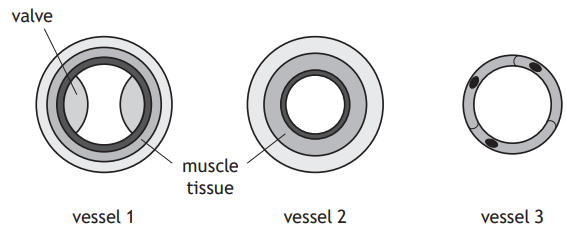
      The diagrams represent cross sections of three types of blood vessel.

      Cross-section diagrams of three blood vessels are shown. Vessel 1 has a valve, vessel 2 has thicker muscle tissue, and vessel 3 is the smallest.

      Which row in the table identifies the blood vessels shown in the diagrams?

      Vessel 1

      Vessel 2

      Vessel 3

      A

      artery

      vein

      capillary

      B

      vein

      artery

      capillary

      C

      vein

      capillary

      artery

      D

      capillary

      artery

      vein

        14a1 mark

        Measles in the UK

        Measles is a disease that can be prevented through two doses of the MMR vaccine. The target set by health experts to achieve measles-free status is to have at least 95% of the population vaccinated. The World Health Organization declared the UK measles-free in 2016.

        However, since 2016, cases of measles in the UK have been increasing, with too few people being vaccinated. It was suggested by experts that when measles cases became less common, some people believed that the threat of the disease was less. Another factor was the publication in the late 1990s of a controversial, and since discredited, piece of research wrongly linking the MMR vaccine with autism.

        In 2018, there was a marked increase in reported cases, with 994 cases in England and Wales, compared with 284 cases in 2017. There were 307 cases across the UK during the first three months of 2019. In 2019, only 87% of the population in England received their second dose of MMR. In both Wales and Scotland it was 92%, and in Northern Ireland it was 91%.

        Measles is caused by a pathogen.

        State the meaning of the term ‘pathogen’.

        14b2 marks

        (i) Describe the relationship between the uptake of the vaccine and the number of cases of measles.

        [1]

        (ii) Suggest a reason why the uptake of the vaccine in the UK has been lower since 2016.

        [1]

        14c
        Sme Calculator
        1 mark

        Calculate the simplest, whole number ratio, of measles cases in England and Wales in 2017 to 2018.

        ...................... : ........................ cases
        2017 2018

        14d1 mark

        Using data from the passage, explain why Scotland lost its measles-free status in 2019.