Transport Systems in Plants (SQA National 5 Biology): Exam Questions

Exam code: X807 75

13 mins6 questions
1a1 mark

An investigation was carried out to find out which leaf surface loses most water through transpiration.

Three plants were set up as shown.

Petroleum jelly was used to prevent water loss.
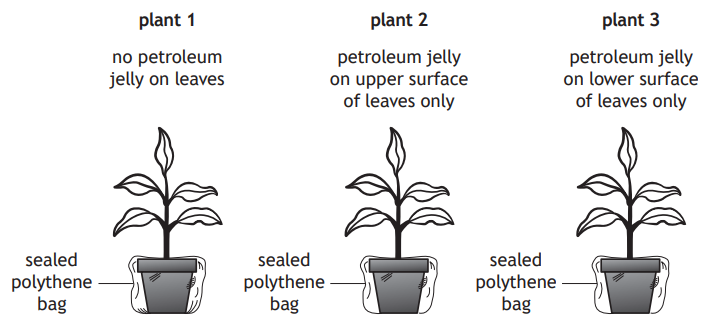
Three plants in pots, each in a sealed polythene bag. Plant 1 has no petroleum jelly on leaves, Plant 2 has it on upper surfaces, Plant 3 on lower surfaces.

The plants were weighed then left for 24 hours at 20 °C before being reweighed.

Name the openings found on leaves that water evaporates through.

1b1 mark

Which plant was used as a control in this investigation?

Plant................................

1c1 mark

Suggest why it was necessary to cover the plant pots with a polythene bag.

1d2 marks

The results for the investigation are shown in the table.

Plant

Mass of plant at start (g)

Mass of plant after 24 hours (g)

Percentage decrease in mass of plant (%)

1

250.0

150.0

40

2

275.0

176.0

36

3

220.0

211.2

4

(i) Explain why the results were calculated as a percentage change.

[1]

(ii) With reference to the aim, give a conclusion for this investigation.

[1]

21 mark

In which part of a leaf are stomata found?

  • Lower epidermis

  • Palisade mesophyll

  • Spongy mesophyll

  • Leaf vein

31 mark

The following factors can affect the rate of transpiration:

  1. increasing humidity

  2. decreasing humidity

  3. increasing surface area

  4. decreasing wind speed.

Which of these factors would cause a decrease in the rate of transpiration in a leafy shoot?

  • 1 and 3

  • 2 and 3

  • 2 and 4

  • 1 and 4

41 mark

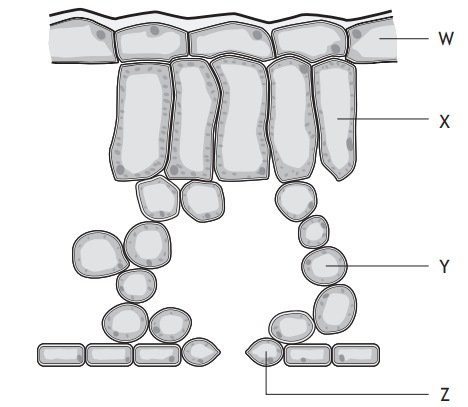
The diagram shows a cross-section of a leaf.

Diagram showing plant root structure with four labelled layers: W is epidermis, X is cortex, Y is endodermis, and Z is pericycle.

Which row in the table identifies the parts of the leaf?

Palisade mesophyll

Spongy mesophyll

Upper epidermis

Guard cell

A

X

Y

Z

W

B

Y

X

W

Z

C

W

X

Z

Y

D

X

Y

W

Z

    51 mark

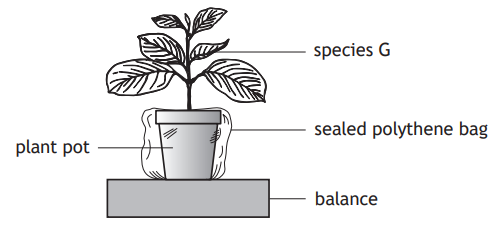
    An investigation was carried out to compare transpiration in two different species of plant, G and H.

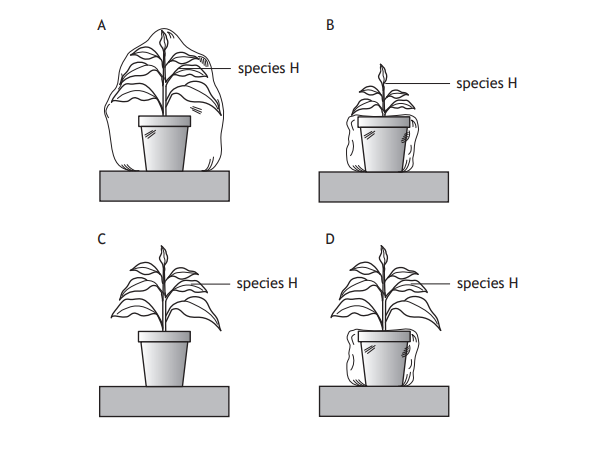
    The diagram shows the set up to measure transpiration in species G

    Diagram of a plant labelled species G in a pot covered by a sealed polythene bag, placed on a balance for measurement.

    Which diagram shows the set‑up for species H, that would allow a valid comparison in the rate of transpiration of the two species?

      6a1 mark

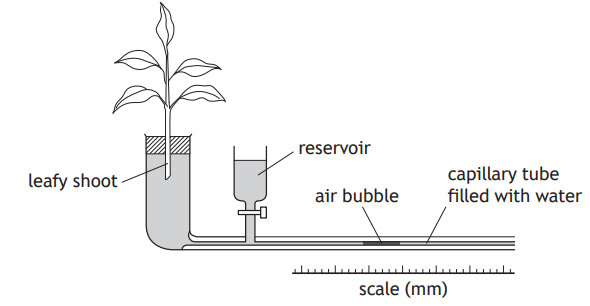
      The apparatus shown can be used to investigate the effect of the total leaf surface area on the rate of water uptake.

      The rate of water uptake can be calculated by measuring the distance the air bubble moves along the capillary tube in a set time.

      Diagram of a potometer showcasing a leafy shoot in water, reservoir, air bubble, and capillary tube with scale in millimetres for measuring water uptake.

      Name this apparatus.

      6b1 mark

      The apparatus was set up and the distance moved by the bubble in 10 minutes was recorded. One of the leaves was then removed from the plant and the distance moved by the bubble was measured over another 10 minute period. This was repeated until only one leaf remained.

      The results are shown in the table.

      Number of leaves

      Distance moved by bubble in 10 minutes (mm)

      5

      85

      4

      69

      3

      52

      2

      12

      1

      8

      With reference to the aim, give a conclusion for this investigation.

      6c2 marks

      (i) Name the process responsible for the movement of water and its evaporation from the leafy shoot.

      [1]

      (ii) Water evaporates from leaves through stomata.

      Name the cells surrounding the stomata that control their opening and closing.

      [1]