Ecosystems (SQA National 5 Biology): Exam Questions

Exam code: X807 75

21 mins8 questions
11 mark

Seals and dolphins compete for food.

Which row in the table describes the interaction between these organisms?

Type of competition

Type of factor

A

intraspecific

biotic

B

intraspecific

abiotic

C

interspecific

biotic

D

interspecific

abiotic

    2a2 marks

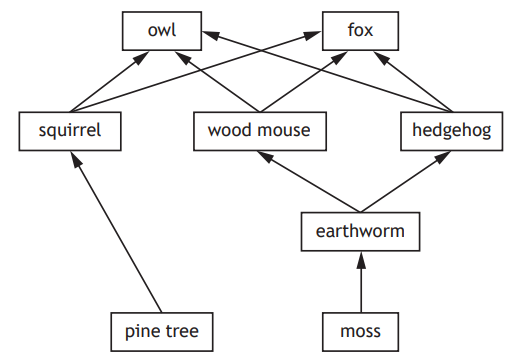
    The diagram shows part of a food web in a pine forest.

    Food web diagram showing pine tree and moss as primary producers, with earthworm, squirrel, wood mouse, hedgehog, owl, and fox as consumers.

    Complete the table by giving one example of each type of organism from the food web.

    Type of organism

    Example

    Producer

    Predator

    2b1 mark

    Use the words ‘increases’, ‘decreases’, or ‘stays the same’ to suggest what might happen to the size of the squirrel population if all the foxes were removed.

    Explain your answer.

    Squirrel population.......................................................................

    Explanation....................................................................................

    2c1 mark

    State the term used to describe the role of an organism within its community.

    2d3 marks

    The table shows some features of fungi commonly found in Scotland’s pine forests.

    Fungus

    Maximum cap size (cm)

    Cap colour

    Stem colour

    Velvet rollrim

    20

    mid brown

    dark brown

    Sickener

    10

    bright scarlet

    Earpick fungus

    2

    dark brown

    dark brown

    Pelargonium bonnet

    1

    dark brown

    dark brown

    Pinewood gingertail

    2

    bright brown

    brown

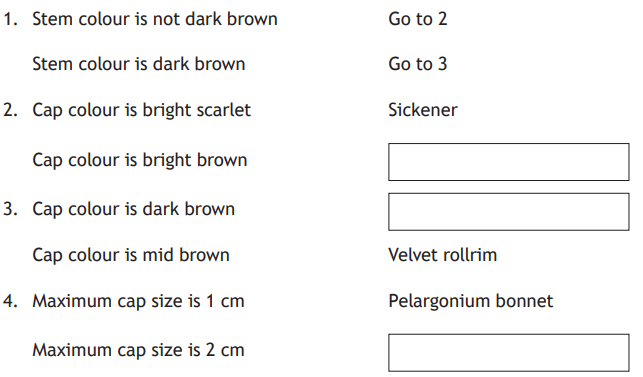
    Use the information in the table to complete the key.

    Flowchart describing mushroom identification steps based on stem and cap colour, and cap size, leading to names like Sickener and Velvet Rollrim.
    31 mark

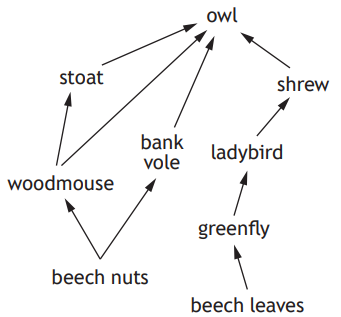
    The diagram represents part of a woodland food web.

    Food web diagram showing relationships: owl preys on stoat, bank vole, shrew; stoat eats woodmouse; woodmouse and bank vole eat beech nuts; ladybird consumes greenfly on beech leaves.

    Which statement is true for the organisms in the food web?

    • Owl and stoat are in intraspecific competition.

    • Bank vole and shrew are in interspecific competition.

    • Ladybird is both predator and prey.

    • Greenfly is a producer.

    4
    Sme Calculator
    1 mark

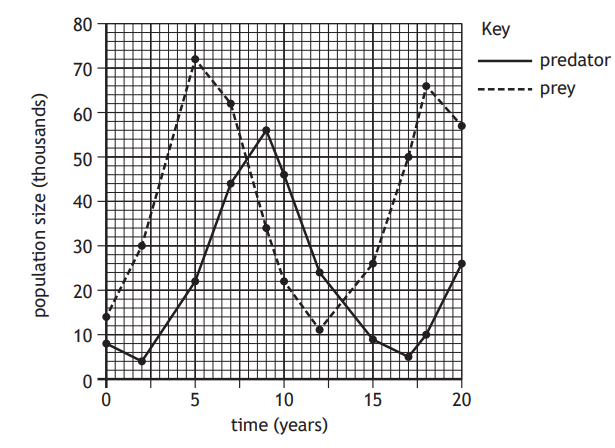
    The graph shows the changes in population size of a predator and its prey over 20 years.

    Graph showing predator-prey population cycles over 20 years. Predator numbers peak after prey peaks, both ranging from 0 to 70 thousand.

    The difference in the population sizes of the predator and its prey when each population was at its maximum is

    • 6000

    • 16 000

    • 22 000

    • 50 000

    51 mark

    In an ecosystem, a niche is defined as the

    • place where an organism lives

    • total number of one species living in a community

    • role an organism plays within a community

    • total number and variety of organisms.

    6a1 mark

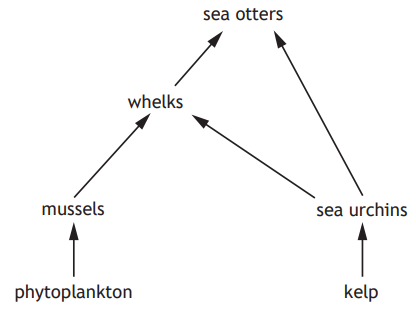
    The food web represents a marine ecosystem in the west coast of Scotland.

    Food web diagram showing relationships among sea otters, whelks, mussels, sea urchins, kelp, and phytoplankton with directional arrows.

    Give an ecological term that describes the sea urchins.

    6b2 marks

    Pollution from microplastics has led to a decline in the mussel population.

    Predict the effect of a decrease in mussels on the sea otter population and explain your answer.

    Effect on sea otter population................................................................

    Explanation..............................................................................................

    6c
    Sme Calculator
    1 mark

    Marine biologists investigated the effect of salt concentration on the number of microplastic particles in mussel body tissue.

    The results are shown in the table.

    Salt concentration (ppb)

    Number of microplastic particles per 1 g of mussel body tissue

    31

    4

    33

    8

    36

    20

    A mussel with a mass of 5 g was found to contain 20 particles of microplastics in its body tissue.

    Identify the salt concentration the mussel was found in.

    ................................ppb

    71 mark

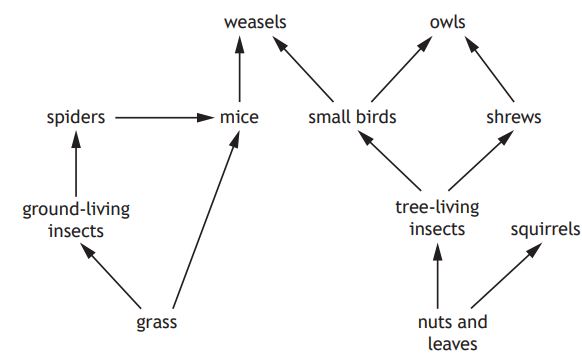
    Some feeding relationships of organisms in a woodland ecosystem are shown in the food web.

    Food web diagram showing relationships between grass, insects, spiders, mice, small birds, weasels, owls, shrews, squirrels, nuts, and leaves.

    Due to extreme weather conditions, the populations of tree-living and ground-living insects were greatly reduced.

    This could lead to:

    • an increase in small birds and a decrease in spiders

    • an increase in squirrels and a decrease in spiders

    • a decrease in nuts and leaves and an increase in small birds

    • a decrease in weasels and an increase in owls

    8a
    Sme Calculator
    3 marks

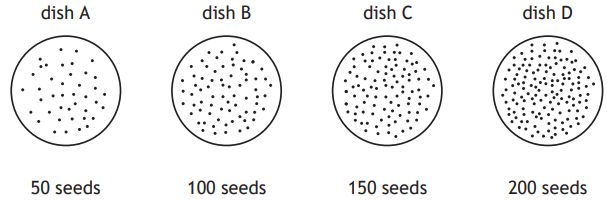
    A student set up four Petri dishes of equal size to investigate competition in cress seeds of the same species. The seeds were scattered on moist filter paper and left to germinate (grow) in the dark.

    Four petri dishes labelled A to D, each containing increasing seed quantities: dish A has 50 seeds, dish B 100, dish C 150, and dish D 200.

    (i) Identify a variable, not already mentioned, that should have been kept the same for each dish.

    [1]

    (ii) The number of seeds germinating in each dish was counted.

    The table shows the results.

    Dish

    Seeds per dish

    Number of germinating seeds

    Germinating seeds (%)

    A

    50

    45

    90

    B

    100

    80

    80

    C

    150

    60

    D

    200

    60

    30

    Complete the table by calculating the number of germinating seeds in dish C.

    [1]

    (iii) Competition was greatest in dish D.

    Explain why this conclusion was drawn.

    [1]
    8b1 mark

    Name the type of competition that occurs among these germinating seeds.

    8c1 mark

    Explain why competition in ecosystems occurs.