Structure Diagrams (SQA National 5 Computing Science): Revision Note

Exam code: X816 75

Robert Hampton

Written by: Robert Hampton

Reviewed by: James Woodhouse

Updated on

Structure diagrams

What are structure diagrams?

  • A structure diagram is a design technique used during the design stage of the software development process

  • It shows the overall structure of a program before any code is written

  • The diagram represents the main steps needed to solve a problem

  • Each step can be broken down into sub-tasks, helping to plan the program in a clear and logical way

  • Structure diagrams are read from top to bottom and left to right
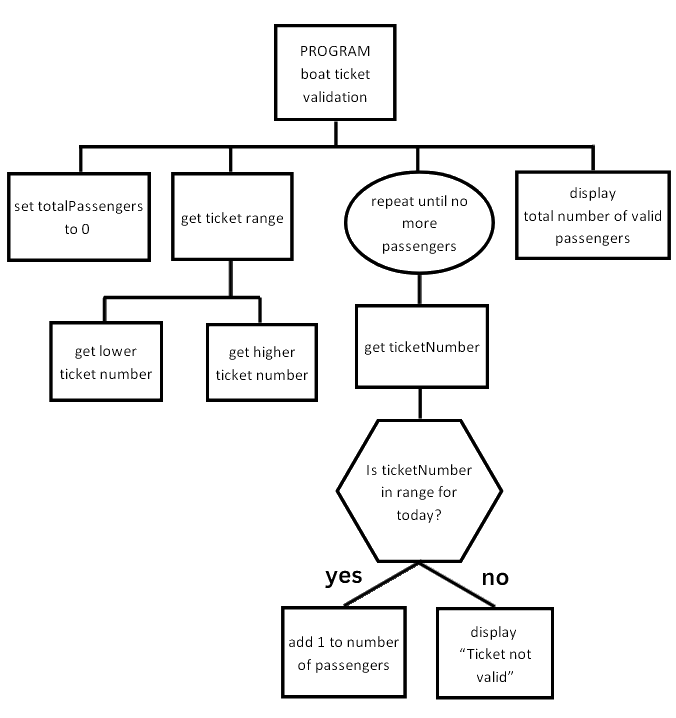
Flowchart illustrating a boat ticket validation process, including setting passenger count, getting ticket range, validating tickets, and displaying results.

Why use structure diagrams?

  • They help visualise the program’s structure before implementation

  • They make programs easier to understand, test, and maintain

  • They allow programmers to identify where loops, decisions, and processes are needed

  • They help to spot repetition or inefficient steps in a design before coding starts

Key components of structure diagrams

Symbol

Name

Meaning

Example

A simple black outline of a rectangle on a white background, with no additional features or text inside the shape.

Process

Shows an action or calculation

set totalPassengers to 0

Hexagon shape with six straight lines connected, forming a closed geometric figure. The sides are of equal length and angles are symmetrical.

Selection

Shows a decision or condition

Is ticketNumber in range for today?

Rounded rectangular shape with a black outline, resembling a basic flowchart symbol, centred on a white background.

Loop

Shows repetition of a process

repeat until no more passengers

Rectangle divided by two vertical lines into three sections, with a wide centre section and narrower side sections. Simple geometric design in black outline.

Predefined process

Refers to a separate subprogram or function

CalculateAverage()

Examiner Tips and Tricks

  • Questions may ask you to identify the type of construct (e.g. loop, conditional, arithmetic operation) used in a diagram

  • Always read the diagram from top to bottom and look for repetition or branching to decide how the logic flows

Unlock more, it's free!

Join the 100,000+ Students that ❤️ Save My Exams

the (exam) results speak for themselves:

Robert Hampton

Author: Robert Hampton

Expertise: Computer Science Content Creator

Rob has over 16 years' experience teaching Computer Science and ICT at KS3 & GCSE levels. Rob has demonstrated strong leadership as Head of Department since 2012 and previously supported teacher development as a Specialist Leader of Education, empowering departments to excel in Computer Science. Beyond his tech expertise, Robert embraces the virtual world as an avid gamer, conquering digital battlefields when he's not coding.

James Woodhouse

Reviewer: James Woodhouse

Expertise: Computer Science & English Subject Lead

James graduated from the University of Sunderland with a degree in ICT and Computing education. He has over 14 years of experience both teaching and leading in Computer Science, specialising in teaching GCSE and A-level. James has held various leadership roles, including Head of Computer Science and coordinator positions for Key Stage 3 and Key Stage 4. James has a keen interest in networking security and technologies aimed at preventing security breaches.