Causes & Effects of Climate Change (SQA National 5 Geography): Revision Note
Exam code: X833 75

What is climate change?
The Earth’s climate has changed over time
It has experienced both warmer and cooler conditions than today
Significant changes in the past were caused by physical factors
More recent changes are largely the result of human activity
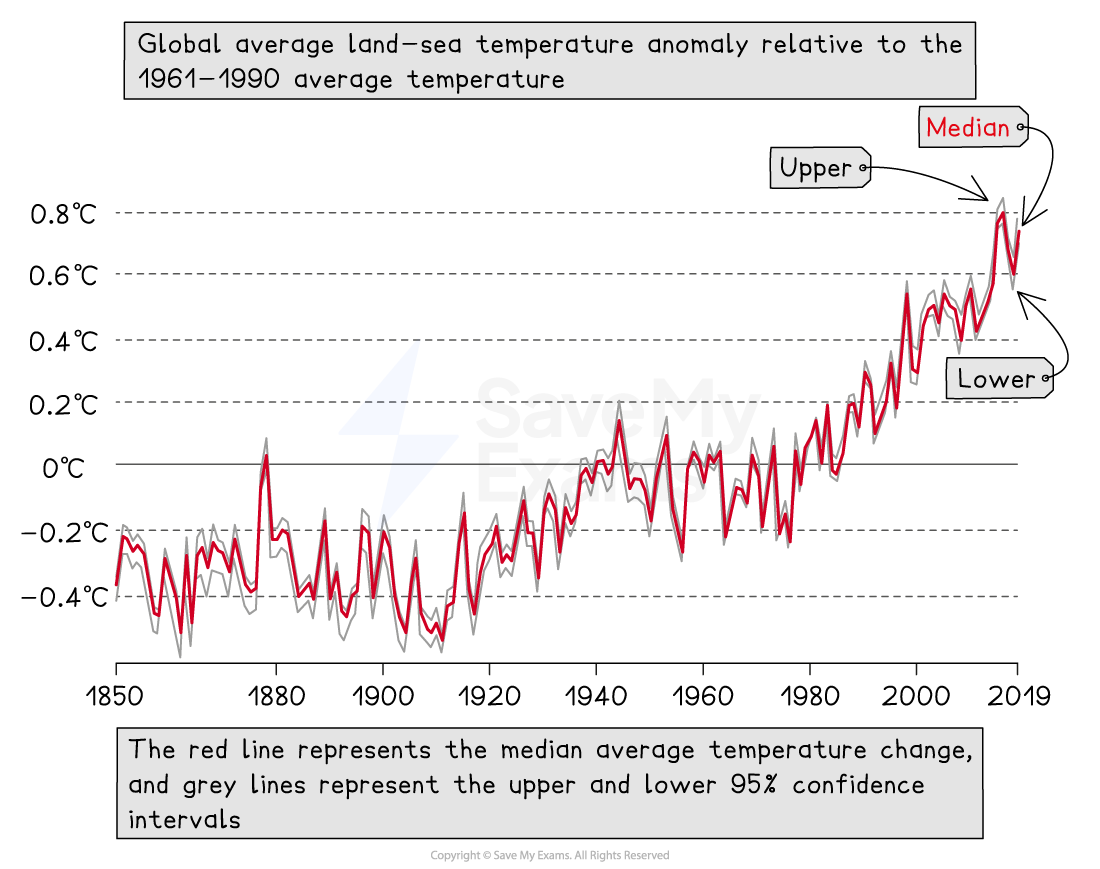
Global temperatures have risen sharply
These changes are happening much faster than natural climate variations
Features of climate change
Rising temperatures
Global temperatures have increased by around 1.4°C above pre-industrial levels
The last 10 years have been the warmest on record
Melting ice and rising sea levels
As temperatures rise, sea ice, glaciers and ice sheets are melting
Global average sea levels have risen by 21-24 centimetres since 1880
Changing weather patterns
Some places are becoming wetter while others are getting drier
More precipitation is falling as rain instead of snow
Extreme weather events
Extreme weather events such as storms, droughts, heatwaves and wildfires are becoming more frequent and more intense
Physical causes of climate change
Milankovitch Cycles
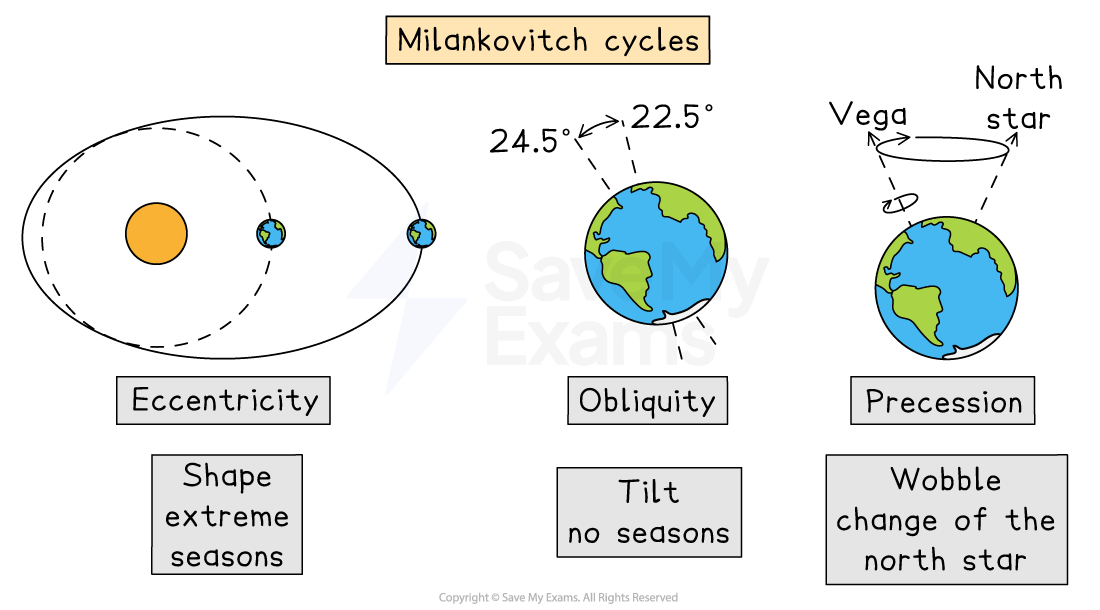
Milankovitch cycles are long-term changes to the Earth’s orbit around the Sun
They affect how much solar radiation the Earth receives
Shape: Every 100,000 years, the Earth’s orbit changes shape
A circular orbit leads to cooler periods, while an elliptical orbit leads to warmer periods
Tilt: Every 41,000 years, the angle of the Earth’s tilt changes
An increased tilt leads to hotter summers and colder winters, while a reduced tilt leads to cooler summers and milder winters
Precession: every 26,000 years, the Earth wobbles on its axis
This affects the timing and intensity of the seasons
Volcanic eruptions
Large-scale eruptions eject vast amounts of ash and volcanic gases into the atmosphere
These block and reflect solar radiation, leading to a fall in global temperatures
For example, in 1991, the eruption of Mount Pinatubo in the Philippines lowered global temperatures by 0.6°C for 1-2 years
Variations in solar output
Sunspots are dark spots that appear on the Sun’s surface
The more sunspots there are, the higher the average temperatures are on Earth
The changes are small – between +0.5°C and -0.5°C
Human causes of climate change
Natural greenhouse effect
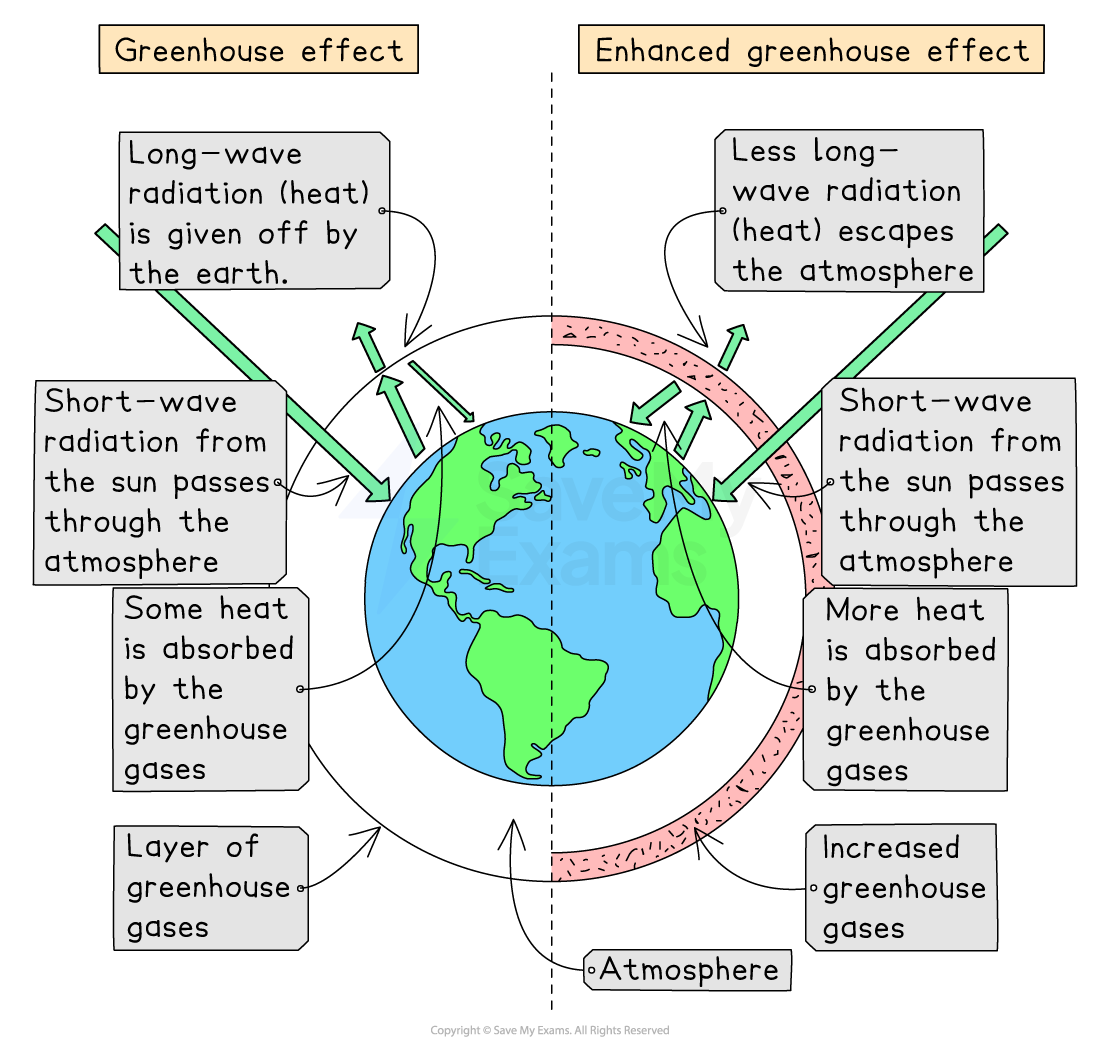
The natural greenhouse effect is essential to the survival of life on Earth
Short-wave radiation from the Sun passes through the atmosphere to heat the Earth’s surface
The Earth then re-radiates heat as long-wave radiation
Greenhouse gases in the atmosphere (like carbon dioxide and methane) absorb and trap some of this long-wave radiation, warming the Earth
Without the natural greenhouse effect, the Earth’s average temperature would be -18°C
Natural sources of greenhouse gases
Water vapour – evaporation from oceans, lakes and rivers and transpiration from plants
Carbon Dioxide – respiration, decay of organic matter, volcanic eruptions and wildfires
Methane – decay of organic matter in wetlands, emitted by termites during digestion
Nitrous oxide – emitted by microbes in soils and oceans
The enhanced greenhouse effect
The process is the same as the natural greenhouse effect
However, human activities have led to much higher concentrations of greenhouse gases in the atmosphere
This leads to more heat being trapped and the planet getting warmer
Human sources of greenhouse gases
Carbon dioxide (CO2)
Burning of fossil fuels (coal, oil and gas) – for electricity, heat and transport
Burning of wood
Deforestation – during photosynthesis, trees remove CO2 from the atmosphere – fewer trees mean less CO2removed
Methane (CH4)
Agriculture – released by cattle and rice cultivation
Landfill sites – decomposition of organic waste
Nitrous oxide (N2O)
Burning of fossil fuels
Use of fertilisers
Chlorofluorocarbons (CFCs)
Used in aerosols, refrigeration units and air conditioning
Key causes of the enhanced greenhouse effect
Population growth has led to:
Higher energy demand
Greater food production
More urbanisation
More industrialisation
Increased use of transport
Energy production
Most electricity is produced by burning coal, oil or gas
Fossil fuels are also used to provide heating and cooling
Burning fossil fuels accounts for two-thirds of global greenhouse gas emissions and 90% of CO2 emissions
Agriculture
Rearing cattle for meat and growing rice release methane
Land is cleared through deforestation to increase food production – this leads to less CO2 being absorbed during photosynthesis
Manufacture of pesticides and fertilisers uses fossil fuels
The use of fertilisers releases nitrogen oxides
Transport
Most cars, lorries, ships and planes use oil as their fuel source, releasing CO2
Construction and industry
Cement production releases CO2 – it is made from limestone, which contains carbon
Most manufacturing processes use energy generated from fossil fuels to produce good
Global and local effects of climate change
Social Effects
Local scale
Health risks
More intense heatwaves lead to health problems such as heatstroke and higher mortality, especially among older people (e.g. summer 2022, UK)
Water security
More frequent droughts lead to local water shortages and restrictions
Damage to housing
More powerful storms cause significant damage to homes and disrupt power supplies (e.g. Storm Éowyn, Scotland, 2025)
Global scale
Diseases
Rising temperatures allow diseases such as malaria to spread to new areas
Environmental refugees
People living in low-lying coastal areas may be forced to flee their homes due to increased risk of flooding and erosion
Food insecurity
Droughts and storms can damage crops, reducing crop yields and leading to food shortages
Economic effects
Local scale
Agriculture
Extreme weather damages crops and livestock, leading to lower incomes for farmers (e.g. the Beast from the East caused major losses for Scottish sheep farmers in 2018)
Tourism
Reduced snowfall in ski resorts in the Cairngorms leads to fewer visitors and lost revenue
Global scale
Global food prices
Crop failures in major food-producing countries like India and Pakistan cause global food prices to increase
Global supply chains
Extreme weather in manufacturing countries like China can disrupt factories, leading to reduced production of electronic goods
Environmental effects
Local scale
Ecosystem changes
Warmer winters lead to declines in the numbers of Mountain Hares in the UK
Coastal erosion
Places like East Anglia experience faster erosion due to rising sea levels and more frequent storms
Global scale
Sea level rise
Melting of ice sheets and glaciers contributes significantly to sea level rise
Biodiversity loss
Melting sea ice puts species like the polar bear at risk of extinction
Loss of habitat
Coral bleaching and ocean acidification threaten to wipe out coral reefs by 2100
Worked Example
Explain the physical and human causes of climate change.
[6 marks]
Example answer
Physical causes include:
Changes in the tilt/orbit of the Earth around the Sun can affect global temperatures. [1] An increased tilt leads to hotter summers and colder winters. [1]
Volcanic eruptions can cause a fall in global temperatures due to large quantities of ash and gases blocking and reflecting solar radiation. [1] For example, the eruption of Mount Pinatubo in 1991 reduced global temperatures by 0.6 °C for 1-2 years [1]
Human causes include:
Deforestation often involves burning forests, which releases carbon dioxide [1] and reduces the number of trees available to absorb and store carbon. [1]
Examiner Tips and Tricks
In questions such as the one above, remember to discuss both physical and human causes of climate change.
You will achieve a maximum of 5 marks if you only discuss one. You can either outline six causes or develop fewer points with more detailed explanations or examples to score additional marks.

Unlock more, it's free!
Join the 100,000+ Students that ❤️ Save My Exams
the (exam) results speak for themselves:

Was this revision note helpful?
