Human Activity & Equatorial Tropical Forest (SQA National 5 Geography): Revision Note
Exam code: X833 75

Human activity in the equatorial tropical forest ecosystem
People use the tropical rainforest landscape to their advantage in several ways
But sometimes the landscape is misused, causing problems for people and the environment
Indigenous people
Indigenous people, such as the Kayapo, tend to use the tropical rainforest environment in a sustainable way
They have lived in the rainforest for thousands of years
They use traditional methods to hunt and fish for their food
They gather fruits, nuts and roots for food and medicine
They use wood from trees to build shelters and make tools and weapons
Shifting cultivation is a traditional method of farming practised by indigenous people
A small area of land is cleared using axes and machetes
Large trees are left to provide shade and fruits
The rest of the vegetation is burned to add nutrients to the soil
This is known as ‘slash and burn’
Crops such as cassava and maize are then planted
After a few years, the soil becomes less fertile, so people move to a new location and repeat the process
The previous site is left to regenerate, and over time, vegetation returns
This does not damage the rainforest because it is practised on a small scale
Causes of deforestation
On a larger scale, human activity can have significant impacts on tropical rainforests
Deforestation is the felling and clearance of trees
More than half of the world’s tropical rainforests have been destroyed since the 1960s
There are six main human causes of deforestation
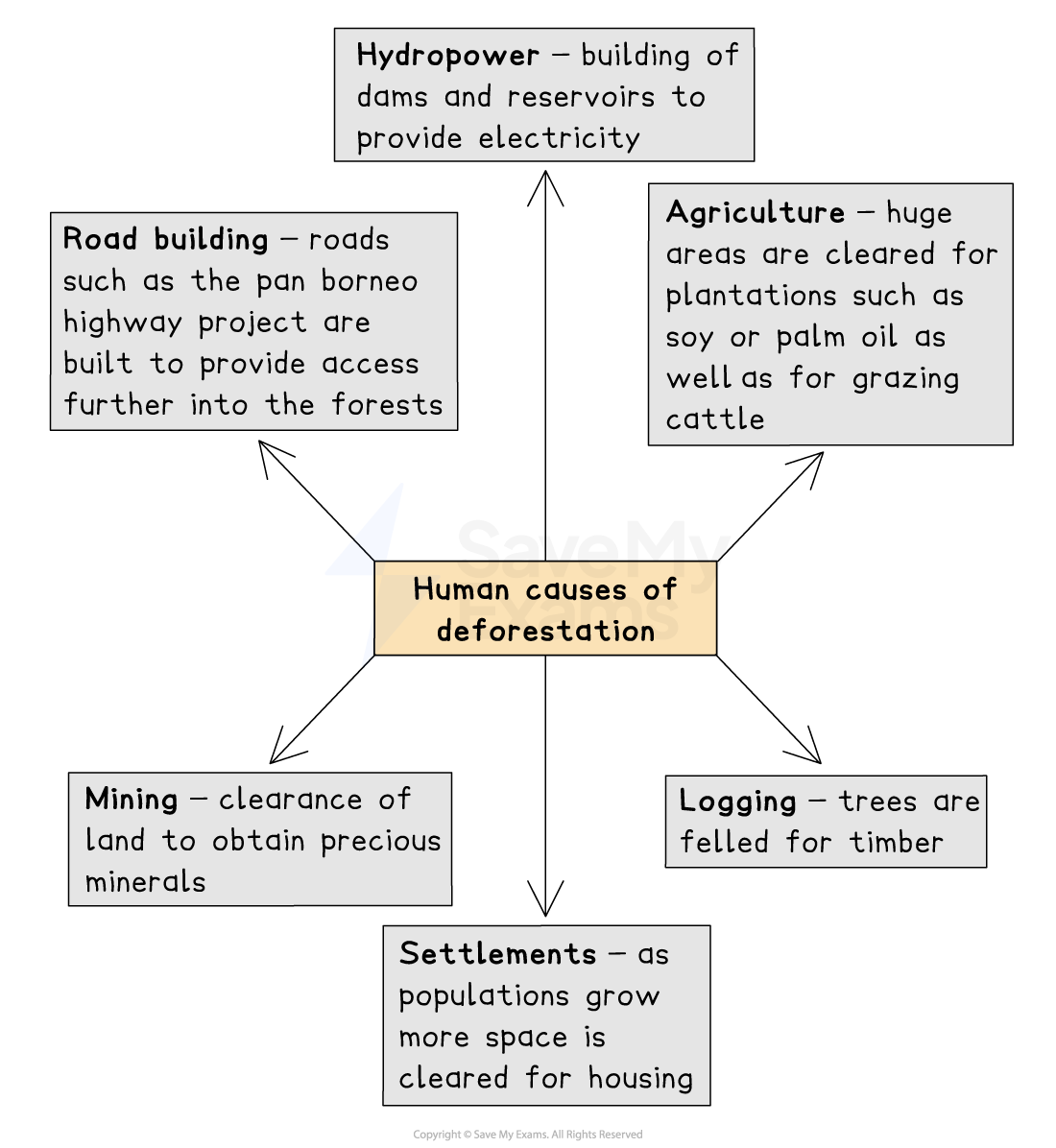
Agriculture
The main cause of deforestation is agriculture, such as cattle ranching and crop plantations
Forest is cleared to create land for cattle to graze and to plant crops such as oil palm, soy and cocoa
Benefits (uses)
Provides food for local and global markets
Creates jobs and income, boosting the economy
Costs (misuses)
Soil loses fertility, resulting in the heavy use of fertilisers
Use of pesticides and monoculture farming reduces biodiversity
Logging
Trees are cut down to provide hardwood timber like teak and mahogany
Benefits (uses)
The wood is valuable and used to make furniture, flooring and building materials
Creates jobs and income, boosting the economy
Costs (misuses)
Once trees are removed, the soil is vulnerable to erosion
Loss of habitats and wildlife
Settlements
As populations grow, large areas of rainforest have been cleared to create towns and cities
For example, Manaus in the Brazilian Amazon has a population of more than 2 million people
Benefits (uses)
People move to the rainforest for job opportunities and housing
People can access services such as schools and healthcare, boosting the standard of living
Costs (misuses)
Indigenous people may be displaced
Increased pollution and waste
Mineral extraction
Rainforests hold significant oil and gas reserves
Nearly a fifth of the world’s recently discovered oil and gas reserves are found in the Amazon rainforest
There are also large reserves of valuable minerals such as gold, bauxite and iron ore in the rainforests
The Carajás Mining Complex in Brazil is the world’s largest iron ore mine
Benefits (uses)
Provides energy and valuable minerals for industries
Provides exports, boosting jobs and economic growth
Costs (misuses)
Construction and heavy machinery damage vegetation
Oil spills and toxic waste pollute the environment
Loss of biodiversity
Transport and infrastructure
Roads and railways are built to access resources
The Pan Borneo Highway in Malaysia is more than 2000km long
Benefits (uses)
Increases trade and improves access to services
Cons (misuses)
Leads to habitat fragmentation, hindering the movement of wildlife and disrupting ecosystems
Increases deforestation and air pollution
Hydropower
Large dams are built on rivers in rainforests to generate electricity
The Itaipu Dam supplies over 10% of Brazil’s electricity and up to 90% of Paraguay’s electricity
Benefits (uses)
Creates renewable energy which does not run out or contribute to greenhouse gas emissions
Provides electricity for homes and industry, boosting economic growth and the standard of living
Helps to control flooding
Costs (misuses)
Floods large areas of forest
Indigenous communities are displaced
Loss of habitats and wildlife
Impacts of human activity in the equatorial tropical forest
Effects of land degradation on people and the environment
Impacts on people
Indigenous communities have less land to sustain their traditional way of life
Land does not get the opportunity to recover
There is less food available
Land and water pollution means that indigenous people may be unable to hunt and fish for their food
Connection to land and culture is lost
Indigenous people get jobs in industries such as mining
Quality of life may improve due to increased income and access to services
Cultures are threatened as indigenous people give up their traditional way of life
Younger generations don’t learn traditional skills like hunting and tracking
Increased risks of flooding and landslides can destroy homes
Plants in tropical rainforests are an important source of medicines
Around 25% of modern medicines are made from rainforest plants
Rosy periwinkle is used to make drugs that treat leukaemia
Deforestation may result in the loss of potential ingredients for medicines that are yet to be discovered
Pollution leads to an increase in respiratory illnesses and cancer
Mental health problems like depression increase due to rapid cultural change
Impacts on the environment
Removal of trees leads to loss of habitats, threatening biodiversity
Deforestation in tropical rainforests could lead to the extinction of half of the world’s species
Oil spills and toxic waste lead to land degradation
When trees are removed, interception and infiltration decrease
This reduces evapotranspiration, which leads to lower precipitation
It also causes leaching, so the soil becomes less fertile, making it more difficult for the ecosystem to regenerate
Overland flow increases, leading to soil erosion and sedimentation of rivers
Sediment builds up in rivers, reducing their capacity and leading to increased risk of flooding
Fewer trees mean less CO2 is absorbed during photosynthesis
This means more CO2 in the atmosphere, which contributes to the enhanced greenhouse effect
Deforestation damages the nutrient cycle
When trees and vegetation are cleared, the main store of nutrients is removed
This makes it harder for the ecosystem to recover and regenerate
Managing human activity in the equatorial tropical
International strategies
UN Forum on Forests was established in 2000 and is committed to the management, conservation and sustainable development of all types of forests
The UN Sustainable Development Goals include the sustainable management of forests
International treaties protect certain areas, such as the Central Amazon Conservation Complex (CACC), which is a World Heritage Site
Activities like hunting, logging and fishing are limited
Trade restrictions on endangered species and timber have been imposed
The Convention on International Trade in Endangered Species of Wild Fauna and Flora (CITES) aims to ensure that international trade in specimens of wild animals and plants does not threaten the survival of the species
The International Tropical Timber Agreement (ITTA) promotes sustainable forest management and restricts the trade in rainforest hardwood timber
The Forest Stewardship Council (FSC) approves wood from sustainable sources
Debt-for-nature swaps
Countries are relieved of some of their debt in return for protecting rainforests
In 2024, Ecuador completed one of the largest debt-for-nature swaps ever, releasing $460 million to fund conservation of its tropical rainforest
Groups like Greenpeace and WWF monitor deforestation and promote awareness about conservation
This encourages sustainable management and pressures governments to prevent biodiversity loss
The Amazon Sustainable Landscapes Project is funded by the World Bank
Several Amazon countries, like Brazil, Peru and Guyana, work together to reduce deforestation and promote sustainable land use
They create protected areas to preserve the forest and restore degraded ecosystems through reforestation
National strategies
Brazil's Forest Code is a law that requires landowners to maintain a proportion of their land as native forest.
In the Amazon, between 50% and 80% of the land must be kept as forest
Brazil’s DETER satellite monitors deforestation in the Amazon
It takes images at regular intervals to detect changes in forest cover
This helps to detect illegal deforestation quickly so that authorities can intervene to prevent further damage
It was estimated that this led to a 60% decrease in large-scale deforestation in some areas
There are 75 national parks in Brazil, helping to protect and conserve the ecosystem
Resource extraction in the parks is not allowed
Nature preservation, scientific research, environmental education and sustainable tourism are prioritised
Some countries, like Malaysia, use selective logging to reduce environmental damage and help maintain biodiversity
It works by ensuring that only mature trees and those over a certain height are cut down
It restricts the number of trees cut down per hectare to maintain forest structure and promote regeneration
It reduces the use of heavy machinery and uses helicopters to remove the trees (heli-logging), reducing damage to surrounding vegetation
Local strategies
Agroforestry combines agriculture with forestry, decreasing deforestation
Trees provide shade, which protects plants and soil from direct sunlight
This reduces evaporation, meaning the soil stays moist for longer
Working conditions are also better as people are less exposed to high temperatures
Trees increase infiltration and interception
This reduces soil erosion and prevents leaching
Provides organic matter from the trees and adds nutrients to the soil
Increases biodiversity due to the variety of plants grown
Education of people involved in the exploitation and management of the rainforest
The Marajó Project in Brazil preserves almost 90,000 hectares of the Amazon Forest
It supports sustainable activities like agroforestry, fishing and small-scale agriculture through training for local people
Financial incentives are used to encourage local communities to protect the rainforest
A tree nursery grows native trees to be planted in areas which have been cleared
The new trees help to bind the soil, reducing soil erosion and increasing infiltration
Ecotourism is becoming more widespread
Ecotourism includes:
A focus on the natural environment
Low impact on the environment – using materials from the local area and buildings to blend in with the environment
Supporting local communities – using locally grown food and employing local people
Education – to inform tourists about the local environment and wildlife
Gaining income which can be used for conservation

Unlock more, it's free!
Join the 100,000+ Students that ❤️ Save My Exams
the (exam) results speak for themselves:

Was this revision note helpful?
