Changing Rural Landscape in Developed Countries (SQA National 5 Geography): Revision Note
Exam code: X833 75

Specification checklist
This page covers what you need to know from the SQA National 5 geography specification to answer questions on:
Changes in the rural landscape in developed countries related to modern developments in farming, such as diversification, the impact of new technology, organic farming, genetic modification, and current government policy
Developments in farming in the UK
Farming in developed countries has changed significantly over the last 200 years:
Farms are larger: many small farms have been taken over and combined to create larger farms
Mechanisation has increased, meaning less labour is needed
Fertilisers and pesticides have improved in effectiveness
Animals are bred to produce more milk and meat
In the UK, farming now only creates around 1% of the GDP (a very small share compared with services and industry)
Overall, farming is becoming less profitable
The cost of farming inputs, such as machinery and animal feed, is greater than the profits made from outputs
This has led to:
Diversification, which refers to any additional activities used to raise income
Methods of raising productivity and profits
Diversification in the UK
There are many different ways of diversifying
All diversification requires an investment of capital

Recreation & leisure
Many of the ways of diversifying are linked to recreation and leisure
People in developed countries have more time and disposable income
Visiting rural areas in leisure time for activities is increasingly popular
Leisure activities linked to this on farms include:
Horse riding
Alpaca walking
Hunting and shooting
Off-roading
Mountain biking
Farms also often provide accommodation with barns and outbuildings converted to holiday cottages and fields used as camping/caravan sites
Other methods of diversification
As well as recreation and leisure, farmers may invest in:
Pick your own
Farm shops and cafes
Renewable energy
Industrial estates/storage facilities
These diversification strategies help boost the farmers’ income
Farmers become more independent and less reliant on subsidies
Issues with diversification
Rising tourist numbers in rural areas lead to;
Traffic congestion
Air pollution
Damage to stone walls
Footpath erosion
Increased litter, which may be harmful to livestock
New technology in the UK
Mechanisation has increased in agriculture including:
Tractors and combine harvesters have Global Positioning Systems (GPS)
These mean that application of fertilisers and pesticides is more efficient
Sowing and harvesting can be completed more quickly and effectively
Automated milking machines
Computerised irrigation systems
New technology reduces the number of workers needed on farms
Use of computerised systems reduces waste and makes the systems more efficient
Organic farming in the UK
Increasing numbers of farmers are converting to organic methods
Demand for organic food is growing due to health, animal welfare and environmental concerns
Organic certification means that:
Organic livestock are grazed on the land
Antibiotics are only used when it is medically necessary
Organic crops are grown without the use of artificial pesticides, herbicides or fertilisers
Organic farming may be less productive
Products are only available seasonally
The price farmers receive for organic produce is higher, which compensates for the lower yield
Genetic modification in the UK
Genetic modification involves using genes from one species to improve another species and increase yields:
Crops can be made pesticide-resistant so that when pesticides are sprayed to remove the pests, the crop is undamaged
The vitamin, which causes carrots to be orange (beta carotene) is added to rice to increase human uptake of the vitamin
Genetic modification is controversial
GM crops are grown in many developed countries, including the USA and Canada,
In 2022, the UK government was looking to remove the controls which stop the widespread growth of GM crops (these are currently still in force, 2025)
For |
|
|---|---|
Against |
|
Government policy in the UK
The Department for Environment, Food and Rural Affairs (DEFRA) is responsible for agriculture in the UK
Following Brexit in January 2020, the UK government passed the Agriculture Act, 2020
The purpose of the act was to move farmers from reliance on EU subsidies to payments to farmers, encouraging more sustainable food production
The UK government provides farmers with payments or grants for a range of schemes, including:
Environmentally sustainable land and water management
Improvements to animal health and welfare
Improving and protecting soil quality
These grants may be used to pay for more efficient irrigation, weeding and harvesting systems
The Scottish Rural Development Programme (SRDP) aims to:
Enhance the rural economy
Support agricultural and forestry
Protect the natural environment
Support rural communities
Forestry grants, including agroforestry grants, are given for the creation or improvement of woodland areas
The Agri-Environment Climate Scheme gives funding for schemes which help to mitigate or adapt to climate change, including:
Peat bog preservation
Hedgerow restoration
Floodplain management
Worked Example
Look at Diagram Q12.
Explain the advantages and disadvantages of recent developments in farming in developed countries such as the UK.
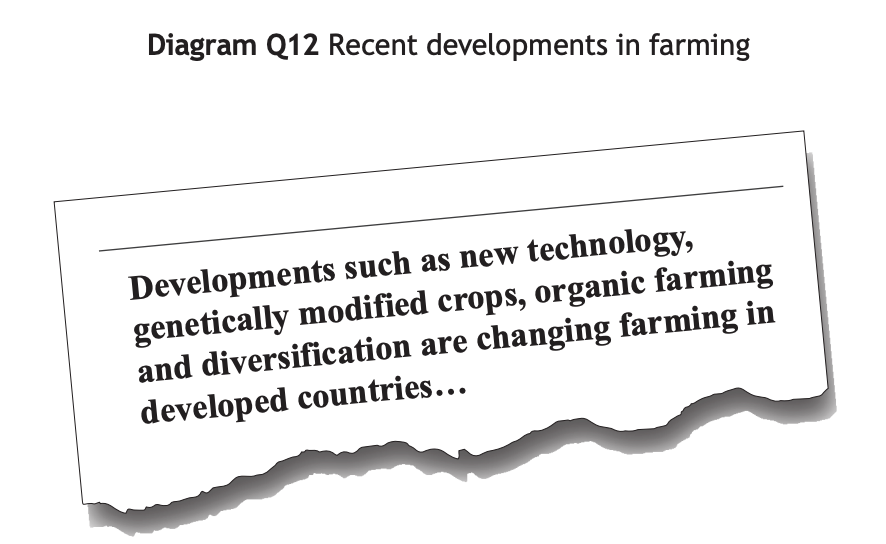
[5 marks]
Example answer
The new technology means that farmers can complete jobs more quickly [1]. For example, automatic milking machines mean fewer people are needed and it is completed faster. [1] Chemical fertilisers and pesticides are used to increase yields. [1]
The use of GM crops has not been approved in some countries due to concerns about their impact on the environment. [1] The possible effects on people's health are also unknown. [1]
Examiner Tips and Tricks
As well as knowing what the changes in agriculture are in developed countries, you also need to understand the advantages and disadvantages of these changes.
In the worked example above, answers which do not refer to both advantages and disadvantages will gain a maximum of four marks.

Unlock more, it's free!
Join the 100,000+ Students that ❤️ Save My Exams
the (exam) results speak for themselves:

Was this revision note helpful?