Changing Rural Landscape in Developing Countries (SQA National 5 Geography): Revision Note
Exam code: X833 75

Specification checklist
This page covers what you need to know from the SQA National 5 geography specification to answer questions on:
changes in the rural landscape in developing countries related to modern developments in farming such as: genetic modification, impact of new technology, biofuels.
Changes in rural landscapes in developing countries
Rural landscapes in developing or emerging countries, such as India, have seen significant change
Rural areas are often based on subsistence farming
This is changing with:
More commercial agriculture
Increased use of mechanisation
The introduction of genetic modification (GM) technology
Production of biofuels
New technologies
Genetic modification (GM) in developing countries
Genetic modification involves using genes from one species to improve another species and increase yields:
Crops can be made pesticide-resistant so that when pesticides are sprayed to remove the pests, the crop is undamaged
GM technology can also be used to add vitamins and additional nutrients
Genetic modification is controversial
GM crops are grown in many developing and emerging countries, including India
Golden rice has beta carotene added using GM technology
The aim is to increase human uptake of vitamin A
Advantages |
|
|---|---|
Disadvantages |
|
High-yield varieties
High-yielding varieties (HYV) were developed using selective breeding, not GM technology
The HYV crops produce significantly more yield
In India, HYV crops were one aspect of the Green Revolution
Advantages |
|
|---|---|
Disadvantages |
|
New technology in developing countries
As in developed countries, technology has led to many changes in the rural landscape in developing countries
There has been an increase in mechanisation
The green revolution in India involved the introduction of tractors
It also led to increased use of fertilisers and pesticides
Mobile phone apps enable farmers to:
Sell their crops via the internet
Monitor crop prices
See weather forecasts
Get pest and disease warnings
Advantages |
|
|---|---|
Disadvantages |
|
Biofuels in developing countries
Biofuels are fuels which are made from organic matter
Biofuels are more sustainable and environmentally friendly than fossil fuels
India is increasingly reliant on biofuels, and it aims for:
Ethanol blended fuel to make up 20% of energy use by 2026
Over 5% of vehicles to use biodiesel
Biodiesel in India mostly uses the Jatropha plant seeds, which are rich in oil
This plant can be grown in marginal land where crops cannot be grown
Other biofuels, such as palm oil, corn and sugar cane, can use valuable farm land
Advantages |
|
|---|---|
Disadvantages |
|
Worked Example
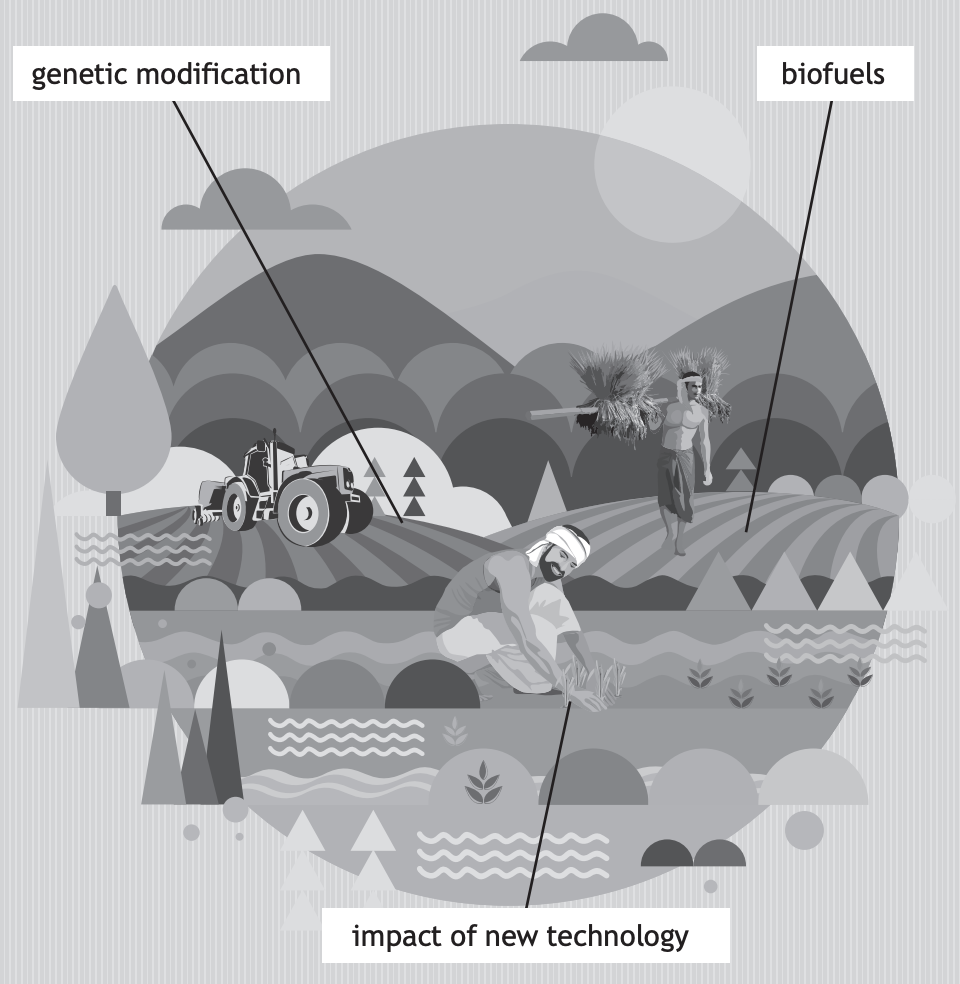
Look at Diagram Q13. Choose two factors from the diagram.
Describe, in detail, how your two chosen factors affect farmers in developing countries.
[4 marks]
GM crops can be grown when there is a low water supply [1], which means that people get a more reliable food supply. [1] The increased demand for biofuels can result in higher crop prices, improving the farmers’ income [1] and can produce jobs. [1]
Marks will be awarded for both positive and negative impacts.
Marks will only be awarded for two factors.
Maximum 3 marks for any one factor.

Unlock more, it's free!
Join the 100,000+ Students that ❤️ Save My Exams
the (exam) results speak for themselves:

Was this revision note helpful?