Land-Use in Urban Areas in Developing Countries (SQA National 5 Geography): Revision Note
Exam code: X833 75

Specification checklist
This page covers what you need to know from the SQA National 5 geography specification to answer questions on:
Recent developments which deal with issues in informal housing settlements in developing world cities
Informal settlements in developing countries
Cities in developing countries often experience high levels of rural-urban migration
Migration to the cities is the result of push and pull factors
Push factors are negative issues which push people away from rural areas, such as the lack of food, clean water and jobs
Pull factors are positive assumptions people make about the cities that attract them there, such as jobs, education and greater food supply
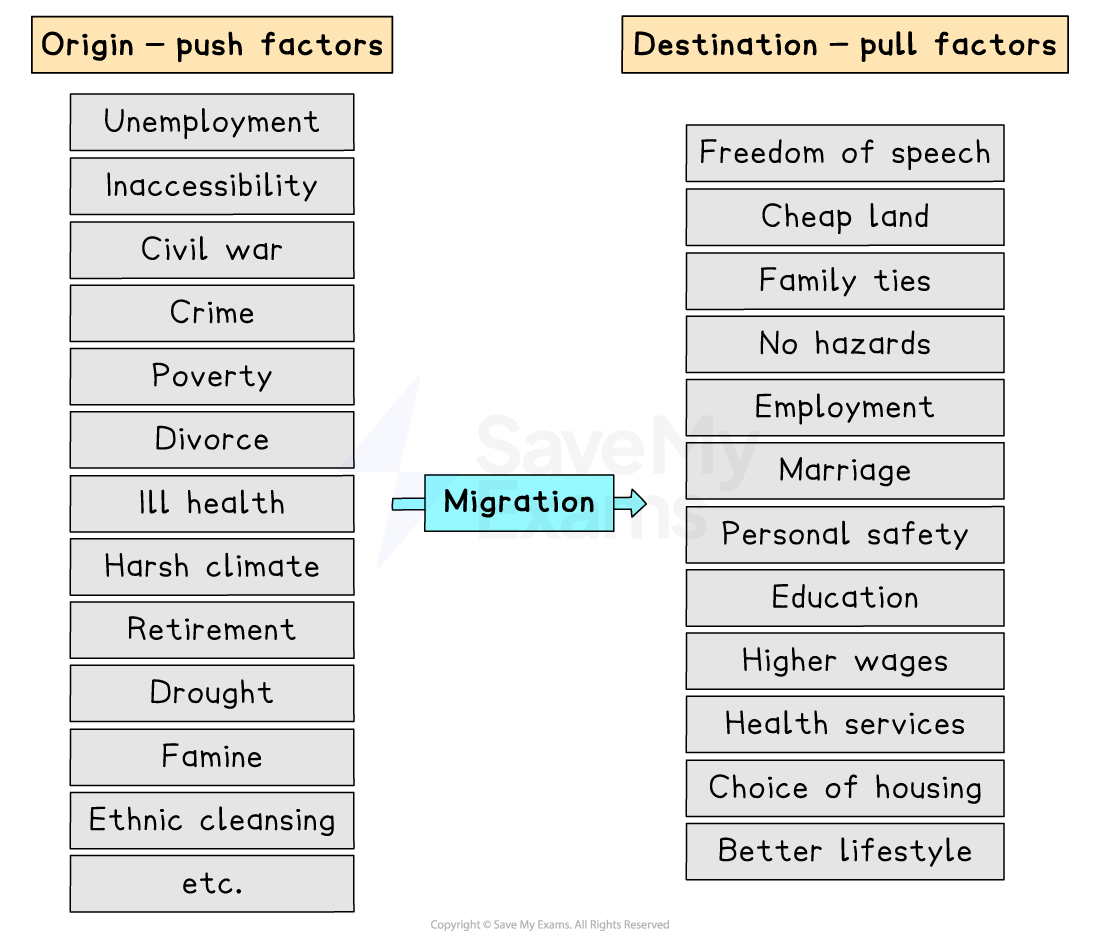
Often, these assumptions are incorrect
People arrive in the cities and cannot find jobs or places to live
This impacts on the land use patterns in the cities
Land use in cities in developing countries is different from that in developed countries
The highest quality housing is close to the CBD rather than on the outskirts of the city
The quality of housing decreases with distance from the CBD
Industry is located along the main roads
Informal settlements
Housing cannot keep up with the rate of population increase in developing cities
This leads to people building their own homes on any vacant land using scrap materials like cardboard, corrugated iron and plastic
These homes are unplanned and unregulated housing (informal settlements) with limited sanitation, limited freshwater and an unreliable energy supply
Usually, the people building the settlements do not own the land and are located
In areas of no economic value
On the urban edges or fringes
Along main roads or railways
On steep slopes
These informal settlements go by various names depending on the country
Favelas in Brazil
Shanty towns in the West Indies and Canada
Bustees on the Indian subcontinent
In developing countries, about a quarter of urban inhabitants (1.6 billion) live in these impoverished informal settlements
By 2030, the UN estimates that 1 in 4 people on the planet will live in some form of informal settlement
Some cities have 'mega-slums', which are huge, overcrowded informal settlements, usually within megacities
The largest examples are found in:
Nairobi, Kenya, with a population of 1.5 million crowded into three sprawling slums of mud huts and tin shacks – Kibera being the largest of the three
Neza, Mexico City, Mexico, with a population of 1.1 million people
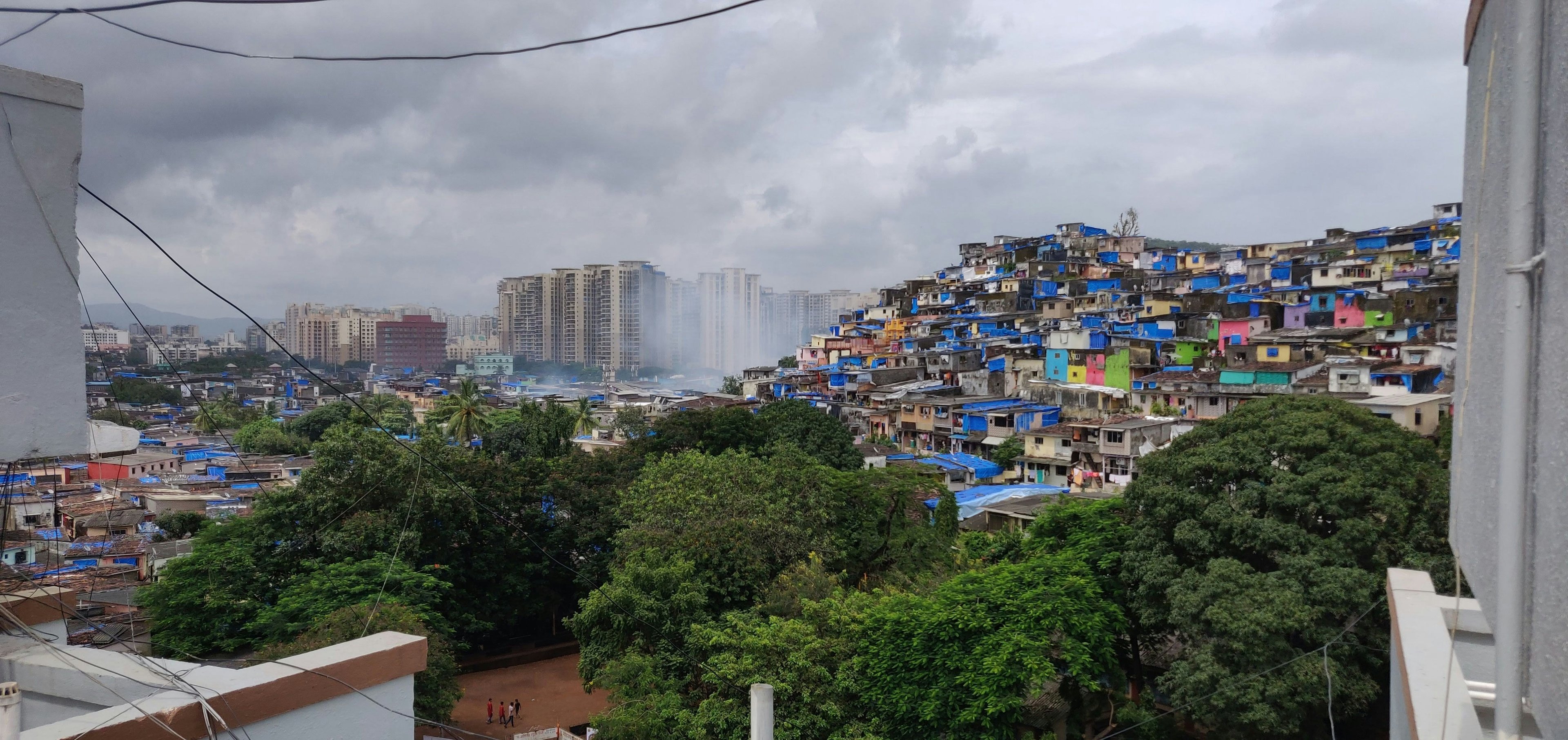
Dharavi, Mumbai, India, with 1 million people in a warren of narrow lanes, interconnected shacks and single-room living spaces that double as factories
Orangi Town, Karachi, Pakistan, with an estimated population of 2.4 million people across 8000 acres of concrete block homes, with 8-10 people sharing two or three rooms
Khayelitsha in Cape Town, South Africa, with a population of 400,000 in iron and wooden shacks
These unregulated housing areas present serious risks such as fire, flooding and landslides
Informal settlements typically suffer from housing, which is:
Made from poor-quality materials
Overcrowded
Small
Built very close together
The settlements have restricted access to water and electricity supplies
There are little to no sanitation facilities and no solid waste disposal
This leads to a polluted and degraded local environment
There are inadequate health facilities
Together with poor living conditions, this increases sickness and death rates
Most people in these areas have insecure living conditions, as they may be forcibly removed by landowners or other authorities
Whereas other governments accept that informal housing is a self-help way of dealing with a housing shortage
Informal settlements in Mumbai
Mumbai is India’s largest city with a population of around 20 million
It is the capital city of the Maharashtra state on the western coast of India
Originally, Mumbai was several separate islands
These were joined through large-scale land reclamation and causeway projects
Mumbai has more millionaires and billionaires than any other Indian city, but also the highest rates of poverty
Mumbai contributes 31% of India's entire tax revenue
It is a major centre for finance, manufacturing, and entertainment, but faces huge challenges from rapid urbanisation
Around 40% of residents live in informal settlements such as Dharavi
Mumbai has air transport links to many world cities and is popular with international tourists
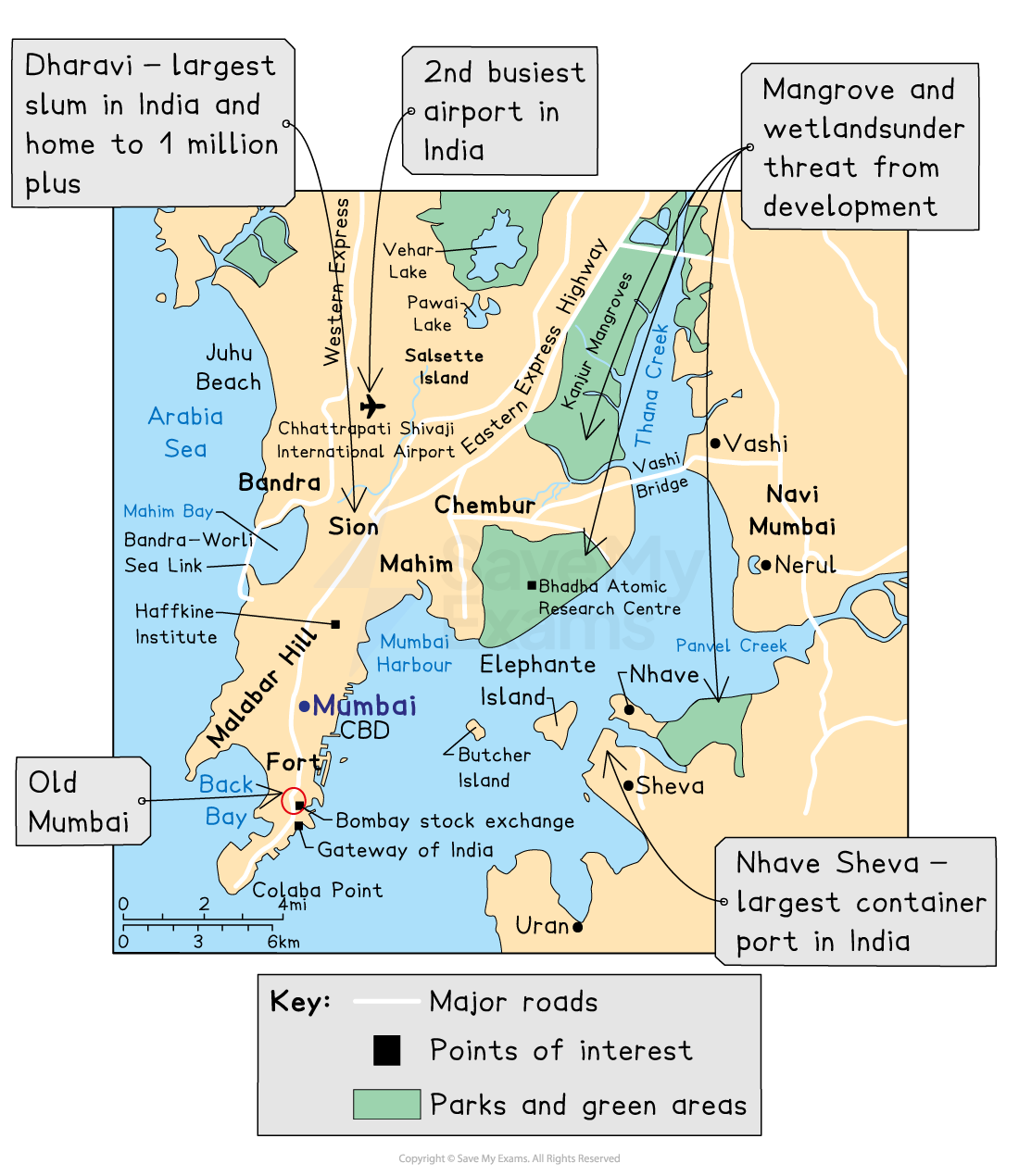
Rapid urban growth has led to a significant increase in rural-to-urban migration, resulting in one of the largest unplanned settlements globally
Dharavi is home to about 1 million residents and occupies an area equivalent to 500 football pitches

Residents in Dharavi face severe challenges, including inadequate:
Water supplies
Sanitation
Waste services
Poor infrastructure and transport contribute to increasing pollution, leading to waterborne diseases like cholera and typhoid
The government plans to redevelop Dharavi into high-end real estate due to rising land prices and limited space
There are over 12,000 companies, 58,000 families, and more than 100,000 people who work in the informal economy, mostly in leather, ceramics, and textiles in Dharavi
Authorities are considering two approaches to improve housing through the Slum Rehabilitation Scheme
A bottom-up approach with NGO assistance
A top-down approach involving demolition and new construction
Managing issues in informal settlements
Redevelopment of Dharavi
There have been many plans for managing informal settlements in Mumbai
The 2004 scheme for the Dharavi Redevelopment Project never happened
Self-help schemes
SPARC (Society for the Promotion of Area Resource Centres) and Mahila Milan
Works with residents to design and upgrade homes in Dharavi
Provides micro-loans, training, and building materials
Encourages households to use durable materials and install sanitation and electricity
Advantages:
Empowers residents and improves living conditions at a low cost
Builds community ownership and local skills
Reduces the spread of disease and improves safety
Limitations:
Only small-scale, slow progress due to limited funding
Legal land ownership is often unclear
Housing clearance and redevelopment
Mumbai Slum Rehabilitation Authority (SRA)
Replaces informal settlements with high-rise apartments
Frees up valuable central land for commercial use
Provides secure housing, sanitation, and infrastructure
Advantages:
Permanent housing with electricity, water, and toilets
Improves city image and attracts investors
Limitations:
Many families relocated far from jobs and schools
Loss of community networks and the informal economy
Only a fraction of 'slum' residents benefit; some are excluded
Housing projects
Mumbai Development Plan 2034
In October 2022, new plans were made to deal with the problem of informal housing
The government invited companies to submit proposals for redevelopment
These proposals included wider city housing targets and specific redevelopment plans for Dharavi
The Adani Group won the bid to replace informal housing with high-rise apartments, focusing on building upwards to reduce urban sprawl
Plans for one million affordable homes using public and private land
Allocates land for schools, hospitals, and open spaces
Advantages:
Addresses the housing shortage
Integrates low-income families into formal housing markets
There are plans to provide free housing with essential services for displaced residents, affecting around 68,000 people
Includes infrastructure improvements
Road building to create wider roads and bridges
Improvements in water supply
Limitations:
Land values remain high, limiting true affordability
Implementation is uneven; bureaucracy slows progress
Many residents and business owners are worried that high-rise developments will erode the community spirit and have a negative influence on the informal economy
To qualify for new housing, residents must prove their informal homes were built before January 2000, raising concerns among long-term residents
Other improvements
Society for Nutrition, Education and Health Action (SNEHA) works with the local communities to:
Improve access to healthcare
Increase vaccination rates
Identify and treat malnutrition
Earth5R works with residents to recycle waste
Over 600 tonnes of waste is produced each day in Dharavi
Over 1,500 tonnes of this is recycled annually due to the Earth5R initiative
Worked Example
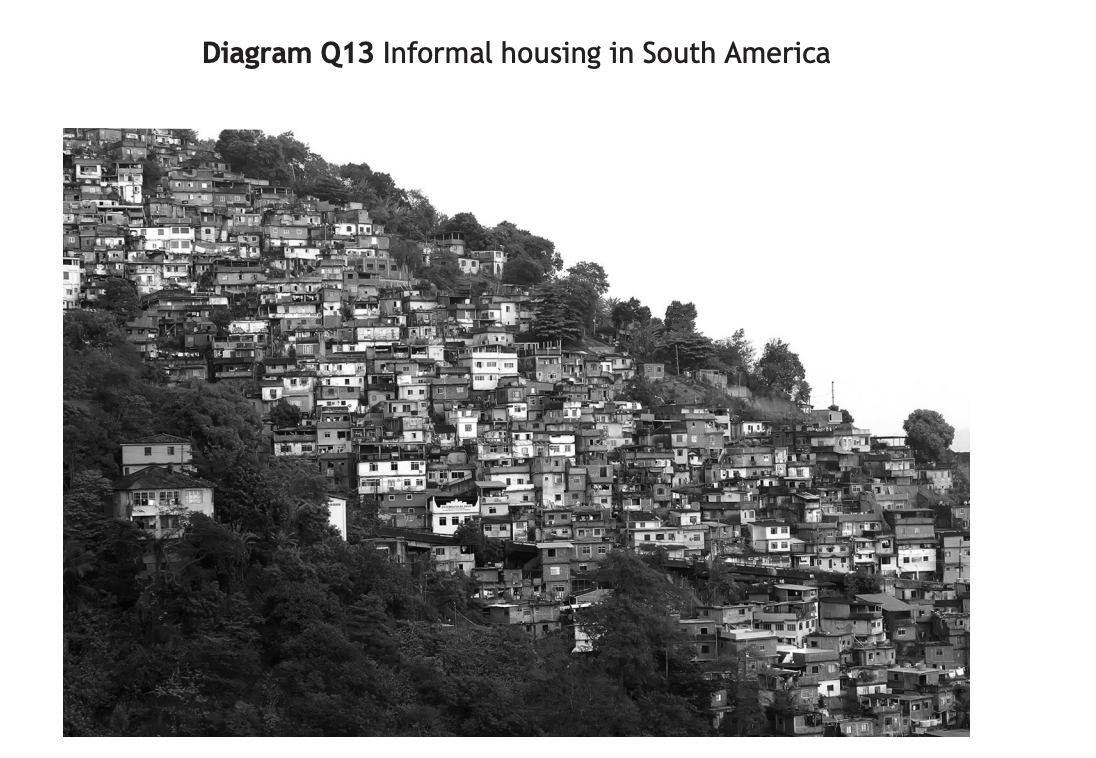
Look at Diagram Q13.
Referring to an area you have studied, explain recent improvements that have taken place in shanty towns.
Example answer
Dharavi, Mumbai
The Mumbai Slum Rehabilitation Authority (SRA) has replaced low-quality housing with high-rise apartments [1]. These have electricity, water and toilets, which helps improve the standard of living and reduce disease. [1]
SPARC has worked with residents in Dharavi to provide materials to build and upgrade their homes. [1] This helps to reduce overcrowding [1]
Examiner Tips and Tricks
Questions will often say 'Referring to a named area you have studied...' it is important that you can give relevant place-specific details about the named place. If you write a generalised answer with no reference to a named place, the number of marks you are awarded will be limited.
The example answer above is just one way to answer the question you could also refer to:
Improvements in waste collection
Transport infrastructure
Health clinics
Increased police presence

Unlock more, it's free!
Join the 100,000+ Students that ❤️ Save My Exams
the (exam) results speak for themselves:

Was this revision note helpful?