The Coming to Power of the National Socialists, 1933-34 (SQA National 5 History): Revision Note
Exam code: X837 75

Summary
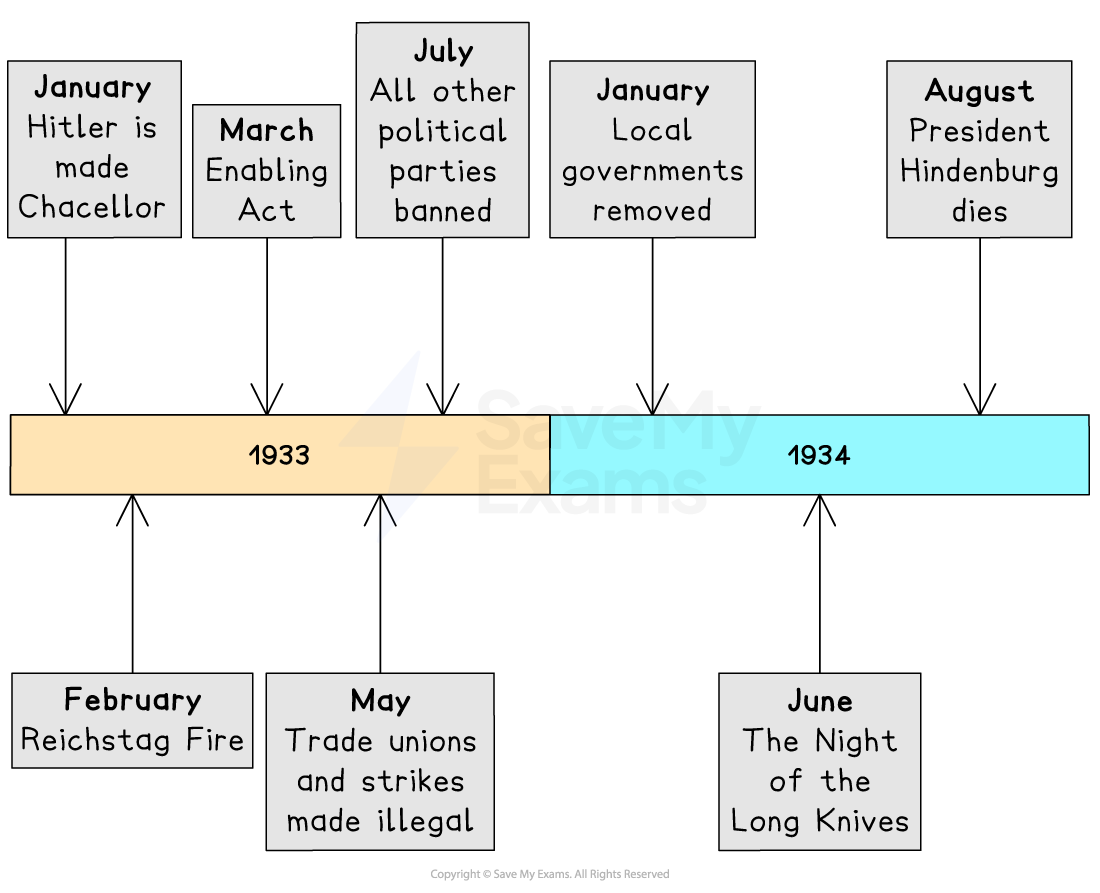
The Nazis gained more support during the Great Depression because they promised jobs and strong leadership. Conservative leaders who feared communism backed Hitler, and President Hindenburg made Hitler the Chancellor of Germany on 30 January 1933.
After the Reichstag Fire in February, Hitler and Hindenburg used Article 48 (an emergency decree) to end many personal freedoms and allow mass arrests of opponents. The police locked up rivals of the Nazi Party and shut down their meetings. This meant that the Nazi Party faced less competition in the March election.
In March 1933, the Reichstag passed the Enabling Act, which allowed Hitler to make laws without its approval. Hitler’s Nazi government quickly broke up trade unions, banned other parties, and took over local government, the police, and the courts.
In June–July 1934, Hitler ordered the Night of the Long Knives, removing rivals and reassuring the army. When Hindenburg died in August 1934, Hitler merged the roles of President and Chancellor and made the army swear an oath to him; by the end of 1934, he held total power.
Hitler becomes Chancellor
The Great Depression gave the Nazis a chance to grow and gain popularity
Millions lost jobs after 1929, and the Nazis promised “Work and Bread,” strong leadership, and an end to the chaos
In the July 1932 election, the NSDAP (Nazi Party) was the biggest party in the Reichstag
The Nazi Party received 38% of the vote
This was not the 50% needed to have a majority in the Reichstag
The NSDAP’s share of the votes had increased from 18% in 1930
Conservative leaders like Franz von Papen thought they could control Hitler
President Hindenburg appointed Hitler as Chancellor on 30 January 1933
Hitler still did not have complete control of Germany
The Nazi Party only controlled one-third of the Reichstag
Hindenburg was the President of Germany
The Weimar Constitution limited the power of the chancellor
The Reichstag Fire
On 27 February 1933, the Reichstag (German parliament) building caught fire
Police arrested Marinus van der Lubbe, a Dutch communist, inside the building
It was believed that van der Lubbe started the fire
He was later tried and executed
Hitler called it proof of a communist plot
Overnight, he pushed President Hindenburg to issue the Reichstag Fire Decree (28 Feb 1933)
This suspended people's basic rights to:
Free speech
Free press
Freedom of assembly
It allowed police to:
Search homes
Read mail
Jail people without trial
Using these powers, the authorities:
Shut opposition newspapers
Banned meetings
Arrested thousands of communists and socialists (including many KPD MPs)
This weakened the Nazi's rival parties just before the March 1933 elections
With opponents jailed or scared, the Nazis and their allies had the votes to pass the Enabling Act (23 March 1933)
Worked Example
Describe the events of the Reichstag fire in February 1933.
[4 marks]
On 27 February 1933, the Reichstag (German parliament) building in Berlin caught fire. [1] Police found and arrested Marinus van der Lubbe inside the building. [1] Hitler and Göring immediately blamed the Communists, claiming an attempted uprising. [1] On 28 February 1933, President Hindenburg signed the Reichstag Fire Decree, suspending civil liberties and enabling arrests without trial. [1]
The Enabling Act
Thousands of Communists and many Social Democrats were jailed or silenced before the March election
On 23 March 1933, the Reichstag held a vote:
The SA lined the chamber and corridors, adding intimidation
The KPD (Communist Party) could not vote
The Enabling Act was passed and allowed Hitler’s cabinet to make laws without parliament
Only the SDP opposed the vote
This law meant Hitler could change Germany step by step without debate or votes
The Enabling Act allowed Hitler’s cabinet to make laws, even change the constitution, without Reichstag approval
From this point, the Reichstag had little real power, and Germany moved rapidly from democracy to a dictatorship
Examiner Tips and Tricks
Hitler, by reducing the power of the Communist Party and branding them enemies of Germany, could weaken opposition while also strengthening his own position. Many members of the public mistakenly believed the Enabling Act to have been created to protect their security and livelihoods. However, it was used as a tool by Hitler to set up the foundations for a police state.
Removing opposition to the Nazi Party
After 1933, the Nazi Party “co-ordinated” the state and removed rivals
They broke up trade unions on 2 May 1933 and replaced them with the German Labour Front
Other parties were pushed out or banned; by 14 July 1933, Germany was a one-party state
Nazis took over local government, the police, the courts, and the civil service; teachers’ and youth groups were also brought under their control
The Night of the Long Knives
Violence and power deals finished the takeover in 1934
Hitler was concerned about internal opposition, especially from the head of the SA, Ernst Röhm
Röhm led around three million SA members, around 60% of whom were unemployed by 1933
Röhm wanted a greater focus on supporting the working class, which contrasted with Hitler’s desire to help the rich
Röhm’s SA clashed with the SS, led by Heinrich Himmler and Reinhard Heydrich
Hitler arranged a meeting with Röhm and other SA leaders on 30th June 1934:
Röhm and around 400 SA members were arrested and later shot
Other opponents, such as von Schleicher, Gregor Strasser and von Kahr, were also arrested and killed
The public was informed that Röhm had been planning to replace Hitler, and therefore, his death served the interests of the country
These killings from 30 June to 2 July 1934 became known as the Night of the Long Knives
This removed rivals, won the army’s support, and tightened Hitler’s control
The killings were then legalised by a special law.
When President Hindenburg died on 2 August 1934, Hitler combined the jobs of President and Chancellor and took the title Führer
The army swore a personal oath to him
By late 1934, he held total power.

Unlock more, it's free!
Join the 100,000+ Students that ❤️ Save My Exams
the (exam) results speak for themselves:

Was this revision note helpful?