The Effects of the First World War on Germany (SQA National 5 History): Revision Note
Exam code: X837 75

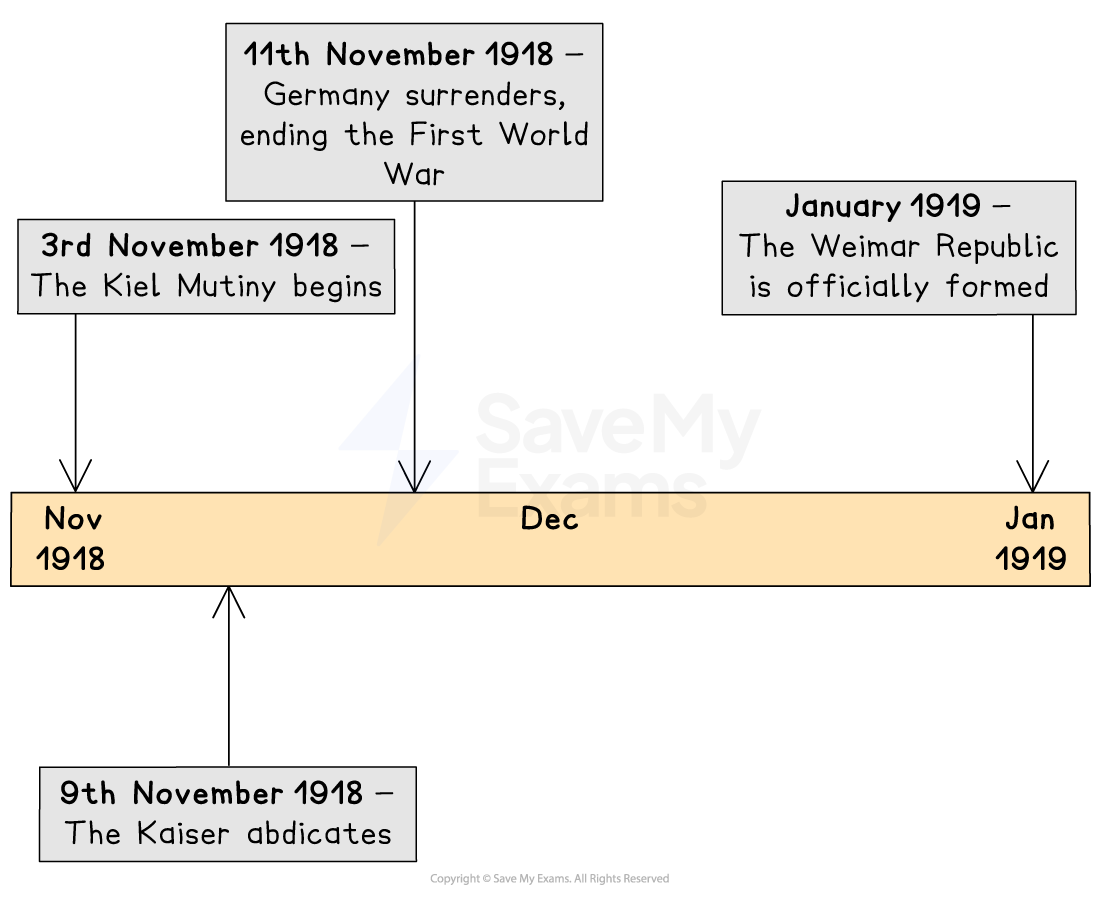
Germany suffered badly after the First World War. About two million soldiers died and many more were wounded, so families lost income and support. Food was in short supply and disease spread, especially in the cities. The economy was weak: the government had large debts, prices rose quickly, and many people lost jobs and savings.
In November 1918, after losing control of the military, the Kaiser abdicated. Eventually, the Weimar Republic took over, but there was unrest and several violent uprisings. The Treaty of Versailles blamed Germany for the war, forced it to pay reparations, reduce its army, and give up control of Alsace-Lorraine. Many Germans felt anger and humiliation, and trust in the new democracy was damaged.
Germany in 1918
The Kaiser gave up his throne (abdicated) on 9 November 1918
The new Weimar Republic was announced in Berlin
Germany was losing the war and there was widespread unrest
Soldiers’ and workers’ councils formed in many cities
These were local committees of elected soldiers and workers that briefly took control in German cities after the Kaiser’s abdication
They aimed to restore order and push for reforms
There was fear and confusion as different groups tried to control the streets
The German army was exhausted and short of men, food, and supplies
The end of the First World War
The Allies broke through on the Western Front
On 11 November 1918, Germany signed the Armistice, and fighting stopped
Many soldiers came home tired, angry, and unsure about the future
People had faced years of hunger because of the British naval blockade
Food and fuel were scarce; prices were rising
Strikes and protests grew in 1918 (e.g. in Berlin and Munich)
Disease (including the Spanish Flu) spread
Many families had lost fathers or sons
The Treaty of Versailles peace settlement
The Treaty of Versailles (1919) was a peace agreement that ended the war between Germany and the Allied Powers
It was signed on 28 June 1919 in the Palace of Versailles near Paris and took effect on 10 January 1920
It set the rules for peace after the First World War
Germany had to:
Accept war guilt
Pay reparations (about £6.6 billion)
Give up land (Alsace-Lorraine, the Polish Corridor, all colonies)
Cut the size of its army and navy significantly
No air force allowed
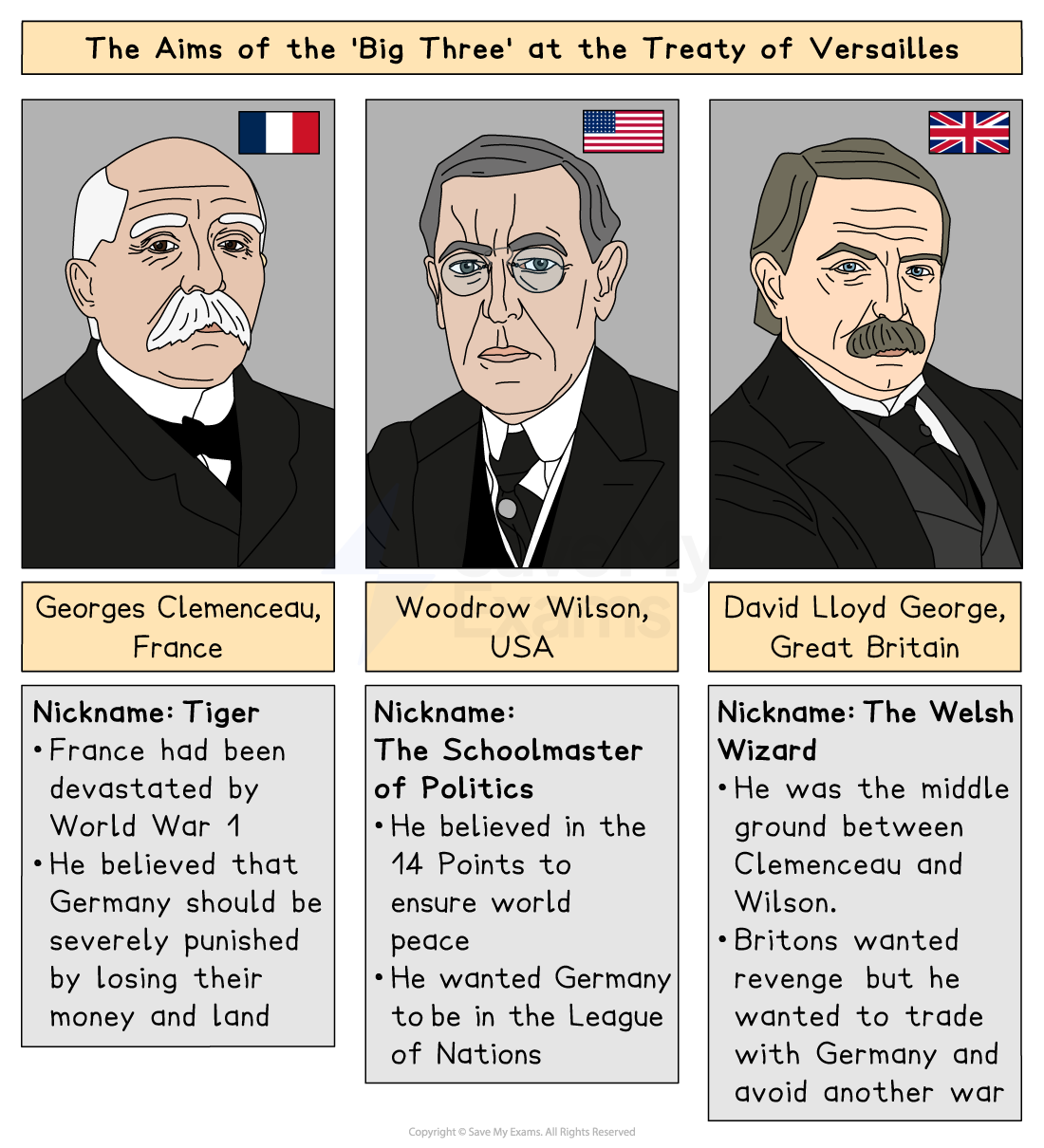
The “Big Three” leaders made the terms: Wilson (USA), Clemenceau (France), Lloyd George (Britain)
Germany was not invited to the talks
Wilson wanted a fair peace and a League of Nations; Clemenceau wanted to punish Germany; Lloyd George wanted a balance
Many Germans felt angry and humiliated by the Treaty of Versailles
They claimed weak politicians in Berlin betrayed the nation by asking for peace and then signing the Treaty of Versailles
This was called the “stab in the back” myth
It made people blame the new Weimar government for surrender and hardship, even though the army was already exhausted and out of supplies
The economy was put under strain
The country became politically unstable
New borders in Europe created additional tension in the 1920s
Worked Example
Source A describes the terms of the Treaty of Versailles.
Source A
In May 1919, the terms of the Treaty were presented to a horrified German delegation. There was resentment in Germany in particular to Article 231, the ‘War Guilt’ clause. The Rhineland was to become a demilitarised zone to act as a buffer between France and Germany. Some terms were resented much more than others. The Anschluss (union with Austria) was forbidden by Article 80 of the Treaty. All of Germany’s colonies were to be handed over to the Allies as decided by the League of Nations.
Question
How fully does Source A describe the terms of the Treaty of Versailles?
[6 marks]
Answer
Source A describes the impact to some extent. It shows that Germany would lose land and people to other countries [1], that Germany would be left weak and unable to defend itself [1], and that Germans felt the settlement was a forced “Diktat,” causing resentment[1]. However, the source misses key impacts: Germany was blamed for starting the war under the War Guilt Clause, which deeply humiliated people [1]; reparations placed a heavy strain on the economy [1]; and Germany was kept out of the League of Nations, showing its isolation [1].

Unlock more, it's free!
Join the 100,000+ Students that ❤️ Save My Exams
the (exam) results speak for themselves:

Was this revision note helpful?
