The Formation of the Weimar Republic (SQA National 5 History): Revision Note
Exam code: X837 75

Summary
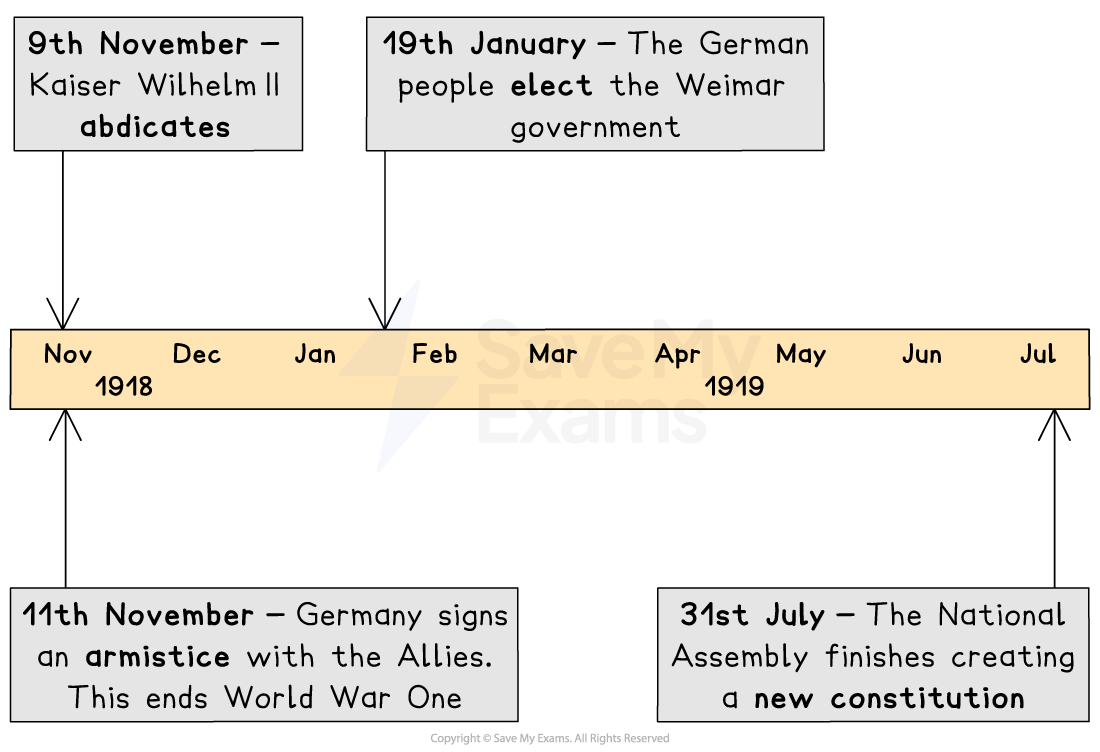
The Weimar Republic was formed after the Kaiser abdicated on 9 November 1918. Leaders in Berlin announced a republic and wrote a new constitution in Weimar in 1919. As part of this, Germany became a democracy with elections.
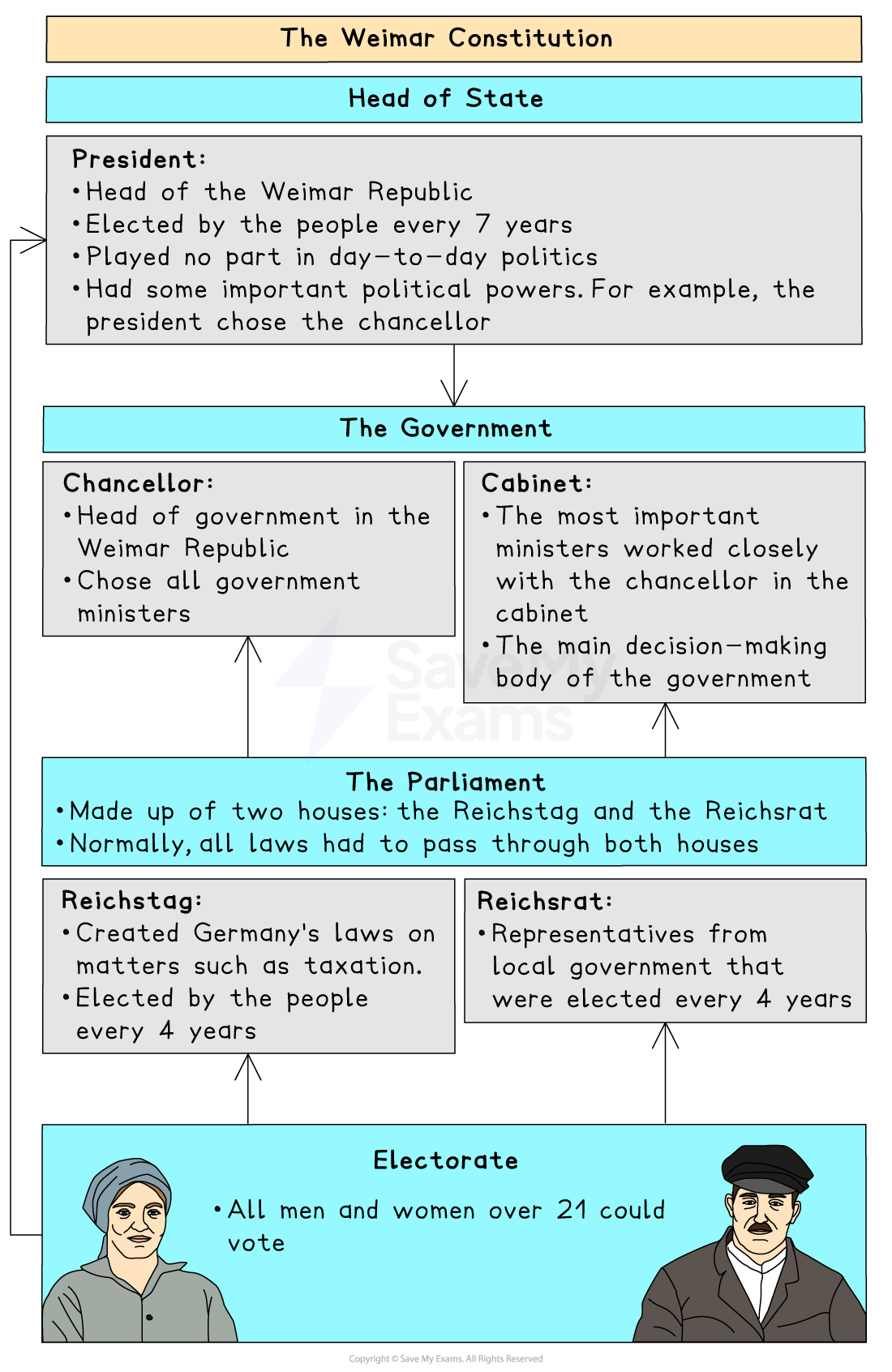
The President was the head of state. The Chancellor ran the government but needed support in the Reichstag. The Reichstag was elected by proportional representation. This meant that many different parties gained seats in the parliament. However, many small parties led to an unstable government. Politicians on the left and right opposed the system. Economic problems and unrest added to theweakness of the government
The formation of the Weimar Republic
In November 1918, the Kaiser left Germany
He abdicated on 9 November and fled to the Netherlands
This ended the monarchy
Leaders in Berlin announced a new republic and called elections
They wanted a fresh start and a government chosen by the people
In 1919, a constitution was written in Weimar
Berlin was unsafe due to civil unrest, so politicians met in the quieter town of Weimar
Constitution of the Weimar Republic
The constitution set up a democracy with a President, a Chancellor, and a Reichstag
The President was the head of state
The Chancellor led the government
The Reichstag was the elected parliament
The Reichstag was chosen by proportional representation
Parties got seats (representatives) in parliament based on their share of the vote
Many small political parties won seats and coalitions were often weak
Governments changed often and found it hard to agree on laws
The Constitution protected rights
It promised free speech, freedom of religion, and fair courts
Men and women over 20 could vote
This made the system more democratic than before 1918
Germany kept its states, which had local powers
These states were called Länder and ran some local services
Article 48 of the Constitution allowed the President to rule by decree in an emergency
This could help during a crisis, but it could also be misused to bypass parliament
Popular opinion of the new government
Attitudes to the Weimar Republic were mixed
Many people welcomed the new rights and the ability to vote
Other people linked the new republic to defeat and the Treaty of Versailles
They said it was weak
Worked Example
Sources A and B are about the formation and characteristics of the Weimar Republic.
Source A
The new German republic was established at Weimar in 1919. Its new constitution was clear and easy to understand, strengthening the young democratic government. There were some sensible measures included. Many welcomed the inclusion of Article 48 that gave the President the power to take control in a crisis. Others were happy about Proportional Representation because they felt that the electoral system was very fair.
Source B
A notable characteristic of the republic was Article 48 ― but this was criticised for giving too much power to the President in a crisis. The constitution caused several problems for the new government, not least because it was confusing. People criticised the introduction of a proportional voting system because it allowed small anti-democratic parties into the Reichstag. Eventually, the Nazis were able to use their presence in the Reichstag to overturn the Weimar Constitution.
Question
Compare the views of Sources A and B about the formation and characteristics of the Weimar Republic.
[4 marks]
Answer
Overall, the two sources disagree about the Weimar Republic’s set-up and how well its constitution worked.
Source A presents the formation as a positive fresh start with a clear democratic system, while Source B suggests the new system was flawed from the beginning and created problems. [1]
They also disagree about Article 48: Source A sees it as useful in a crisis, but Source B argues it gave the President too much power. [1]
In addition, they differ on proportional representation: Source A treats PR as fair because seats match votes, but Source B says PR let many small parties into the Reichstag and made stable government harder. [1]
Finally, they contrast attitudes to rights and participation: Source A stresses wider voting rights and freedoms as strengths, while Source B links the new system to defeat and unrest, suggesting many people did not accept it. [1]
Examiner Tips and Tricks
For a 4-mark compare question, you can score full marks with two developed comparisons (each backed by evidence from both sources), or four simple comparisons. Keep quotes short and always state the disagreement or agreement clearly.

Unlock more, it's free!
Join the 100,000+ Students that ❤️ Save My Exams
the (exam) results speak for themselves:

Was this revision note helpful?
