Rent Strikes (SQA National 5 History): Revision Note
Exam code: X837 75

Summary
In 1915, tenants in Glasgow and other Clydeside areas fought rent rises during the war. Mary Barbour and the Glasgow Women’s Housing Association led mass meetings, organised rent refusal, and formed anti-eviction groups that turned away sheriff officers.
Protests increased in Govan, Partick and Bridgeton, and workers threatened to stop work. Court cases collapsed as crowds gathered outside. The UK government then passed the Increase of Rent and Mortgage Interest (War Restrictions) Act 1915, which froze most working-class rents at pre-war levels. The strikes gained a quick result and showed strong community and women’s leadership.
What were the rent strikes?
Rent rises in wartime Glasgow hit shipbuilding districts hardest
Landlords increased rents in Govan, Partick and Bridgeton while overcrowding worsened
They were seen to be taking advantage of the fact that many men were away fighting the war
Families in tenements with poor sanitation faced higher weekly charges that they could not afford
People took action to fight the rent rises
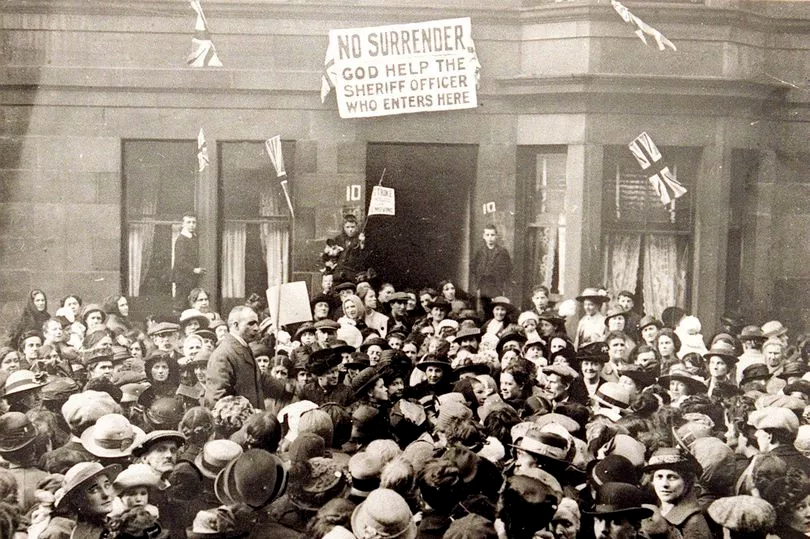
What did people do to stop the rent increases?
Mary Barbour and the Glasgow Women’s Housing Association built close door-to-door networks
They held meetings at Kinning Park and Govan Town Hall
They coordinated streets to refuse payment on the same day, so no one household stood alone
Tenants used collective non-payment and anti-eviction action
When sheriff officers arrived, neighbours rang bells, beat pans and formed crowds to block furniture removals
“Mrs Barbour’s Army” turned back officers in Govan and Partick and escorted them to tram stops while mocking them
How were the engineering works and shipyards involved?
Engineering and shipyard workers added pressure
Shop stewards from yards like Fairfield and Beardmore warned they would stop work if courts evicted tenants
This threatened Clydeside production of ships, so pushed city leaders and the government to act
Packed galleries and large crowds outsideGlasgow courts led to cases being dropped or delayed
Magistrates faced a backlog, and police struggled to clear streets without inflaming the situation
Red Clydeside
Red Clydeside’s strong unions backed the rent strikes
Shipyard workers threatened to stop work if evictions went ahead, which put big pressure on the authorities.
Women leaders worked with local socialists to organise crowds that blocked evictions in places like Govan and Partick
The result of rent strikes
Their action helped push through the 1915 rent cap law
The campaign won legal change and left a legacy
The UK passed the Increase of Rent and Mortgage Interest (War Restrictions) Act 1915
This froze most working-class rents at pre-war levels across Scotland
Tenants’ groups stayed active after 1915
The strike showed how organised communities, led by women, could force a change in national policy
Worked Example
Source D is from a textbook written by a modern historian in 2013.
Source D
The disagreements of the rent strikes were about the high cost of housing. The threat of eviction led to a woman in some tenement blocks being posted as a sentry to warn others if the bailiffs arrived. Everyone in the building would then run to defend their neighbour against eviction. Flour, rotting food and even wet clothes were thrown at the bailiffs to stop them from entering the building. The solidarity of the women was often so strong that it could not be broken.
Evaluate the usefulness of Source D as evidence of what happened during the rent strikes of 1915. (You may want to comment on what type of source it is, who wrote it, when they wrote it, why they wrote it, what they say and what has been missed out.)
Source D was written by a modern historian. This makes it useful because the author is likely to be a well-informed expert on the rent strikes, drawing on a range of research.[1]
It is a textbook, which increases usefulness as such books are thoroughly researched and intended to provide accurate coverage of events. [1]
Written in 2013, it is a secondary source with the benefit of hindsight, allowing the author to synthesise evidence produced at the time and afterwards.
The source says that a woman was posted as a sentry to warn others if the bailiffs arrived, after which neighbours defended tenants from eviction and items (like flour or wet clothes) were thrown at bailiffs. These details are accurate accounts of tactics used during the rent strikes, so they make the source more useful as evidence of what happened. [1]
The source omits that local women led by Mary Barbour formed the Glasgow Women’s Housing Association (February 1915) and that the movement grew to c. 25,000 tenants by May 1915, which are important for understanding the organisation and scale of events. Not mentioning these limits completeness, so this reduces usefulness.[1]

Unlock more, it's free!
Join the 100,000+ Students that ❤️ Save My Exams
the (exam) results speak for themselves:

Was this revision note helpful?
