Projectile Motion (SQA National 5 Physics): Exam Questions

Exam code: X857 75

29 mins9 questions
1a1 mark

During a cycle race, a cyclist attempts to pass a water bottle to a team-mate.
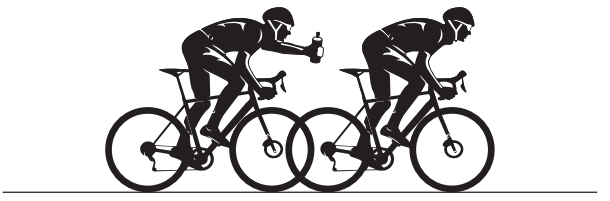
Two cyclists in a race, wearing helmets. The rear cyclist reaches forward with a water bottle while maintaining balance on the bike.

The cyclist is travelling in a straight line at 12.5 m s−1 when they drop the bottle.
The bottle hits the ground 0.53 s later.

The effects of air resistance on the bottle are negligible.

A spectator at the side of the road observes the cyclist dropping the bottle.

On the diagram below, sketch the path taken by the bottle from the point it is dropped, as observed by the spectator at the side of the road.
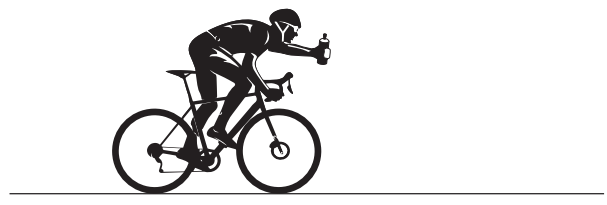
Silhouette of a cyclist holding a water bottle while riding a bicycle, wearing a helmet and cycling attire, against a white background.
1b
Sme Calculator
8 marks

(i) Calculate the vertical velocity of the bottle as it reaches the ground.

[3]

(ii) Sketch a velocity‑time graph showing the magnitude of the vertical velocity of the bottle from the time it is released until it reaches the ground.

Numerical values are required on both axes.

[2]
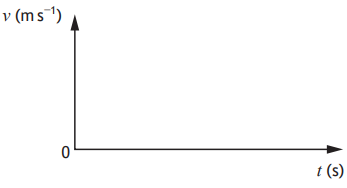
Graph with horizontal axis labelled 't (s)' for time and vertical axis labelled 'v (ms⁻¹)' for velocity, both starting at origin.

(iii) Determine the height from which the bottle was dropped.

[3]

21 mark

Astronauts orbiting in the International Space Station experience ‘weightlessness’.

A group of students make the following statements to explain ‘weightlessness’ in the orbiting space station:

I The gravitational field strength inside the space station is zero.

II The space station and astronauts are both accelerating at the same rate towards the Earth.

III The forces acting on the astronauts are balanced.

Which of these statements is/are correct?

  • I only

  • II only

  • III only

  • I and II only

  • II and III only

3a5 marks

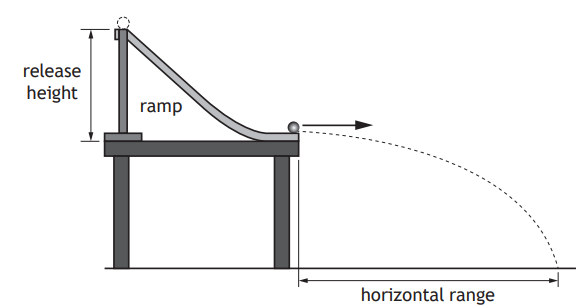
A student is investigating factors that affect the horizontal range of a marble, using the apparatus shown.

Diagram of a ball being released from a ramp at a height, showing its parabolic trajectory and horizontal range upon leaving the ramp.

The student releases a marble from different heights on the ramp and measures the horizontal range.

The student’s results are shown in the table.

Release height (m)

Horizontal range (m)

0.10

0.39

0.14

0.44

0.18

0.51

0.26

0.64

0.30

0.70

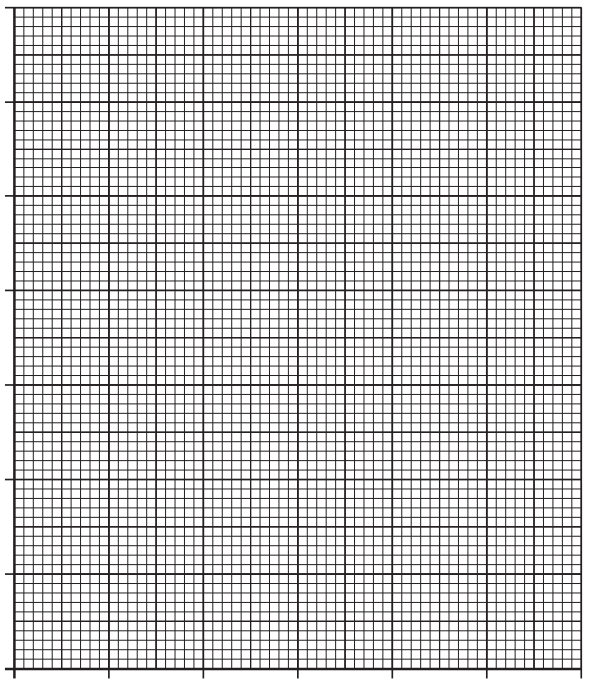
(i) Using the graph paper on page 09, draw a graph of these results.

[3]

A graph paper with fine grid lines, featuring horizontal and vertical axes with tick marks. The grid is square and evenly spaced across the page.

(ii) Use your graph to predict the horizontal range of a marble released from a height of 0.22 m.

[1]

(iii) In order to measure the horizontal range, the student watched to see where the marble hit the ground.

Suggest an improvement to the experiment to determine more accurately where the marble hit the ground.

[1]

3b3 marks

(i) Suggest another variable that could be investigated, which may affect the horizontal range of a marble.

[1]

(ii) Describe experimental work that could be carried out to investigate how the variable you suggested in (b) (i) affects the horizontal range of a marble.

[2]

4
Sme Calculator
1 mark

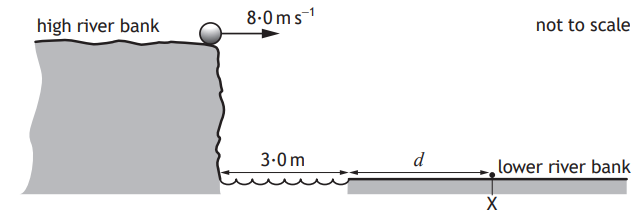
A ball is kicked horizontally off a high river bank as shown.

Ball on high river bank moving right at 8.0 m/s towards lower bank; 3.0 m gap with water below; distance d to lower bank marked X.

The ball lands on the lower river bank at X, 2·0 s after the ball is kicked.

The river is 3·0 m wide.

The effect of air resistance on the ball is negligible.

The distance d between the edge of the lower river bank and X is

  • 1·0 m

  • 4·0 m

  • 13 m

  • 16 m

  • 19 m

51 mark

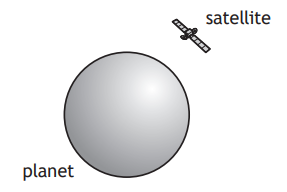
A satellite is in circular orbit around a planet.

Illustration showing a grey planet with a small satellite positioned above and to the right, labelled respectively as "planet" and "satellite".

A group of students make the following statements about the satellite in orbit:

I The horizontal speed of the satellite is constant.

II The satellite does not move.

III While orbiting the planet the satellite is weightless.

Which of these statements is/are correct?

  • I only

  • II only

  • III only

  • I and III only

  • II and III only

61 mark

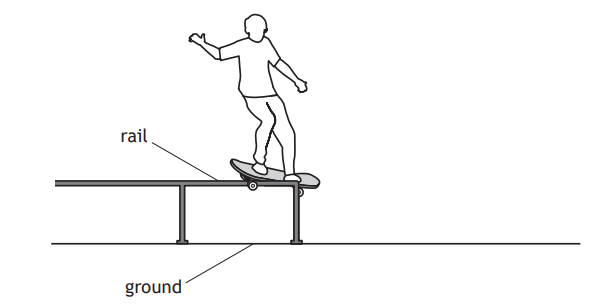
The skateboarder and board slide off the end of the rail.

Illustration of a skateboarder grinding on a rail, labelled "rail" and "ground", with the skateboard positioned on the rail above a flat surface.

On the diagram above, sketch the path of the skateboarder and board between leaving the rail and reaching the ground.

71 mark

A ball is thrown vertically upwards. The ball reaches its maximum height.

Which of the following describes the forces acting on the ball at this instant?

  • There is no vertical force acting on the ball.

  • There is only a horizontal force acting on the ball.

  • There is an upward force acting on the ball.

  • The forces acting on the ball are balanced.

  • There is only a downward force acting on the ball.

8
Sme Calculator
4 marks

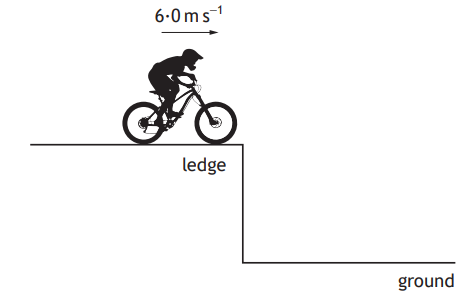
During a competition, a cyclist and a bike travel horizontally at 6∙0 m s−1 off a ledge as shown.

Silhouette of a cyclist riding at 6.0 m/s on a ledge above ground level, indicating motion towards the edge.

(i) On the diagram above, sketch the path taken by the cyclist and bike between leaving the ledge and reaching the ground.

[1]

(ii) The cyclist and bike reach the ground 0∙40 s after leaving the ledge.

Calculate the vertical velocity of the cyclist and bike as they reach the ground.

The effects of air resistance can be ignored.

[3]

93 marks

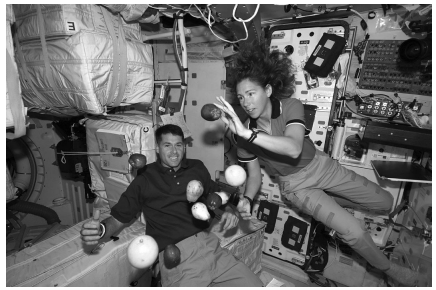
A group of students are watching a video clip of astronauts on board the International Space Station (ISS) as it orbits the Earth.

Two astronauts float in a space station module with several pieces of fruit suspended in zero gravity, surrounded by equipment and controls.

One student states, ‘I would love to be weightless and float like the astronauts do on the ISS.’

Using your knowledge of physics, comment on the statement made by the student.