How Did Stalin Gain Power? (Edexcel A Level History): Revision Note
Exam code: 9HI0

Timeline & Summary
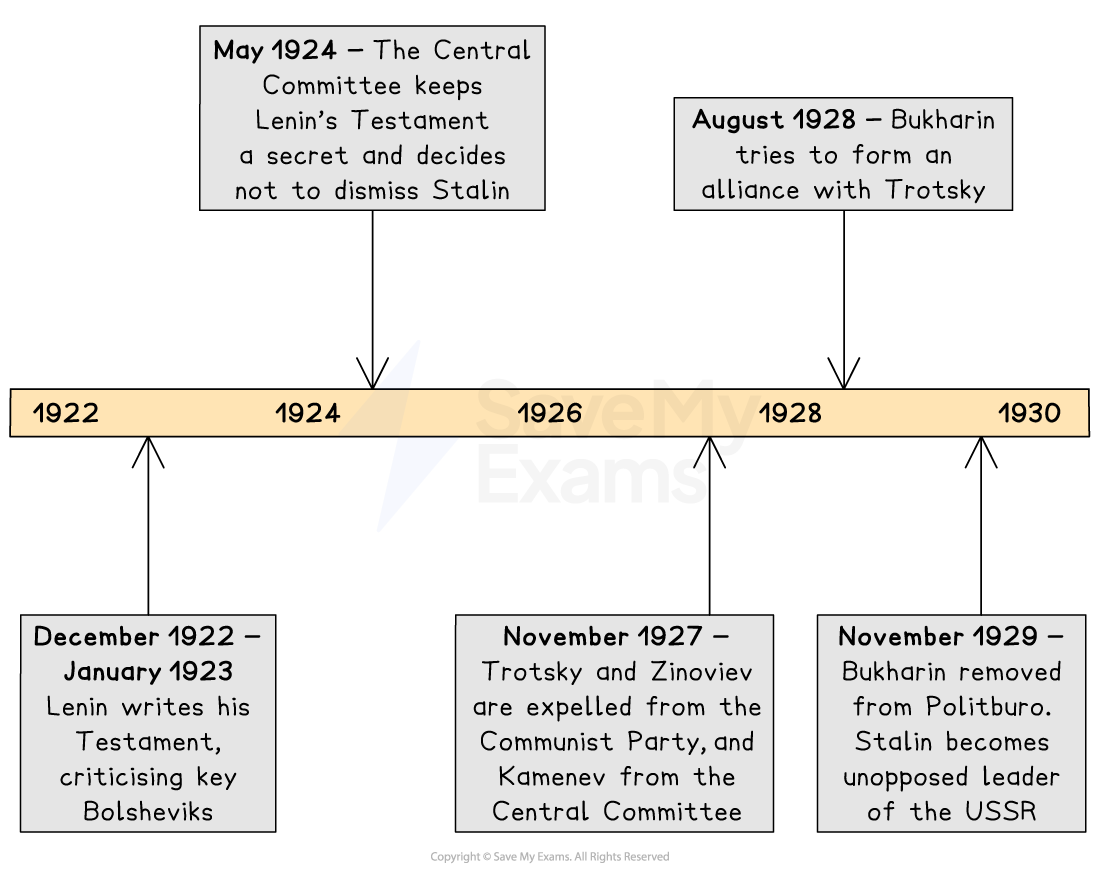
This note will examine how Stalin became the unopposed leader of the USSR by 1929
Lenin’s death in 1924 created a power vacuum in the Communist Party
Lenin’s Testament criticised Stalin and Trotsky, which prevented its publication
Several contenders emerged, but Stalin’s position as General Secretary gave him a key advantage
Stalin rose by controlling appointments, building alliances, and outmanoeuvring rivals
Historians debate whether Stalin’s rise was due to his skill, his opponents’ weaknesses, or structural factors
Death of Lenin, 1924
From mid-1921, Lenin’s health declined
He survived an assassination attempt in 1918
Fanya Kaplan, a member of the SRs, shot Lenin twice outside a factory in Moscow
One of the lead bullets was lodged in Lenin's head. It was slowly poisoning his brain
He suffered a massive stroke in May 1922
From then until his death in January 1924, Lenin became increasingly paralysed
Another stroke in March 1923 left Lenin unable to speak
From this point, he was unable to lead the Communist Party actively
Lenin died on 21st January 1924
The Bolsheviks embalmed Lenin's body and created a mausoleum

Lenin's Testament
Between late 1922 and early 1923, Lenin dictated his last will
It stated Lenin's aims for the Communist Party after his death
It would become a controversial document
What did Lenin say about Trotsky?
[Trotsky] is personally perhaps the most capable man in the present C.C. [Central Committee], but he has displayed excessive self-assurance and shown excessive preoccupation with the purely administrative side of the work
What does this mean?
Lenin believed that Trotsky was a capable member of the Party
However, he thought Trotsky was:
Overconfident and arrogant
Too focused on paperwork rather than leading the Party
What did Lenin base his opinion on?
Lenin had given a lot of power to Trotsky. Instances of this include:
Trotsky was a gifted orator and writer
Party members believed that Trotsky thought himself more intelligent and devoted to communism than them
Trotsky was Jewish
Although Trotsky did not practice Judaism, it turned many of the Party against him
What did Lenin say about Stalin?
Comrade Stalin, having become Secretary-General, has unlimited authority concentrated in his hands, and I am not sure whether he will always be capable of using that authority with sufficient caution
Stalin is too rude... That is why I suggest that the comrades think about a way of removing Stalin from that post and appointing another man in his stead who [is] more tolerant, more loyal, more polite and more considerate to the comrades
What does this mean?
Lenin believed that Stalin could not be trusted with power
Stalin came across as rude, disloyal, unpolite and argumentative with his colleagues
What did Lenin base his opinion on?
Stalin had risen quickly through the Bolshevik Party
Stalin had little to no role in the October Revolution
Lenin gave Stalin the position of Commissar for Nationalities in November 1917
Stalin made his reputation during the Russian Civil War
In 1921, Stalin became General Secretary of the Bolshevik Party
Lenin became suspicious of Stalin
Stalin built a support base in the Party that was loyal to him
The alliance between Stalin, Kamenev, and Zinoviev was called the Triumvirate
Stalin's anger became a serious issue
In March 1923, Lenin discovered that Stalin had shouted at his wife on the telephone
Lenin saw this as an unforgivable act
Another stroke left Lenin unable to remove Stalin as General Secretary
Lenin viewed Stalin as cruel and uneducated
Stalin came from Georgia, which Lenin viewed as an inferior nationality
Examiner Tips and Tricks
In an exam question, you do not necessarily have to remember quotes from Lenin's Testament. An examiner would expect you to know Lenin's opinions on Trotsky and Stalin and why he had these opinions.
Contenders by 1924
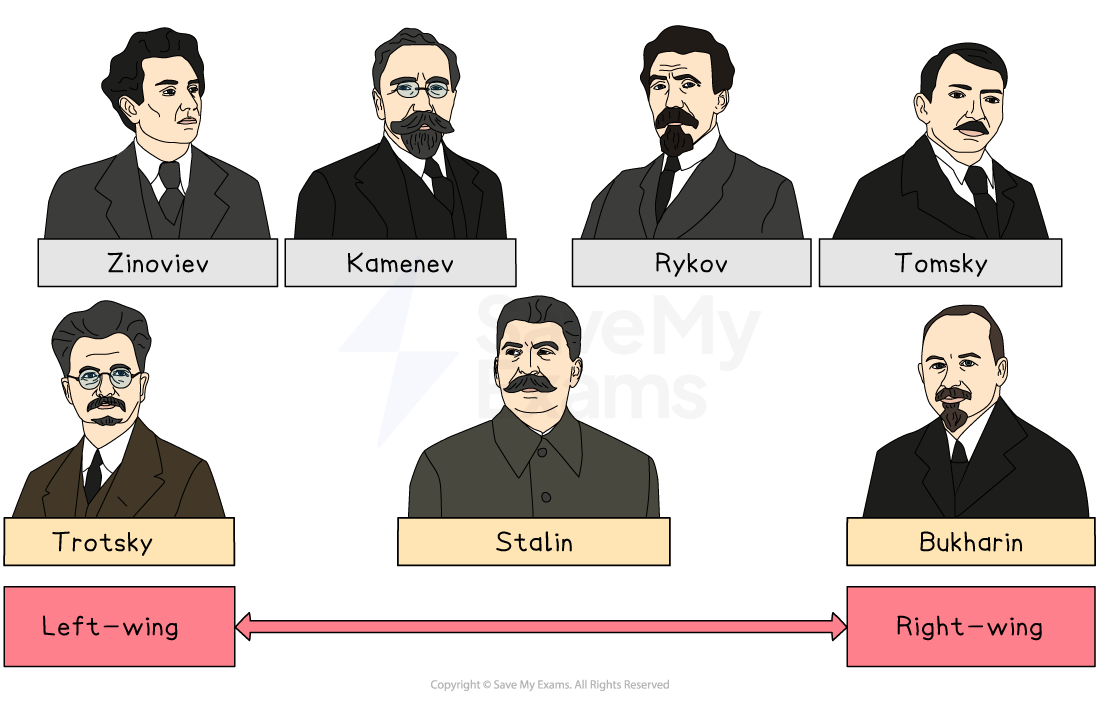
After Lenin's death, the party became divided between the left-wing and the right-wing
Left-wing
Believed in War Communism
Favoured the 'permanent revolution'
This stated that the USSR needed to spread communism across the world
This idea was unpopular with the Party
Right-wing
Believed in the New Economic Policy
Favoured 'Socialism in One Country'
This was intended to strengthen communism in the USSR before pursuing global communism
This idea was popular with the party
Key members of the Party and their allegiances
Why was there a power struggle from 1924?
Lenin did not name a successor
The left and right of the Bolshevik Party fought in a power struggle
How did Stalin become leader?
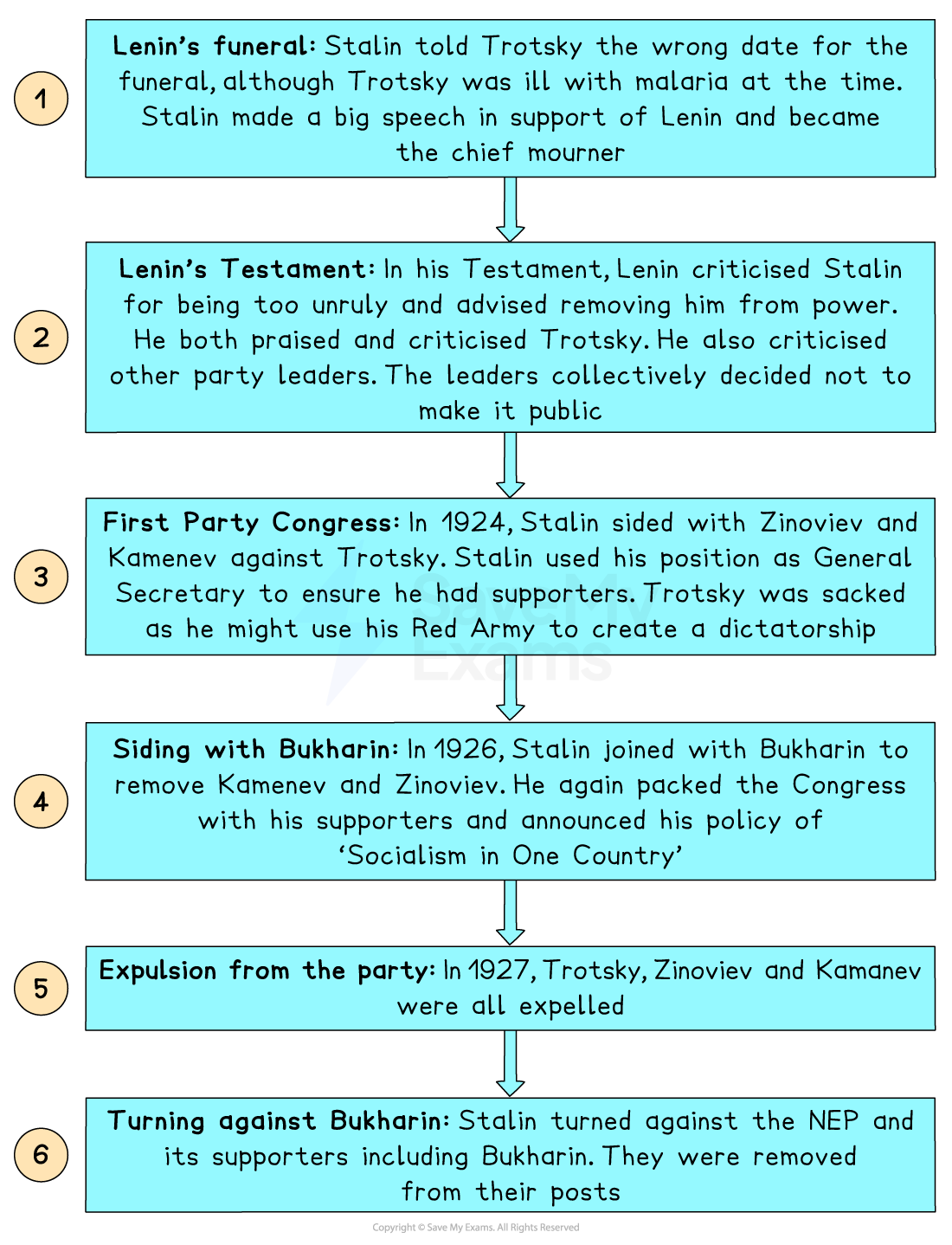
Stalin played a clever political game to become the leader of the USSR
By December 1929, Stalin was the undisputed leader of the USSR
Examiner Tips and Tricks
Students often find the power struggle between 1924 and 1929 very confusing to understand. Try to remember that Stalin went:
To the left of the Party to win support and isolate Trotsky
To the right of the Party to remove the left
Back to the centre of the Party to remove the right-wing threats
What was the biggest factor that allowed Stalin to take power?
Stalin’s rise can be explained in different ways
Some historians highlight his political skill
Others emphasis the weakness of his rivals
Historians also argue the structure of the Party itself allow Stalin to take power
Stalin’s political skill
Stalin used his control of Party machinery and his talent for building alliances to outmanoeuvre rivals
Key historians
"The key to Stalin's growing power was his control of the party apparatus in the provinces. As the Chairman of the Secretariat and the only Politburo member in the Orgburo, he could promote his friends and dismiss opponents. During the course of 1922 alone, more than 10,000 provincial officials were appointed by the Orgburo and the Secretariat, most of them on Stalin's personal recommendation. They were to be his main supporters during the power struggle against Trotsky in 1922-3." - Orlando Figes, A People’s Tragedy (1996)
"Stalin had already used the massive patronage of the Secretariat to promote his allies, Molotov, Voroshilov and Sergo; he also supplied an encouraging and realistic alternative to Trotsky’s insistence on European revolution: “Socialism in One Country.” The other members of the Politburo, led by Grigory Zinoviev, and Kamenev, Lenin’s closest associates, were also terrified of Trotsky, who had united all against himself. So when Lenin’s Testament was unveiled in 1924, Kamenev proposed to let Stalin remain as Secretary, little realizing that there would be no other real opportunity to remove him for thirty years. Trotsky, the Revolution’s preening panjandrum, was defeated with surprising ease and speed. Having dismissed Trotsky from his power base as War Commissar, Zinoviev and Kamenev discovered too late that their co-triumvir Stalin was the real threat." - Simon Sebag Montefiore, Stalin : the court of the Red Tsar (2003)
Weakness of rivals
Stalin’s rise was assisted by Trotsky’s arrogance, Zinoviev and Kamenev’s unpopularity, and his political abilities being under-estimated
Key historians
"Nor was Trotsky's personality an asset. He was widely disliked for his arrogance and lack of tact. As he himself admitted, he had a reputation for "unsociability, individualism, aristocratism." Even his admiring biographers conceded he "could rarely withstand the temptation to remind others of their errors, and to insist on his superiority in insight." - Richard Pipes, Russia under the Bolshevik regime (1995)
"Trotsky refrained from attacking Stalin because he felt secure... it seemed to Trotsky almost a bad joke that Stalin, the wilful and sly but shabby and inarticulate man in the background, should be his rival." - Isaac Deutscher, Stalin: A political biography (1993)
"What counted in Stalin’s favour, though, was that Kamenev, Zinoviev and others anticipated a strong bid from Trotski for supreme power. Stalin was a valuable accomplice whom they were disinclined to remove from the General Secretaryship. They knew his defects as well as Lenin did; they were also less aware of his capacities and ambition than Lenin had become: they therefore underestimated the difficulty they might have in handling him in the years ahead. This meant that if Stalin played his hand skilfully, he might yet survive the storm." - Robert Service, Stalin (2005)
Structural factors
The nature of the Party after the Civil War — centralised, authoritarian, and bureaucratic — gave Stalin systemic advantages
Key historians
"But there was one problem. The party's apparat - a hierarchy of committees and 'cadres' (who were really appointed officials), topped by the Central Committee's Secretariat - was to all intents and purposes a bureaucracy; and bureaucracy was something that Communists disliked on principle. In the succession struggle of the mid 1920s, Trotsky tried to discredit Stalin, the party's General Secretary, by pointing out that he had built a party bureaucracy and was manipulating it for his own political ends. However, this criticism seemed to make little impact on the party as a whole." - Sheila Fitzpatrick, The Russian Revolution (1982)
"From the earliest years of the Soviet government, small overlapping groups of high officials made the most important and wide-reaching decisions, and Stalin was the only person who was a member of all of these groups...Stalin was able to use this institution to make appointments throughout the party and to work out his own policies." - Ronald Suny, Stalin and His Stalinism: Power and Authority in the Soviet Union, 1930-1953 (2008)
Examiner Tips and Tricks
Wider reading from historians can sometimes be very hard to understand. If you are struggling, try academic magazines as these are usually more accessible.

Unlock more, it's free!
Join the 100,000+ Students that ❤️ Save My Exams
the (exam) results speak for themselves:

Was this revision note helpful?