Lenin's Government (Edexcel A Level History): Revision Note
Exam code: 9HI0

Summary
This note will examine how Lenin structured his government
Lenin’s government became increasingly centralised and bureaucratic
Terror and repression were used to remove opposition and enforce control
The 1921 ban on factions ended internal party democracy
The 1924 Constitution confirmed the USSR as a centralised one-party state
Historians debate whether Bolshevism was secure or already fragile by 1924
Bureaucracy under Lenin
As the Bolsheviks consolidated power, the state apparatus expanded rapidly
This growth created a complex network of commissars, councils, and local soviets that often overlapped in function
By 1922, the Communist Party had created a new bureaucratic elite
The Party relied on nomenklatura
This blurred the line between Party and state institutions
It concentrating power in the hands of the Bolshevik leadership
Lenin became frustrated by the growth of this bureaucracy, complaining about inefficiency, corruption, and excessive 'red tape'
He described the Soviet state as “a workers’ state with bureaucratic distortions”
Despite these criticisms, Lenin relied on bureaucracy
The new regime lacked experienced administrators
Former tsarist officials (known as “specialists”) were retained to keep the state functioning
Political centralisation under Lenin
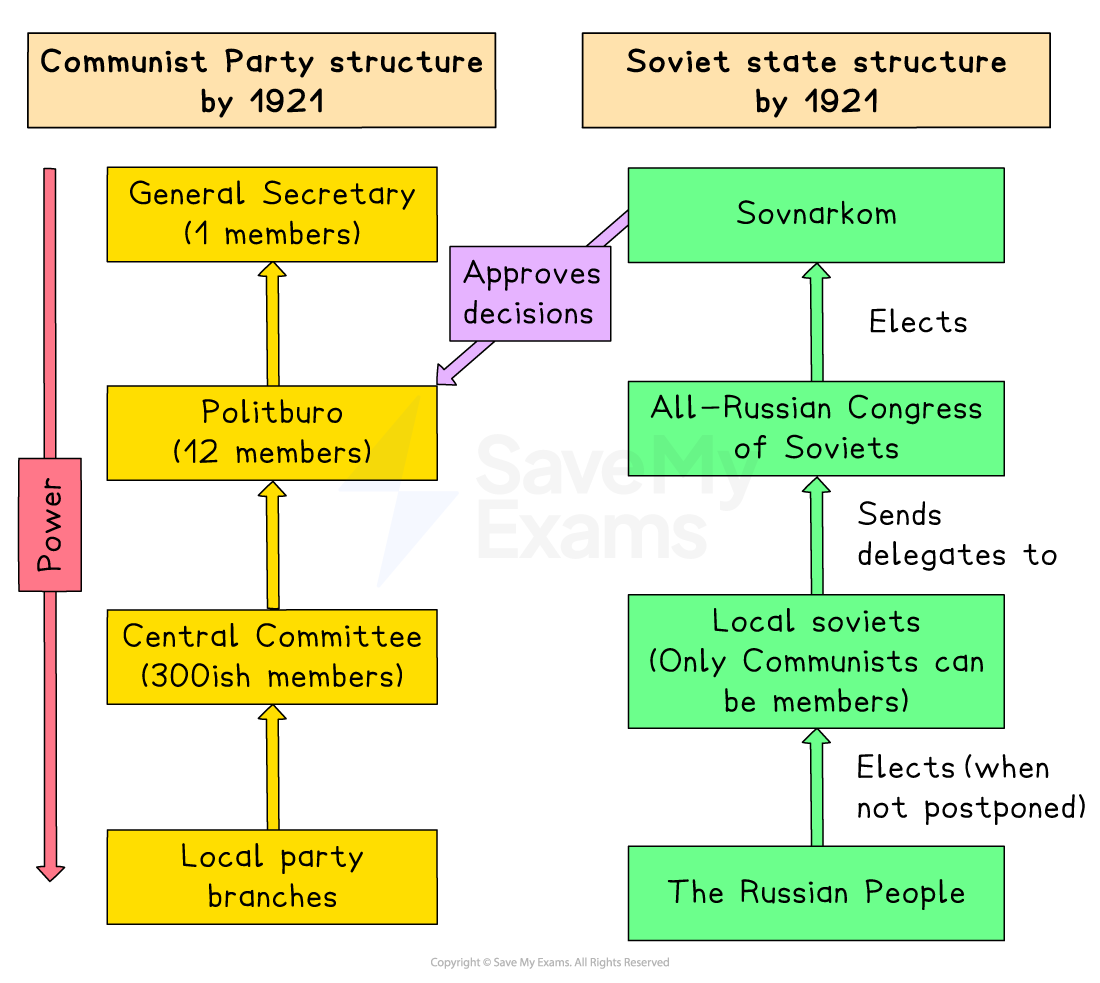
By 1921, the soviets lost power to the Communist Party
This caused a form of government known as the one-party state
Political authority became increasingly concentrated in the Politburo
This side-lined the larger Central Committee and Sovnarkom
Real power lay in the hands of a few senior leaders
Lenin became General Secretary of the Communist Party
Other senior members included Trotsky, Kamenev, Zinoviev, and Stalin
The principle of Democratic Centralism meant decisions, once made, could not be challenged
Examiner Tips and Tricks
Students often find the structure of the government quite complicated to understand.
Use this diagram to visualise how the two systems worked together, and how the Bolsheviks dominated both.
The use of terror under Lenin
Why did the Bolsheviks use terror?
Lenin believed violence was necessary to suppress counter-revolution and defend the revolution, especially during the Civil War
A number of events increased the use of violence by the Bolsheviks:
The assassination attempt on Lenin in August 1918
Aleksandr Antonov's peasant rebellion in 1921
A rebellion at Kronstadt naval base in 1921
The role of the Cheka
The Cheka, created in December 1917 under Felix Dzerzhinsky, became the main instrument of repression
It had powers of arrest, censorship, execution, and operated outside the courts
By 1922, the Cheka was reorganised into the GPU, marking the permanent embedding of political policing
The Red Terror (1918–21)
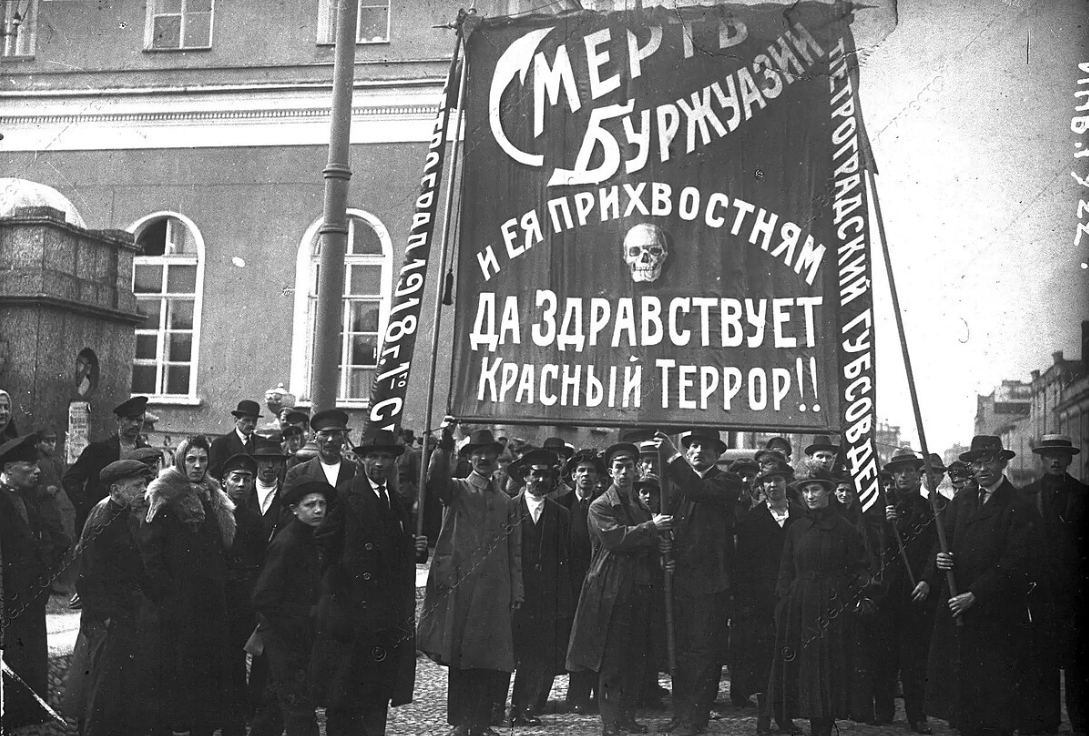
The Red Terror began in autumn 1918 as a campaign of mass arrests, executions, and hostage-taking against 'class enemies'
Targets included:
Former tsarist officials
Priests
Landowners
Rival political groups, such as the Mensheviks and the Socialist Revolutionaries
Tens of thousands were executed without trial
More people were sent to labour camps
In the countryside, grain requisitioning caused the Russian Famine of 1921-1922
This resulted in the death of millions of peasants
Significance of Terror
Terror became a normal feature of Soviet government, not just a temporary Civil War measure
It eliminated political opposition and enforced Bolshevik control
The methods of terror created under Lenin created the framework for Stalin’s later system of mass repression
The ban on factions
At the Tenth Party Congress (1921), Lenin introduced the ban on factions
This outlawed organised opposition groups within the Communist Party
If members created opposition groups, they could be expelled from the Party
While presented as temporary, the ban remained permanent
The ban on factions:
Strengthened Lenin's control over the Party
Created a culture where opposition, even within the Party, was equated with treason
The Soviet Constitution, 1924
The 1924 Constitution formally established the Union of Soviet Socialist Republics (USSR)
The concept of the Soviet Union was created in 1922
This was a federation of 'independent' republics, including Russia, Ukraine and Belarus
In reality, these republics were controlled by Russia
The All-Union Congress of Soviets was established as the highest authority
However, real power lay in the Central Executive Committee and the Politburo of the Communist Party
It confirmed that the USSR was a one-party state, with political power centralised under Bolshevik control in Moscow
How secure was Bolshevism by 1924?
The official line was that the Bolsheviks had defeated their enemies, centralised power, and built the structures of a one-party state
This suggests that their rule was secure
However, many historians note how Bolshevism relied heavily on repression, faced economic weakness, and was unsettled by Lenin’s ill health
Soviet perspective
Soviet historians argue that Bolshevik rule was secure by 1924
The Party had defeated its opponents
Lenin had laid down the foundation for socialism
Key Soviet historians
"The attempt to destroy the workers’ and peasants’ state and the gains of the October Revolution by military force ended in complete failure. This was hardly accidental. The Civil War left an indelible mark on the country’s history and in the memory of the Soviet people. It made millions of people aware of their strength and of the righteousness of their cause, the cause which they had fought for and had secured by their struggle." - Yuri Polyakov, The Civil War in Russia, its causes and significance (1981)
"Perhaps the idea of the mighty revolutionary organisation is central to Leninism, but his accomplishment was not merely that he created a party with a disciplined organisation, but that he was rapidly able to erect it into a state system. The party soon acquired a monopoly of power, of thought and of life itself. It became a Leninist order, in whose name its 'leaders' and their 'comrades-in-arms' were to rule the country for decades to come." - Dmitri Volkogonov, Lenin (2008)
Western perspective
Western historians believed that the Bolshevik government was fragile by 1924 because:
Economic problems remained severe
The regime relied heavily on repression, suggesting it lacked genuine popular support
Lenin’s ill health and eventual death in 1924 raised uncertainty about succession and the regime’s future
Key Western historians
"On 30 August 1918 Lenin was gravely wounded by two shots fired by a terrorist assassin called Fanny Kaplan whilst visiting a Moscow factory... It was 'proof' in the paranoic theory that the regime was surrounded by a well-connected ring of internal and external enemies; and that to survive it had to fight a constant civil war against them. The same logic would drive the Soviet terror for the next 35 years... It was under Lenin, not Stalin, that the Cheka grew into a vast police state within the state. By 1920, it employed more than a quarter of a million officials. Terror was an integral element of the Bolshevik regime from the start. Nobody will ever know the number of people repressed by the Cheka in these years, but it may have been as many of those killed in the battles of the civil war." - Orlando Figes, A People’s Tragedy (1996)
"Lenin's ideas on violence, dictatorship, terror, centralism, hierarchy, and leadership were integral to Stalin's thinking. Furthermore, Lenin had bequeathed the terroristic instrumentalities to his successor, the Cheka, the forced labour camps, the one-party state, the mono-ideological mass media, the legalised administrative arbitrariness, the prohibition of free and popular elections, the ban on internal party dissent... Lenin had practised mass terror in the Civil War and continued to demand its application, albeit on a much more restricted basis." - Robert Service, A History of Modern Russia from Nicholas II to Vladimir Putin (2005)
"From the first moment after his Bolshevik revolution in October 1917, Lenin and his comrades felt insecure. He thought that power could slip away at any time, which explains so much of the 74-year history of the Soviet state. Having achieved power illegitimately, Lenin’s only real concern for the rest of his life was keeping it – an obsession he passed down to his successors. Lenin launched the ‘Red Terror’ to destroy his opponents. He established the Cheka, which morphed into the NKVD and then the KGB, imitated wherever communist regimes came to power. He allowed a freely elected parliament to sit for just 12 hours before abolishing it – perhaps a record in brevity. There would not be another elected parliament in Russia for more than 70 years." - Victor Sebestyen, Vladimir Lenin and his lust for power (2021)

Unlock more, it's free!
Join the 100,000+ Students that ❤️ Save My Exams
the (exam) results speak for themselves:

Was this revision note helpful?