Stalin’s Power Over Party & State (Edexcel A Level History): Revision Note
Exam code: 9HI0

Summary
This note will examine how Stalin's power of the Party and the state changed during his rule
Stalin claimed to embody totalitarianism, with control over Party, state, economy, media, and society
The 1936 Constitution promised democracy but in practice reinforced the one-party state
During the Second World War, Stalin’s personal authority was strengthened as the USSR fought for survival
The years of High Stalinism (1945–53) marked the peak of repression, censorship, and propaganda
Historians debate whether Stalin truly achieved 'total' control or whether limits and resistance still existed
Stalin & totalitarianism
Stalin adopted a system often described as totalitarian
This is were the government tries to control every aspect of public and private life
Under Stalin, the Communist Party and the Soviet state became deeply intertwined
The Party made the key decisions through its leading bodies, such as the Politburo and the Central Committee
The state institutions, such as government ministries and the police were responsible for carrying out those decisions
In practice, the Party directed the state
Stalin, as head of the Party, controlled both
This fusion of Party and state was central to the totalitarian system:
There was no separation of powers
The same individuals often held positions in both Party and state
Stalin’s position as General Secretary gave him control over Party appointments
This ensured loyalty across government structures
The Soviet Constitution, 1936
The 1936 Constitution is sometimes called the “Stalin Constitution”
On the surface, it made the USSR the “most democratic country in the world”
It created a clear and democratic system of government
It promised universal suffrage, civil rights, and freedom of speech, press, and assembly
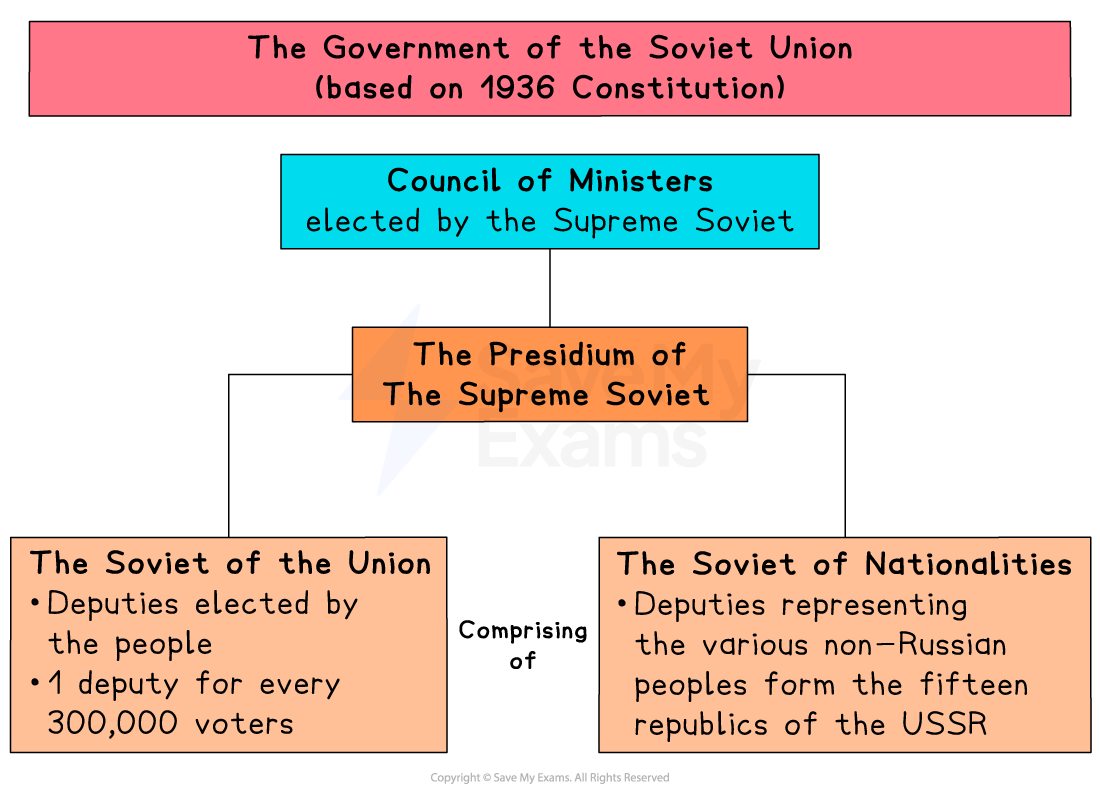
In practice, the 1936 Constitution reinforced one-party rule:
Only Communist candidates could stand for election
There was no rule of law in the Soviet Union
Therefore, the government did not have to obey the law
Rights existed only “in the interests of socialism"
Stalin's power in the Second World War
How did the USSR get involved in the Second World War?
In August 1939, Stalin signed the Nazi-Soviet Pact
This was a non-aggression treaty with Germany
When Germany invaded Poland in September 1939, the USSR occupied eastern Poland under the terms of the pact
In June 1941, Hitler launched Operation Barbarossa, a massive surprise invasion of Soviet territory
Stalin had ignored intelligence warnings of an imminent German attack
This left the USSR unprepared in the opening stages of war
The impact of the purges on Soviet war efforts
The purges of the late 1930s had devastated the Red Army’s leadership
Around 50% of the officer corps had been removed
This included skilled commanders like Marshal Tukhachevsky
As a result, the Red Army was initially poorly led and unprepared
This contributed to catastrophic defeats in 1941
Changes made to government during the war
Stalin chaired the State Defence Committee (GKO)
This became the supreme governing body, directing all aspects of the war effort
By 1942, it became more powerful than the Politburo
During the war, the state gained greater prominence in administration compared to the Communist Party
State Ministers, rather than Party members, made key decisions in the war
State Ministers were allowed to join the Politburo
Stalin stopped the purges
People worked more efficiently without the fear of state-sponsored violence
High Stalinism, 1945–1953
After the war, Stalin re-tightened his control in a period often called High Stalinism
Features of High-Stalinism include:
Intensification of censorship and propaganda
Renewed use of terror
Expansion of the GULAG
The Leningrad Affair (1949)
Leading officials in Leningrad were accused of building an independent power base after the war
The resulting purge caused:
The death of 100 officials
The arrest and dismissal of around 2,000 Party members
Historians speculate that Lavrentiy Beria, rather than Stalin, was behind the purge
Stalin had just celebrated his 70th birthday
Beria believed that Stalin would soon die and need a successor
Beria's biggest rival, Zhdanov, was the chief of the Leningrad Party
Beria may have encouraged Stalin to launch the purge after Zhdanov's death in 1949 to remove Zhdanov's supporters
It also demonstrated Stalin’s fear of local leaders gaining too much popularity
Testing loyalty: Molotov and his wife
Stalin often tested the loyalty of his closest colleagues, even those who had served him faithfully for decades
In 1949, Polina Zhemchuzhina, wife of Stalin’s ally Vyacheslav Molotov, was arrested and imprisoned on false charges
Molotov publicly denounced his own wife, proving his loyalty
This incident highlights the climate of fear, even at the highest levels of government
Examiner Tips and Tricks
Identifying patterns across time periods is an important skill in essays, as your answers and judgments can become more nuanced.
From this revision note, you should see a clear pattern of Stalin's use of power over the Party and the state.
Before the war, Stalin needed to have a lot of power over the Party and the state to consolidate his position.
During the war, this power was subdued in order to win the war.
He acknowledged that the right people needed to be in administrative positions to make the country operate.
After the war, when the external danger was defeated, Stalin and the Party reasserted their power over the state.
Stalin had elevated educated and competent people to government during the war.
This increased the chance of opposition, which needed to be eliminated.
How total was Stalin's control of the USSR by 1953?
Historians debate whether Stalin achieved genuine 'totalitarian' control or whether his authority had real limits
Stalin’s control was total
Some historians emphasise that Stalin had complete and ruthless control over the Soviet Union by 1953
Key historians
"The post-war years saw no return to the terror levels of the 1930s. But every year several tens of thousands - many of them Jews and other nationalities accused of siding with the West - were arrested. The Gulag population rose by at least 1 million in the five years after 1945. Stalin launched a new purge of the army and the Party leadership. His first priority was to cut down the top army leaders, who enjoyed enormous popular authority as a result of the victory of 1945 and, in the case of Marshal Zhukov, had become the focus of the people's hopes for reform. On Stalin's orders, Zhukov was demoted to commander of the Odessa Military District. He was written out of Soviet accounts of the Great Patriotic War which portrayed Stalin as the sole architect of victory." - Orlando Figes, A People’s Tragedy (1996)
"[Stalin] was far too suspicious of his associates and the country's elites to provide them with the entirely stable circumstances they would have alleviated the strains in politics, the economy, and society. His health deteriorated after the Second World War... but he could intervene whenever he wanted in any public deliberations. If an open debate took place on any big topic, it was because he had given permission. If a problem developed without reaction by central government and party authorities, it was either because Stalin did not think it very important or did not it amenable to a solution. He remained the dictator." - Robert Service, A History of Modern Russia from Nicholas II to Vladimir Putin (2005)
"When Stalin died on 5 March 1953, his successors appealed against ‘"panic and disarray." But their qualms were unnecessary. Although the single will of the creator of the new State had now gone, the machinery he had created remained in existence. And aspirations among the citizenry toward a different order of things had no possible means of expression and organization." - Robert Conquest, The Great Terror: A Reassessment (1990)
Limits to Stalin’s power
Other historians emphasis the political enemies that Stalin had and ordinary people resisted or manipulated the system
Key historians
"But it was true that Stalin was aging. He seems to have had a heart attack in the latter half of 1945. For the sake of his health, he now spent many months of the year in the south, and even when in Moscow his daily workload – hitherto phenomenal dropped sharply. His interventions in policy debates became more sporadic, though no less disruptive when they occurred, and his Politburo comrades were generally left to run their own shops (heavy industry, agriculture, trade and so on) with minimal interference. There were no more mass purges of the political elite... But there is no avoiding the conclusion that a consensus on the need for wide-reaching change ‘when the time comes’ had quietly developed among Stalin’s associates." - Sheila Fitzpatrick, The Shortest History of the Soviet Union (2021)
"In public, they proclaimed their devotion. In private, they grumbled and complained. They learned how to 'speak Bolshevik', according to Stephen Kotkin, yet were also able to remain sceptical, and to express resentment at the hardship of life, or the privileges enjoyed by the new elite. They participated and worked for a variety of motivations too. Self-interest, patriotism, fear, self-preservation, and belief in the cause. They pulled together in desperate times. For most people, it was a question of survival and muddling through. Stalinism became an everyday way of life, and people adapted to it and tried to make it work. In this sense, people in the USSR were similar to people struggling to live, work, and raise their children elsewhere." - Dr Mark Sandle, Who Supported Stalin? (2013)

Unlock more, it's free!
Join the 100,000+ Students that ❤️ Save My Exams
the (exam) results speak for themselves:

Was this revision note helpful?