The Communist Revolution, October 1917 (Edexcel A Level History): Revision Note
Exam code: 9HI0

Summary
This note will examine why there was a revolution in Russia
Russia was weakened by long-term problems and the pressures of the First World War
The Provisional Government failed to make decisions on key issues, such as food, land, and war
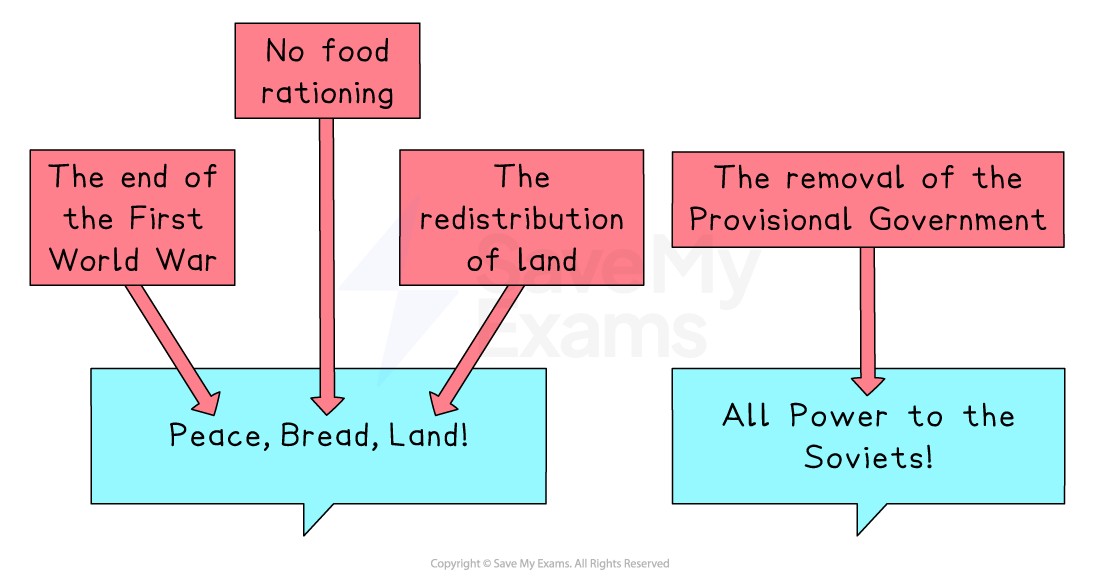
Lenin and the Bolsheviks offered simple promises to the people, such as “Peace, Land, Bread”
Lenin wanted an immediate revolution, despite this going against Marxist principles and the opinion of Party members
In October 1917, the Bolsheviks, led by Lenin and Trotsky, seized Petrograd and overthrew the Provisional Government
Historians debate whether the Communist Revolution was a genuine revolution or a coup
Soviet accounts stress the mass support of the people
However, Western historians often see it as a carefully timed power grab by the Bolsheviks
Why was there a revolution in Russia?
Long-term causes
Geographical reasons
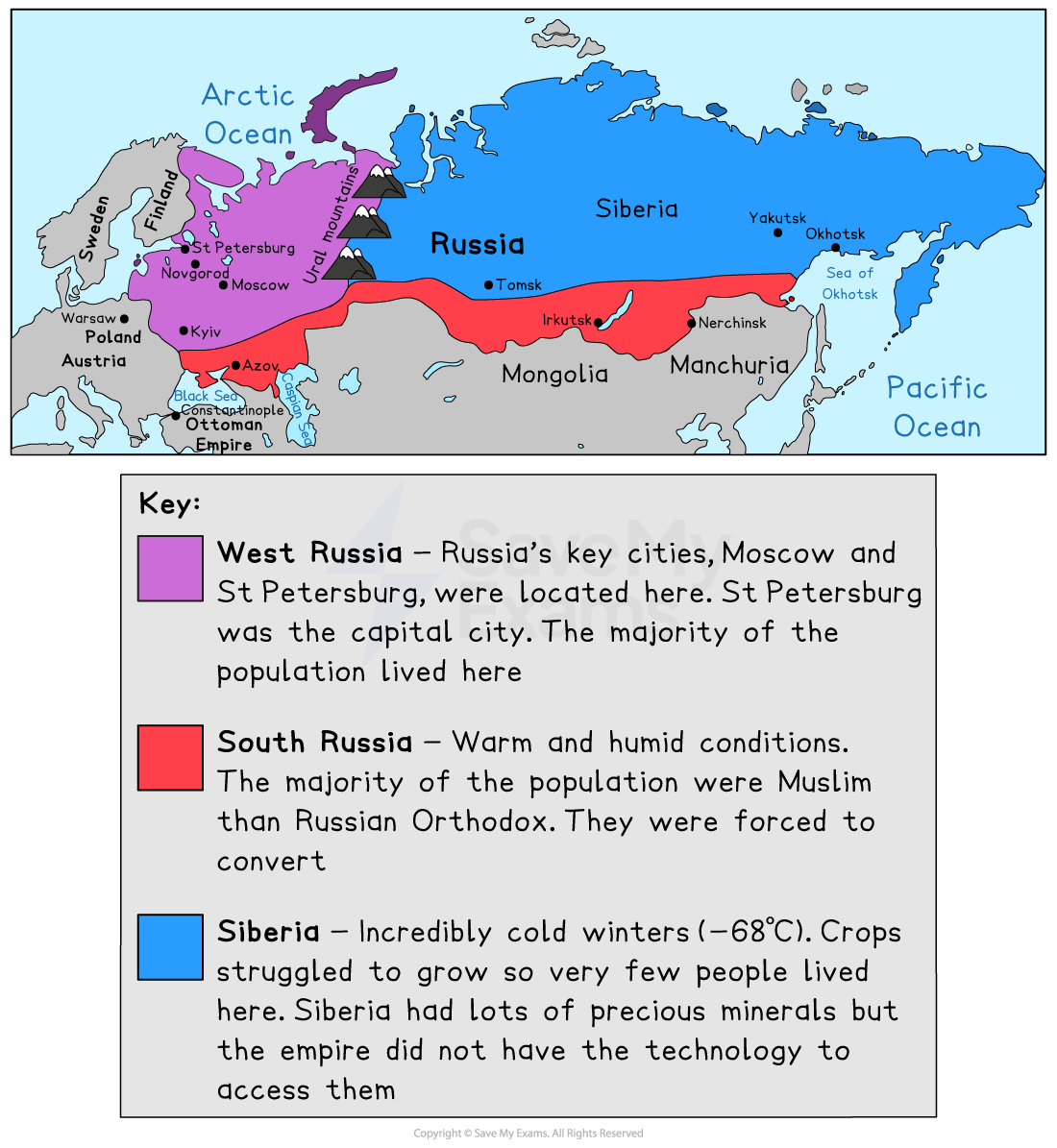
The Russian Empire was large
It was nearly 5,000 kilometres wide
It spanned Europe and Asia
Standards of living varied significantly across the empire
There were around 200 nationalities living in the Russian Empire, with widely different religions and customs
Political reasons
The political system in Russia had experienced very little change for centuries
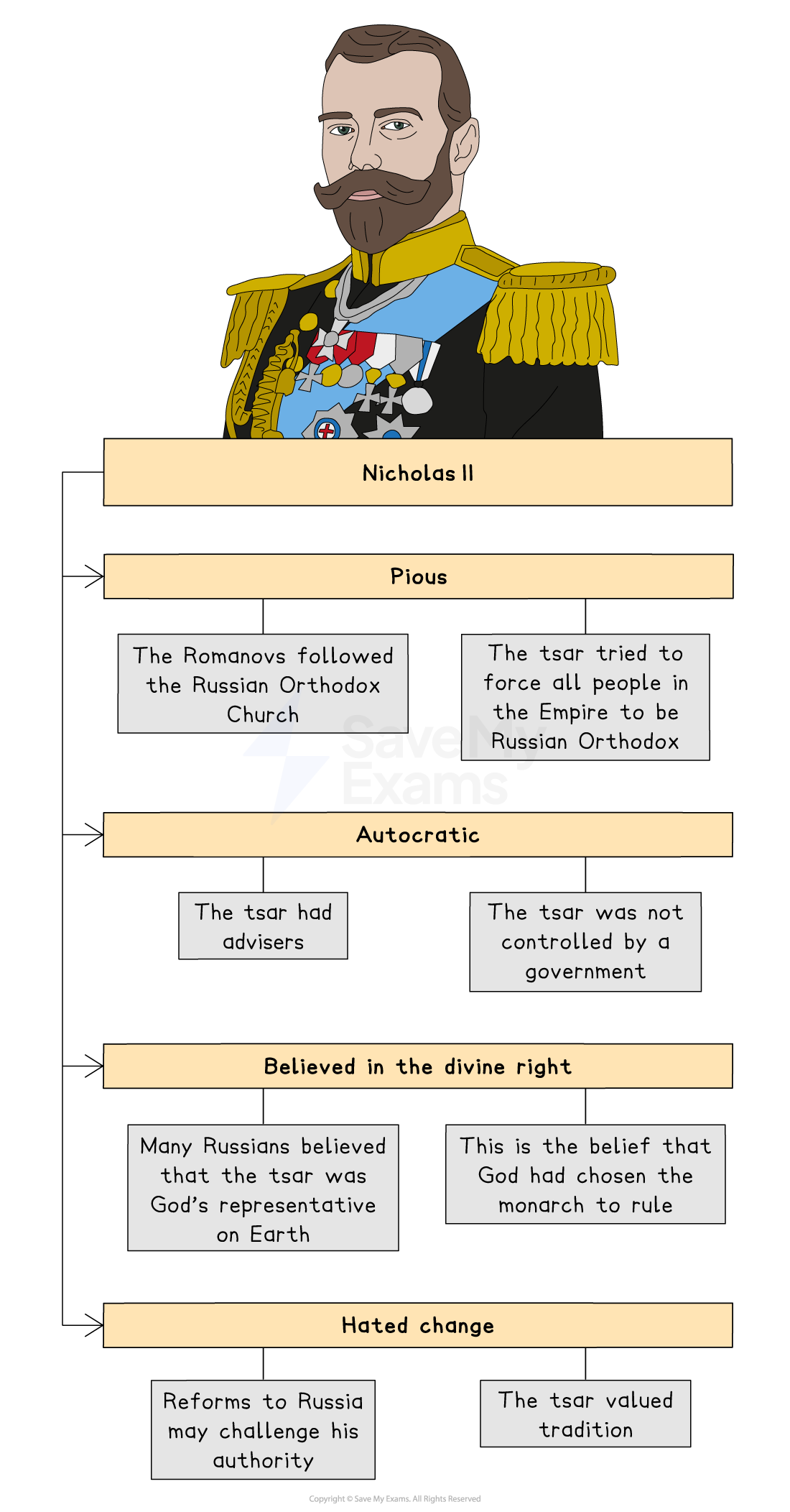
The Tsar was an autocratic monarch
He did not have to listen to his advisers
He believed he was chosen by God to rule
The Duma created in 1905 had minimal authority after being deliberately weakened
The tsar could ignore the Duma's advice
It was down to the tsar when the Duma ended
Voting laws meant that the Duma only contained people loyal to the tsar
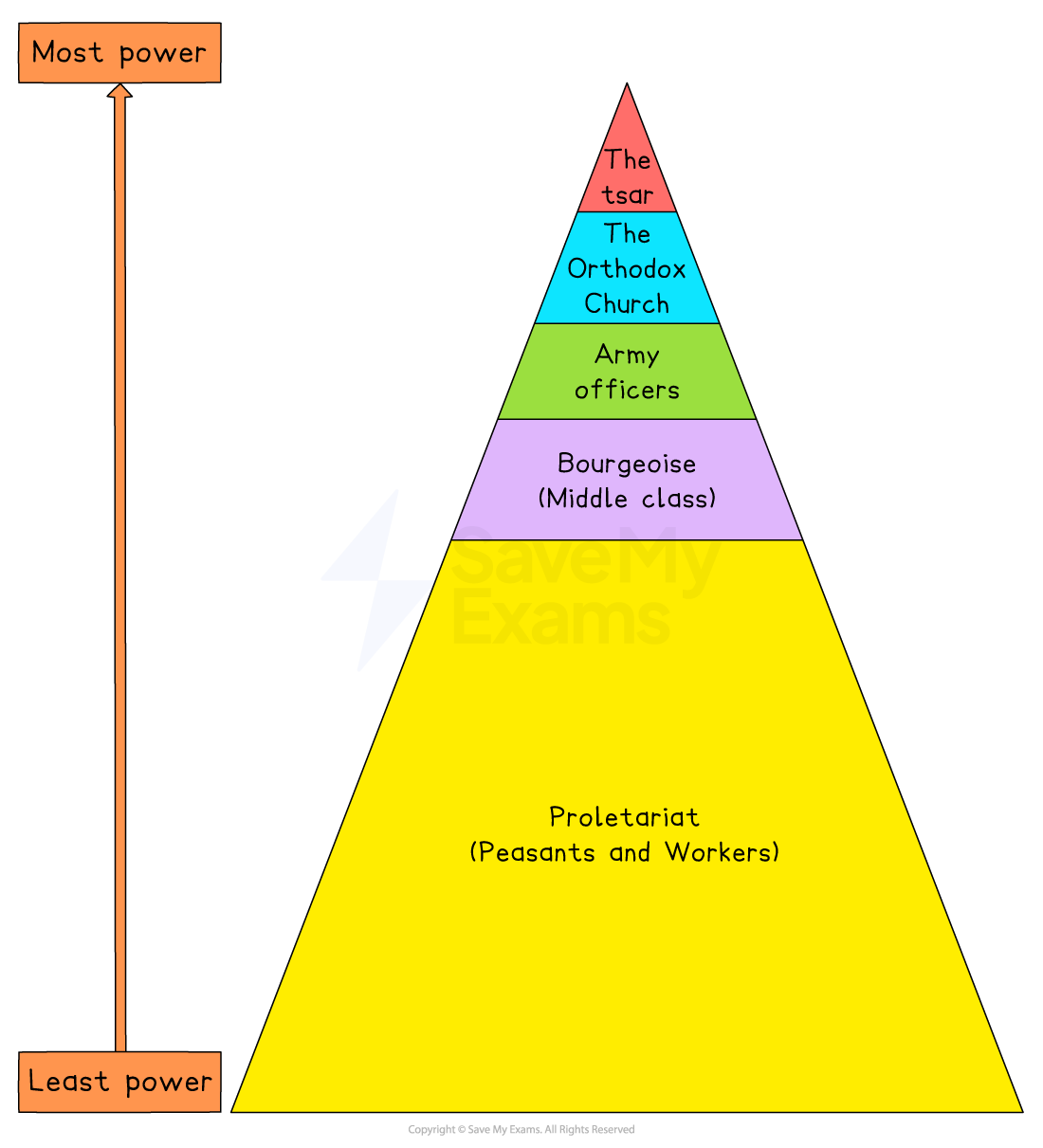
The tsar held all of the power, whilst peasants and workers had little to no power
Social and economic reasons
Historians describe Russia in 1917 as a backward country
Most Russians lived in villages or mirs
Around 87% of Russia’s population lived in the countryside
Peasant farmers worked in agriculture using traditional tools and methods
Land passed down through generations by inheritance
Land was split up so small that modern techniques or equipment could not be used to farm efficiently
Peasants remained dissatisfied
The 1861 Emancipation Edict had given peasants their legal freedom
However, many peasants:
Did not have enough food or money to survive
Were illiterate
Faced redemption payments and limited access to land
Life for industrial workers was no better. They:
Lived in overcrowded housing
Worked long hours for low wages
Had limited workers' rights
Faced unsafe living and working conditions
Short-term causes
Tsar Nicholas II
Nicholas became tsar in 1894
Nicholas had many beliefs of what a tsar should be
However, Nicholas was a weak ruler who could not live up to previous tsars
Nicholas damaged his authority by taking command of the army in 1915. This caused:
Nicholas to be personally responsible for the success or weakness of the army
His wife, Tsarina Alexandra, and her religious healer, Rasputin to take control of the government
Rasputin was a controversial figure hated by the public
Alexandra and Rasputin were not effective in government
The First World War
By 1917:
Millions of Russian soldiers had been killed or wounded
Thousands of Russian soldiers, who were mostly untrained peasants, had deserted the army
Inflation was spiralling and taxes on products like vodka were unpopular
Food shortages were severe in towns and the countryside
The weakness of the Provisional Government
Tsar Nicholas II was forced to abdicate in February/March 1917
Officials from the Petrograd Soviet and the Provisional Government ruled together in a system called dual power
However, the Provisional Government was unpopular because:
It delayed making quick political decisions, insisting on an election
The people became impatient, wanting resolutions to issues such as land and food
It refused to end Russia's involvement in the First World War
Examiner Tips and Tricks
In 1917, Russia still used the Julian calendar, which was 13 days behind the Gregorian calendar, used in most of Western Europe. Therefore, the February Revolution actually happened in March by Western dates.
In an exam, it is most common to use the February Revolution. This point is also relevant to the October Revolution.
The Bolsheviks
The Bolsheviks were an extremist political party who had been suppressed during Tsarism and the Provisional Government
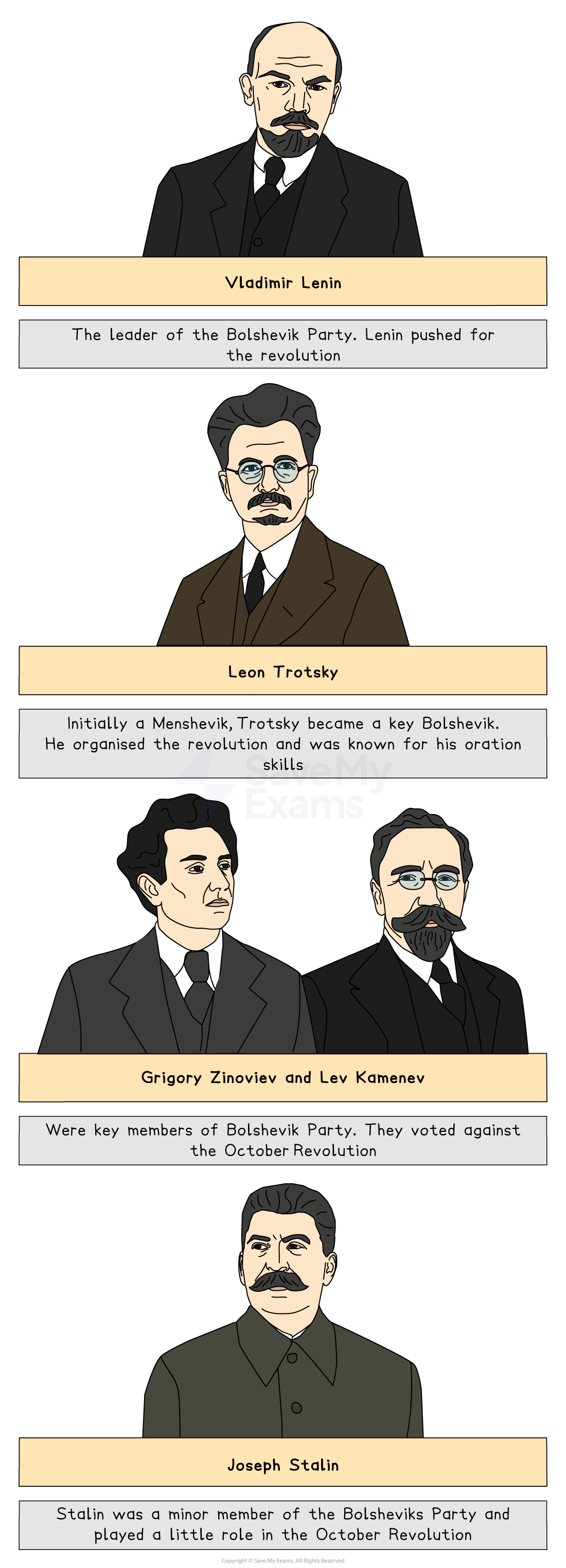
Its leader, Vladimir Lenin, believed October 1917 was the perfect time for a revolution in Russia
However, many leading Bolsheviks, including Zinoviev and Kamenev, opposed a violent uprising
They preferred to wait for elections
Lenin ignored their concerns
He tasked Leon Trotsky to plan the revolution
How did the Bolsheviks seize power?
Lenin and the April Theses
In April, Lenin returned to Russia
Germany funded his journey
They believed that Lenin's presence in Russia would force Russia to surrender in the First World War
Lenin travelled on the 'sealed train'
This means that Lenin travelled through countries without passport checks
When Lenin returned to Petrograd, he made a speech called the 'April Theses'
Trotsky and the Petrograd Soviet
In September 1917, Trotsky became chairman of the Petrograd Soviet
This showed an increase in support for the Bolsheviks
In October, Trotsky organised the Military Revolutionary Committee (MRC)
This brought the Red Guards, soldiers, and sailors from Kronstadt under Bolshevik control
Events of the Bolshevik seizure of power
On 24–25 October 1917, Bolshevik forces took control of strategic locations in Petrograd, including:
Railway stations
Telegraph offices
Bridges
The Winter Palace, the official base of the Provisional Government, was stormed on the night of 25 October
Defended only by a small group of cadets and the Women’s Battalion, it fell with minimal resistance
Prime Minister Kerensky fled Petrograd
The Bolsheviks announced that power had been transferred to the soviets
Lenin's ideology
Marxism
Karl Marx was a German philosopher
He and Friedrich Engels developed the theory of communism through:
The Communist Manifesto (1848)
The political and social viewpoint of communism
Das Kapital (1867)
The economic viewpoint of communism
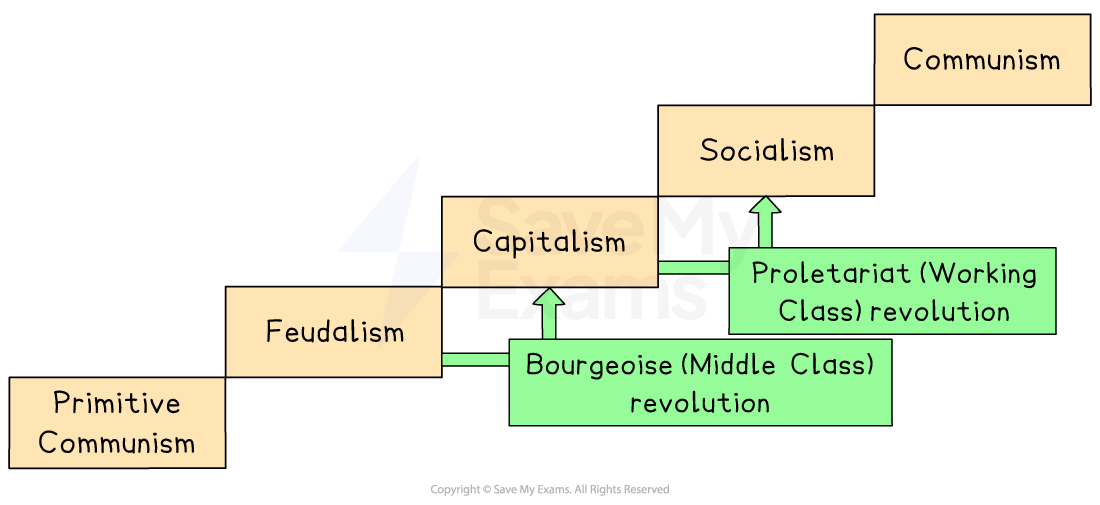
Marxism believed that all countries moved through five ‘stages of history’
Examiner Tips and Tricks
Don’t confuse communism with socialism. They share similar features and are both leftist beliefs. However, socialism has established classes, permits belief in religion and allows individuals to own their own property. True communism has no government, no religion and no classes.
How was Lenin influenced by Marxism?
Lenin believed that:
The First World War was the perfect opportunity to overthrow capitalism in Russia
Revolution in Russia would trigger a global communist revolution
This is despite Marx believing that true communism took hundreds of years to achieve
Lenin's beliefs are called Marxist-Leninist
Should the Bolshevik takeover be called a 'revolution' or a coup?
Historians have debated whether the Communist Revolution should be classed as a revolution
Revolutions require mass support
Coups are armed seizures of power by a small group of people, usually without popular support
Soviet perspective
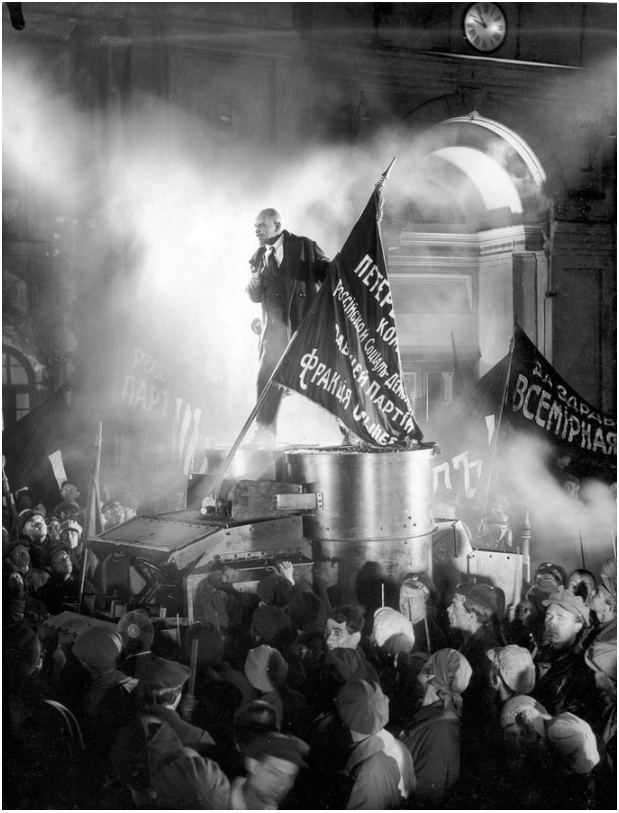
Under the USSR, Soviet historians portrayed the events of October 1917 as a genuine mass revolution, representing the will of workers, peasants, and soldiers
Their opinion was based on Soviet propaganda films, such as Sergei Eisenstein's October (1928)
Censorship meant that they had to express the opinions of the Soviet government
Key Soviet historians
“In his guidance of the uprising, Lenin’s genius as a leader of the masses, a wise and fearless strategist, who clearly saw what direction the revolution would take, was strikingly revealed.” - G.D. Obichkin, V. I. Lenin: A Short Biography (1968)
"Lenin chose a suitable time for it when the forces of the enemy were demoralised and the ranks of the insurgents were inspired by confidence in victory. That explains why this insurrection, in which huge masses of people participated, triumphed in a single day and involved virtually no bloodshed." - B.N. Ponomarev, A Short History of the Communist Party of the Soviet Union (1970)
Western perspective
Western historians argue that the Bolshevik Revolution was a coup, lacking real popular support
Many historians also highlight the opportunistic nature of the Bolsheviks to exploit the weakness of the Provisional Government
Key Western historians
"It was almost a bloodless coup, enabling Lenin to set up a new soviet government with himself in charge. The coup had been successful because Lenin had judged to perfection the moment of maximum hostility towards the Kerensky government, and the Bolsheviks, who knew exactly what they wanted, were well disciplined and organised, whereas all other political groups were in disarray." - Norman Lowe, Mastering Modern World History (1982)
"October was a classic coup d'état, the capture of governmental authority by a small band...with a show of mass participation, but with hardly any mass involvement.” - Richard Pipes, The Russian Revolution (1990)
"The Great October Socialist Revolution, as it came to be called in Soviet mythology, was in reality such a small-scale event, being in effect no more than a military coup, that it passed unnoticed by the vast majority of the inhabitants of Petrograd. Theatres, restaurants and tram cars functioned much as normal while the Bolsheviks came to power." - Orlando Figes, A People’s Tragedy (1996)
Examiner Tips and Tricks
The Edexcel A Level Russia, 1917–91: from Lenin to Yeltsin exam does not require you to use historians' interpretations in this section of the course.
However, to achieve top grades at A Level History, it is recommended that you do wider reading. Read extracts from historians to understand the key areas of debate around topics covered in the course. This will help you to form your own opinions, ready to answer essay questions in the exam.

Unlock more, it's free!
Join the 100,000+ Students that ❤️ Save My Exams
the (exam) results speak for themselves:

Was this revision note helpful?