The Creation of a One-Party State (Edexcel A Level History): Revision Note
Exam code: 9HI0

Timeline & Summary
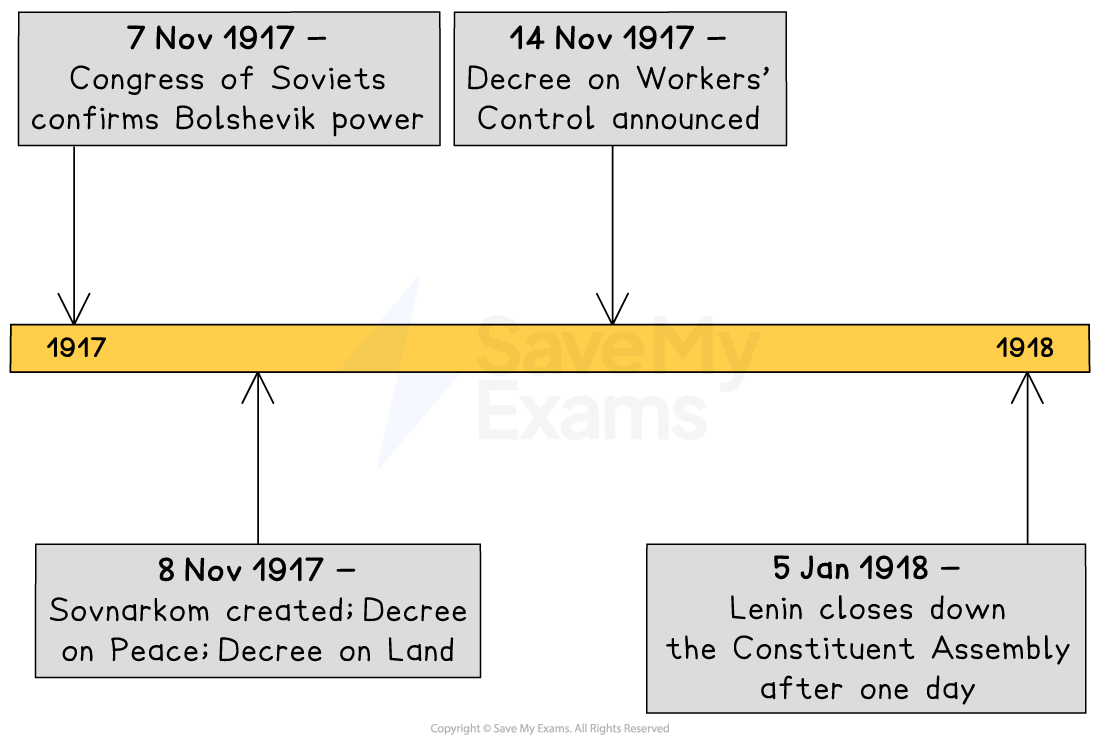
This note will examine how Lenin created a one-party state after the Communist Revolution
After October 1917, the Bolsheviks created new governing bodies: the All-Russian Congress of Soviets and the Sovnarkom
Lenin’s early decrees gave the Bolsheviks immediate popularity
The Constituent Assembly was shut down when it threatened Bolshevik power
This marked the start of a one-party system, justified as a "dictatorship of the proletariat"
Historians debate whether this was genuine socialism or just authoritarianism
The All-Russian Congress of Soviets
The All-Russian Congress of Soviets met in June 1917
Local soviets sent representatives to the meeting
The Congress discussed the future of Russia
The Second All-Russian Congress of Soviets met after the Bolshevik seizure of power
Lenin claimed that the Bolsheviks had seized power on behalf of the soviets
This gave the revolution a democratic appearance
The Mensheviks and Socialist Revolutionaries walked out in protest
Tsereteli (the Mensheviks leader) stated that the Bolshevik government would not last three weeks
Get out of here to where you belong – in the dustbin of history - Trotsky after the Mensheviks and SRs walked out of the Second All Russian Congress of Soviets
The Congress was not a permanent system of government as it was too big to meet regularly
This led to the creation of the Sovnarkom
The Sovnarkom
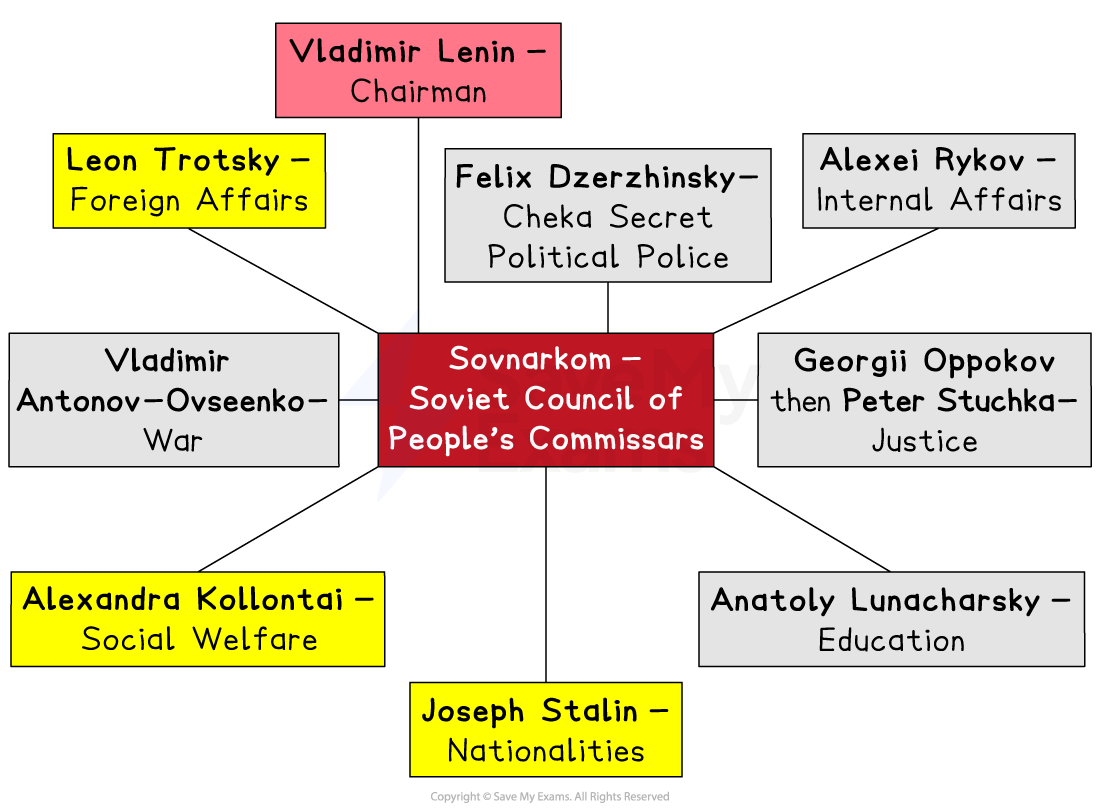
The Bolsheviks established the Sovnarkom (Council of People’s Commissars) to act as the executive government after October 1917
13 People's Commissars made up the first Sovnarkom
Examiner Tips and Tricks
You do not need to know or remember each member of the Sovnarkom. However, it is important to note:
The roles of Stalin and Trotsky, showing their importance to the Party
The inclusion of a female politician within the central government
On the surface, this shows how progressive the Bolsheviks were
The Sovnarkom gave the Bolsheviks direct control of policy and law-making
The Sovnarkom was supposed to answer to the Congress of Soviets
In reality, Lenin bypassed the Congress and ruled through Sovnarkom decrees
Lenin's first decrees
Lenin issued several decrees in his first few months in power
The Congress of Soviets approved the degrees
October 1917
Decree on Peace called for an immediate armistice to end Russia’s involvement in the First World War
Decree on Land gave peasants the right to seize land from nobles and the Church
November 1917
Decree on Workers’ Control allowed workers to supervise management in factories
Workers' Decrees set an eight-hour working day and a minimum wage
Impact of the decrees
Positive impacts
The decrees were popular with workers, peasants, and soldiers
They seemed to deliver the Bolsheviks’ promises quickly
Ending Russia's involvement in the First World War allowed Lenin to:
Rebuild the economy
Establish a new government
Negative impacts
The Bolsheviks only held power in Petrograd
The majority of Russia's territory had not heard about the revolution or was not under Lenin's control
The Bolsheviks had little ability to enforce them across Russia in late 1917
The Constituent Assembly
Elections for a Constituent Assembly were held in November 1917
The Socialist Revolutionaries won around 370 seats
The Bolsheviks only gained 175 seats
When the Assembly met in January 1918, it rejected Bolshevik proposals
Lenin ordered Red Guards to close it down after one day
Lenin argued that the Assembly was unrepresentative of the people’s will and that the Soviets were a higher form of democracy
The closing of the Constituent Assembly demonstrated that the Bolsheviks would not share power
It confirmed the beginning of one-party rule
Examiner Tips and Tricks
Many students get confused between the Sovnarkom and the Constituent Assembly. The Sovnarkom was created by Lenin as his inner cabinet. The Constituent Assembly was democratically elected by the people.
Was the 'dictatorship of the proletariat' a step towards communism?
Lenin justified one-party rule as the “dictatorship of the proletariat”
Karl Marx stated that this was an important transition phase from capitalism to communism
Lenin argued that a temporary dictatorship was necessary to destroy capitalism and protect the revolution
In practice, Lenin's actions meant centralised Bolshevik control
Soviet perspective
Soviet historians argued that Lenin’s actions were a necessary stage on the road to communism, defending the working class against counter-revolution
Key Soviet historians
"The working people of the Soviet Republic were confronted with far- reaching, complicated and difficult tasks: they had to defend the gains of the Revolution and utilise the dictatorship of the proletariat in order to achieve complete victory over the exploiting classes and carry out socialist changes. Soviet power triumphed both at the centre and in the localities. The working people of Russia and the rest of the world saw for themselves that Soviet power expressed the basic interests of the masses. ” The central committee of the Communist Party of the Soviet Union, 50th Anniversary of the Great October Socialist Revolution (1967)
"The single-party system became for the Bolsheviks an inescapable necessity. Their own survival, and no doubt the survival of the revolution, depended on it. They had not aimed at it with any premeditation. They established it with misgivings as a temporary expedient. The single-party system went against the inclinations, the logic and the ideas of Lenin, Trotsky, Kamenev, Bukharin, Lunacharsky, Rykov and so many others." - Isaac Deutscher, The Unfinished Revolution: Russia 1917-1967 (1967)
Western perspective
Most Western historians view the dictatorship as the start of Bolshevik authoritarianism
They argue Lenin’s actions undermined democracy and set Russia on the path towards totalitarianism
Key Western historians
"The Bolsheviks had found out by experience what they meant by ‘dictatorship of the proletariat’. It was not a collective class dictatorship exercised by workers... It was a dictatorship run by full-time ‘cadres’ or bosses." - Sheila Fitzpatrick, The Russian Revolution (1982)
"The pressures from below, to which they attributed Communist actions during and after October, will be revealed for what they were, fictions invented to justify arbitrary deeds of leaders concerned above all with staying in power." - Richard Pipes, Seventy-Five Years on: The Great October Revolution as a clandestine coup d’etat (1992)
"Although the seizure of power had been carried out in the name of the Soviet Congress, Lenin had no intention of ruling through the Congress, or its permanent executive, where the Left SRs, the Anarchists and a small group of Menshevik Internationalists acted as a parliamentary brake on Sovnarkom. On 4 November Sovnarkom decreed itself the right to pass legislation without approval from the Soviet - a clear breach of the principle of Soviet Power." - Orlando Figes, A People’s Tragedy (1996)
"The soviet order was extremely disorderly for a great deal of the time. Yet the movement towards a centralised, ideocratic dictatorship of a single party had been started. Neither Lenin nor his leading comrades had expressly intended this; they had few clearly elaborated policies and were forever fumbling and improvising. Constantly they found international, political, economic, social and cultural difficulties less tractable than they assumed. And constantly they dipped into their rag-bag of authoritarian concepts to help them survive in power… and they felt that the ruthless measures were being applied in the service of a supreme good." - Robert Service, A History of Modern Russia from Nicholas II to Vladimir Putin (2005)

Unlock more, it's free!
Join the 100,000+ Students that ❤️ Save My Exams
the (exam) results speak for themselves:

Was this revision note helpful?