The Russian Civil War (Edexcel A Level History): Revision Note
Exam code: 9HI0

Summary
The Civil War of 1918 to 1921 broke out between the Bolsheviks (Reds) and their enemies (Whites)
Causes included opposition to Bolshevik rule, foreign intervention, and economic crisis
Key events saw the Red Army, led by Trotsky, defeat divided White forces
The war strengthened Bolshevik power but at the cost of repression and centralisation
Historians debate whether the Russian Civil War explains the rise of a one-party dictatorship or whether Bolshevism was already authoritarian by design
Causes of the Russian Civil War
The Treaty of Brest-Litovsk (March 1918) angered many Russians
Many people wanted the war to end but this treaty gave huge areas of land to Germany, fuelling opposition to Bolshevik rule
Foreign powers such as Britain, France, Japan, and the USA were willing to stop Bolshevism
They wanted to reopen the Eastern Front against Germany
The Whites opposed Bolshevik policies. They were made up of several groups:
Senior soldiers in the Russian Army who wanted to restore tsarism
The Socialist Revolutionaries (SR) and Mensheviks who wanted more democracy
Anarchists who did not want a government at all
Nationalist groups who wanted independence from Russian rule
Economic collapse, food shortages, and class tensions gave rise to peasant uprisings and resistance to Bolshevik rule
Events of the Russian Civil War
Fighting began in January 1918 after Lenin dissolved the Constituent Assembly
It became a full-scale war by the summer of 1918
The White Army fought the war across multiple fronts:
Admiral Kolchak commanded the White forces in Siberia
General Denikin and later Wrangel had soldiers in the South
General Yudenich's White army in the North-West of Russia, with support from Britain and France
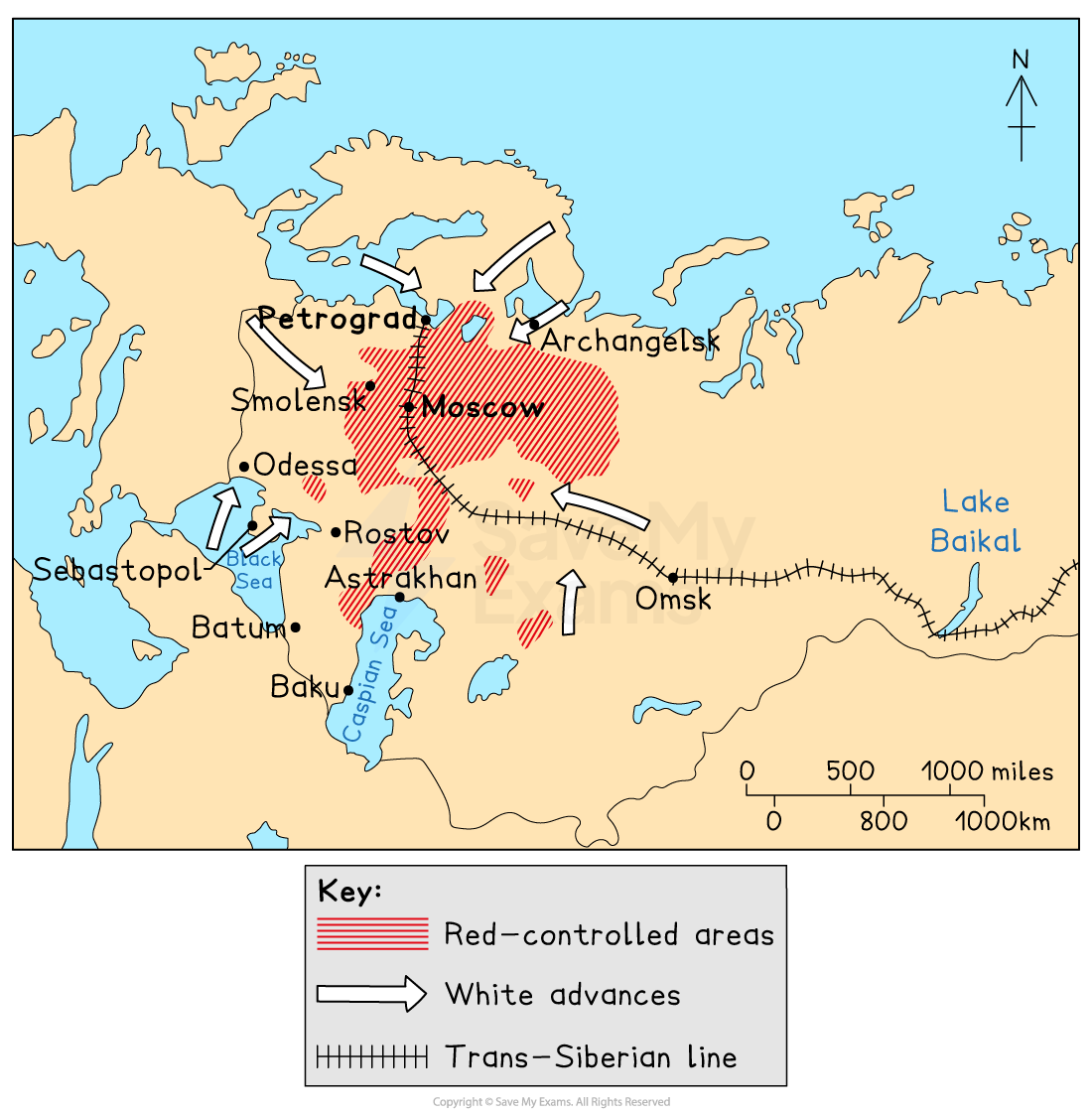
Early conflict (1918)
In January 1918, General Kornilov led an anti-Bolshevik army
The SRs and liberals created a government in Omsk, Siberia
Admiral Kolchak led White forces in Siberia, while General Denikin advanced from the south
Trotsky organised the Red Army. He
Introduced conscription
Trotsky quickly raised an army of 300,000 men
Ensured strict discipline within the army
He reinstated the death penalty for desertion or disloyalty to the Red Army
Hired political commissars to ensure loyalty
Mid conflict (1919)
The Whites gain a huge amount of territory by June 1919
However, by the end of 1919, the Red Army turned the tide of the war:
Kolchak’s forces advanced westwards but were pushed back by the Reds
Denikin launched a major attack from the south, threatening Moscow, the new capital city of Russia
However, Denekin was forced into retreat
General Yudenich led an offensive against Petrograd from the north-west but was defeated by Red Army defenders
End of the conflict (1920–21)
Wrangel replaced Denikin in the south but was defeated in Crimea in 1920
Nationalist uprisings, such as those in Ukraine, were suppressed
By 1921, the Red Army gained a decisive victory over the Whites
Why did the Reds win?
Weaknesses of the Whites
The various groups under the White Army fought separately from each other
In major attacks, the White Army did not have enough troops in reserve
This allowed Trotsky to defeat each army one by one
The White Army did not have a base
This made coordination between divisions difficult
The members of the White Army did not have the same aim
The monarchists disagreed with the SRs and Mensheviks who did not want the return of the tsar
A hatred of Bolsheviks was not enough to unify these groups
Some generals treated their soldiers badly
This encouraged troops to defect to the Bolsheviks
Strengths of the Reds
The Red Army held significant areas of Western Russia
Moscow and Petrograd were key industrial centres
The Bolsheviks used this to gain troops and resources
The Bolsheviks controlled access to the Trans-Siberian railway
This allowed easy movement of troops and equipment across Russia
Trotsky provided strong leadership and kept the Red Army disciplined and united
Political impacts of the Russian Civil War
Several key aspects of Bolshevik government developed in the Civil War:
Lenin increasingly centralised the government
The economy came under War Communism, which meant nationalisation of industry, grain requisitioning from peasants, and strict rationing
All policies were passed through the Politburo, rather than the soviets
The Bolsheviks created the Cheka, which carried out the Red Terror
This suppressed any opposition
The Bolsheviks increasingly portrayed themselves as the only defenders of the revolution, justifying a one-party dictatorship
How important was the Russian Civil War to the success of Bolshevism?
Lenin justified repression and centralisation as necessary to win the Civil War, strengthening Bolshevik power
The war provided an excuse for one-party rule, but some argue this path was already visible before 1918
Soviet perspective
Soviet historians presented the Civil War as a heroic struggle in which the Bolsheviks defended the revolution against counter-revolution and foreign invasion
Key Soviet historians
"It was among other things a flagrant violation of Russia’s sovereignty, an act of brazen interference in its domestic affairs, a striking example of the “export of counter-revolution”. Foreign intervention caused enormous loss of life and great damage... The outcome of the Civil War was, nevertheless, highly instructive. Despite everything, the young Soviet Republic emerged victorious against the combined forces of the domestic counter-revolution and world reaction." - Yuri Polyakov, The Civil War in Russia, its causes and significance (1981)
Western perspective
Many Western historians see the Civil War as the turning point that consolidated the Bolsheviks' authoritarian style of rule
Key Western historians
"From the Civil War the Bolsheviks inherited their cult of sacrifice; their military style of government, with its constant 'battles' and 'campaigns' on 'fronts'; their insistence on the need to struggle permanently against the revolution's enemies, foreign and internal, which they saw everywhere; their mistrust of the peasants; and their prototype of the planned economy with its militarization of labour and utopian vision of the state as the maker of a new society." - Orlando Figes, Revolutionary Russia, 1891-1991 (2014)
"The way that the October Revolution had occurred made a civil war virtually certain. This in turn meant that once the civil war was over, the party state was unlikely to be dismantled by the Russian Communist Party. The party-state was at the core of the Soviet compound. Without the party-state, it would not be long before all the other elements in the compound underwent dissolution." - Robert Service,
A History of Modern Russia from Nicholas II to Vladimir Putin (2005)
"On the domestic front, the Civil War proved to be one of the great formative influences on the Bolshevik Party (renamed the Communist Party in 1919). Their attempt at government took place during a period of conflict in which their very survival was at stake. The development of the party and the government has to be set against this background. The revolution had been born in war and the government had been formed in war." -Michael Lynch, Reaction and Revolution: Russia 1894-1924 Third Edition (2005)

Unlock more, it's free!
Join the 100,000+ Students that ❤️ Save My Exams
the (exam) results speak for themselves:

Was this revision note helpful?