Soviet Attacks on Religion (Edexcel A Level History): Revision Note
Exam code: 9HI0

Summary
This note will examine the relationship between religion and the Soviet state
Communism was an atheist ideology
The Bolsheviks saw religion as a rival belief system that had to be controlled or removed
Every Soviet leader attacked religion, but the intensity of persecution varied
Stalin used religion during the war to unite the country, Khrushchev renewed attacks, and Brezhnev relied more on control than destruction
Historians debate whether attacking religion strengthened Soviet power or created more problems in the long-term
Communism & religion
Marx called religion the “opium of the people”
He believed religion kept workers passive and distracted from class struggle
However, communism viewed all people as equal, regardless of their beliefs
Why was religion important in the Russian Empire?
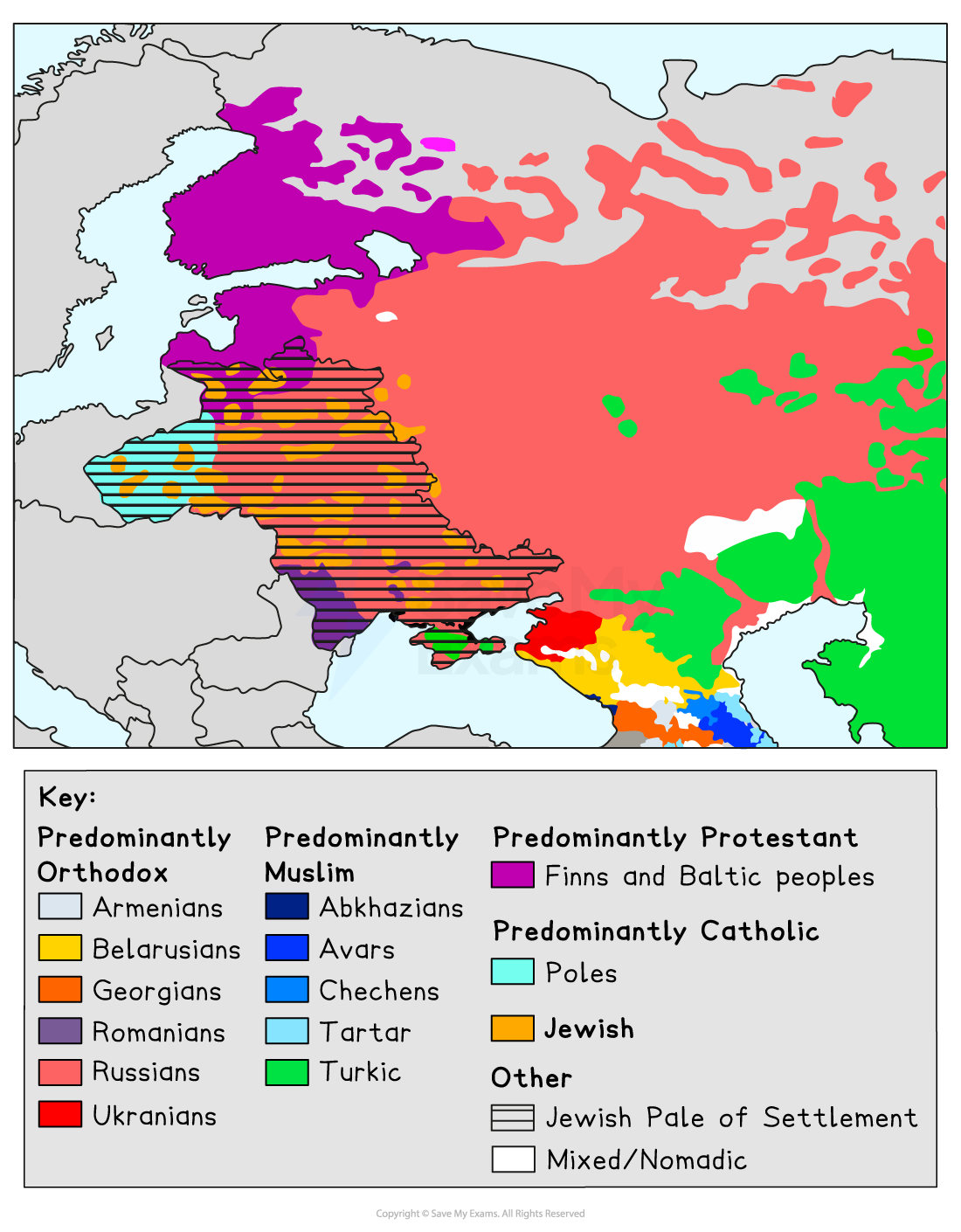
By 1900, the Russian Empire was home to over 200 nationalities
Religion was central to identity and often tied to ethnicity:
Russian Orthodoxy
The state-supported religion in Tsarist Russia
Around 70% of the population were Russian Orthodox
Islam
Widespread in Central Asia and the Caucasus
Catholicism
Strong in Poland and parts of the western empire
Linked to Polish nationalism
Judaism
Concentrated in the Pale of Settlement to the West of the Empire
The Russian Orthodox Church had been a pillar of tsarist autocracy:
It preached loyalty to the tsar as God’s chosen ruler
It reinforced the idea of social hierarchy and obedience
Many priests were closely tied to the state
Lenin's views on religion
For Lenin, attacking religion was a way of dismantling the ideological foundations of Tsarism
Religion was seen not just as a belief system
It was a source of opposition to Communist authority
The Bolsheviks believed that true socialism had to replace religious faith with loyalty to the state and science
Religious policies under Lenin
Laws
Decree on Land (October 1917)
Gave peasants the right to seize land from the Church
Decree on the Separation of Church and State (January 1918)
The Russian Orthodox Church lost its land, schools, and special privileges
Religious teaching was banned in schools
The state no longer gave money to the Church
The Soviet Constitution (1922)
The state allowed all people to have 'freedom of conscience'
This essentially allowed people to have whatever faith they wished
Reality in Leninist Russia
First year in power
In 1918, the Cheka received an order from the Politburo to execute all Orthodox priests
Within two years, the Cheka had killed the most well-known and respected priests
The Civil War
Orthodox Churches were shut down
The state seized Church property
This continued during the 1921 famine to fund aid
Priests were deported or persecuted
Islamic charities were seized
However, Communist leaders reversed the policy and encouraged Muslims to join the Party
After the Civil War
The state created the Living Church. It was:
Ran by the GPU
Intended to split the Orthodox Church
Banned from public debating in 1925 due to differences of opinion with the State
The state attempted to weaken Islam by:
Closing mosques
Attacking Islamic shrines
Accusing Muslims of 'crimes based on customs' against women
Campaigning against women wearing the chador
Examiner Tips and Tricks
On paper, the USSR under Lenin seemed to promise freedom of belief. In reality, religion was heavily suppressed and attacked.
A key turning point was the Civil War, when repression intensified, and the state openly attacked religious institutions.
In an exam, highlight these differences to show evaluation skills. Leaders often presented policies in one way, but the reality of them was very different.
Religious policies under Stalin
Stalin's approach to religion was pragmatic
Stalin was Georgian
This meant he was an ethnic minority of the Russian Empire
Lenin had made Stalin the Commissar for Nationalities
He did not focus on religion
However, his policies often had religious implications
Collectivisation
Collectivisation campaigns included closing churches and arresting clergy
Resistance to collectivisation often came from the clergy
By 1939, only about 1 in 40 churches remained compared to 1917
Purges
Purges often set numbers for how many people from each ethnic group should be targeted
The NKVD heavily attacked Islamic and pro-Islamic groups in Central Asia
By 1936, Sufi groups had almost been wiped out
Women in Kazakhstan kept the religion alive in underground communities
Second World War
Stalin formed an alliance with the Russian Orthodox Church. This was because:
Orthodoxy linked to national identity, improving patriotism
The Church comforted grieving families
Religion provided reassurance to soldiers that they would go to Heaven if they died
It boosted public morale against the Nazis
414 Orthodox Churches reopened
Numbers of other Christian religions also increased in this era
The state:
Ended anti-religious propaganda
Promised to end censorship of religious publications
Post-war
Restrictions increased again
However, this was not as severe as the 1930s
Many churches were allowed to remain open
Examiner Tips and Tricks
Stalin had studied at a seminary in his youth and knew the language of faith. At Lenin’s funeral in 1924, he used religious-style wording, calling Lenin a “saint of the revolution” whose ideas would live forever.
This shows how Stalin could borrow religious language and imagery when it suited him, even though he later launched some of the harshest anti-religious campaigns in Soviet history.
Religious policies under Khrushchev
Policies
Khrushchev launched a new anti-religious drive:
From 1958–1964, over 10,000 churches were closed
Anti-religious magazines were re-established
Propaganda harassed and mocked the clergy
Religion was presented as unscientific and outdated in a modern, space-age USSR
Many strategies targeted women
Women accounted for over 80% of Protestant Christians
The state accused nuns of being 'unnatural' for not being wives and mothers
Muslim groups, especially in Central Asia, also suffered
Mosques were closed
Khrushchev revived the 1920s campaign to 'liberate' Islamic women
Impact
Policies against women proved unsuccessful
Women protected their religious freedom by:
Marching
Distributing pamphlet
Taking their children out of school
Dissident groups formed due to religious issues
Religious policies under Brezhnev
Policies
Brezhnev avoided aggressive persecution, focusing instead on control:
Churches could remain open but were closely watched by the KGB
Atheism was promoted
In 1969, the state opened the Institute for Scientific Atheism
The state advised teachers on how to teach atheism
The government supported anti-American Islamic groups
From the late 1960s, the state believed that these groups had many common beliefs with them
Brezhnev opened the Spiritual Board of Muslims of Central Asia and Kazakhstan
This allowed Soviet Islamic leaders to communicate with Muslims in other countries
Impact
Religious believers in the USSR remained stable at 20% from 1960 to 1985
Impact of religious policies on the USSR
Weakening of the Church
Religion never regained its political influence after 1917
Survival of faith
Religious belief continued underground, especially in rural areas and among Muslims in Central Asia
Baptisms, weddings, and funerals were still common
Links to nationalism
In non-Russian republics, religion was closely tied to national identity
In Poland, the Catholic Church remained strong and became a focus for resistance to Soviet control
Public distrust
Heavy-handed repression often created sympathy for religious groups
It also pushed people into opposition or resentment towards the state
Did the Soviet attitude towards religion cause more issues than it solved?
Historians disagree over whether repression of religion strengthened Soviet control or damaged it
Attacks on religion strengthened communist power
Religion was linked to the old Tsarist regime
Suppressing it allowed the Bolsheviks to secure authority
By the 1960s, the Church had no political influence
Key historians
"The persecution of the Church was accompanied by a highly organized campaign to promote atheism and to destroy Russia's religious culture.. Children from 8-14 years of age were enrolled in Groups of Godless Youth, and the League of Communist Youth (Komsomol) took a vigorous antireligious line... Much of this antireligious propaganda was extremely crude— embarrassingly so for some party intellectuals — and probably did not greatly harm the Church, though the long-term programme of indoctrinating children and young people in atheism has clearly helped to produce two generations of adults who are largely alienated from the Church and from Russia's traditional culture and piety." - Paul D. Steeves, Keeping the Faiths: Religion and Ideology in the Soviet Union (1989)
"People were confused by the loss of Communism as a system of beliefs and practices. They felt a moral vacuum. For some, religion filled the gap. Orthodoxy was a ready-made alternative to Marxism-Leninism. It offered reconnection with a Russian way of life that had been lost since 1917, repentance for the repression of ancestors and self-purification from the moral compromises involved in living with the Soviet regime." - Orlando Figes, Revolutionary Russia, 1891-1991: A History (2014)
Attacks on religion created more problems
Repression alienated peasants, nationalist groups and rural communities
Targeting religious groups created resistance and undermined trust in the state
Key historians
"It is impossible to assess the full extent of Stalin's persecution of religious believers, their persons, their beliefs, and their institutions. So many died in general purges and famines, and no figures can be extracted to indicate that those who were victims were primarily because of their faith. In Stalin's Russia, simply to be a priest warranted a prison sentence, which in its turn was often the equivalent of a death sentence... While no one would assert that Christian protest was the sole motivator of an emergent human rights movement, it unquestionably played a role with academic research, even to this day, has never fully acknowledged... Even Jewish protests, which for many people came to symbolise the human rights movement in the Soviet Union, did not emerge until almost a decade after isolated Christians had first begun to call for justice." - Michael Bourdeaux, The Gospel's Triumph Over Communism (1991)
"In terms of winning believers to atheism success is yet harder to evaluate. Such statistics as are available do suggest a general decrease in the number of believers, but it remains difficult to ascribe this to propaganda and educational activities alone, for the decline took place during a harsh anti-religious campaign when public confession of faith could lead to discrimination and job loss, and during which the number of open places of worship was radically reduced. Propaganda messages repeated over time probably had some effect in shaping the perception of religion held by ordinary citizens, but it seems unlikely that many believers were genuinely converted to atheism as a result of such measures." - John Anderson, Religion, State and Politics in the Soviet Union and Successor States (1994)

Unlock more, it's free!
Join the 100,000+ Students that ❤️ Save My Exams
the (exam) results speak for themselves:

Was this revision note helpful?