Agricultural Collectivisation (Edexcel A Level History): Revision Note
Exam code: 9HI0

Timeline & Summary
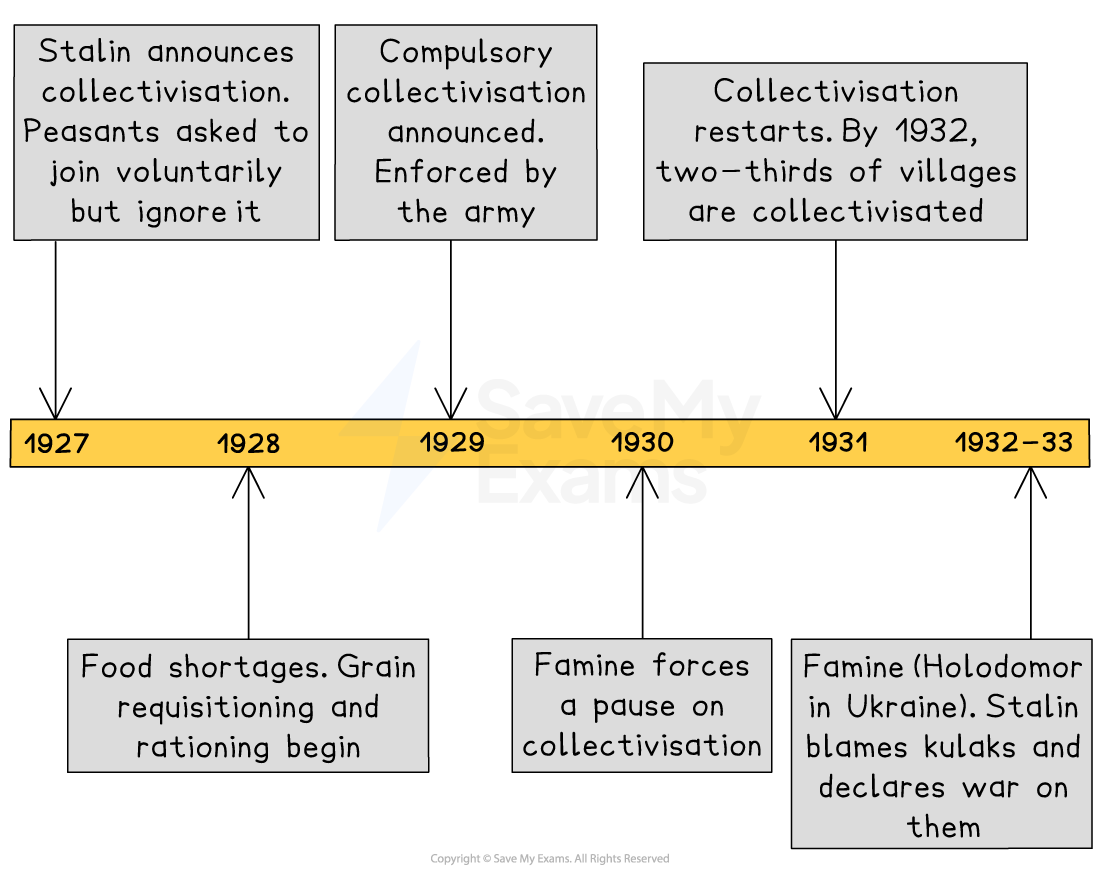
This note will examine the implementation of collectivisation in the Soviet state
Stalin launched collectivisation to modernise farming, secure grain supplies, and strengthen state control over the countryside
It involved merging small peasant farms into large collective farms and removing kulaks as class enemies
While it secured grain for the cities and exports, it caused famine, resistance, and millions of deaths
Historians remain divided over whether collectivisation was necessary modernisation or reckless destruction
Reasons for collectivisation
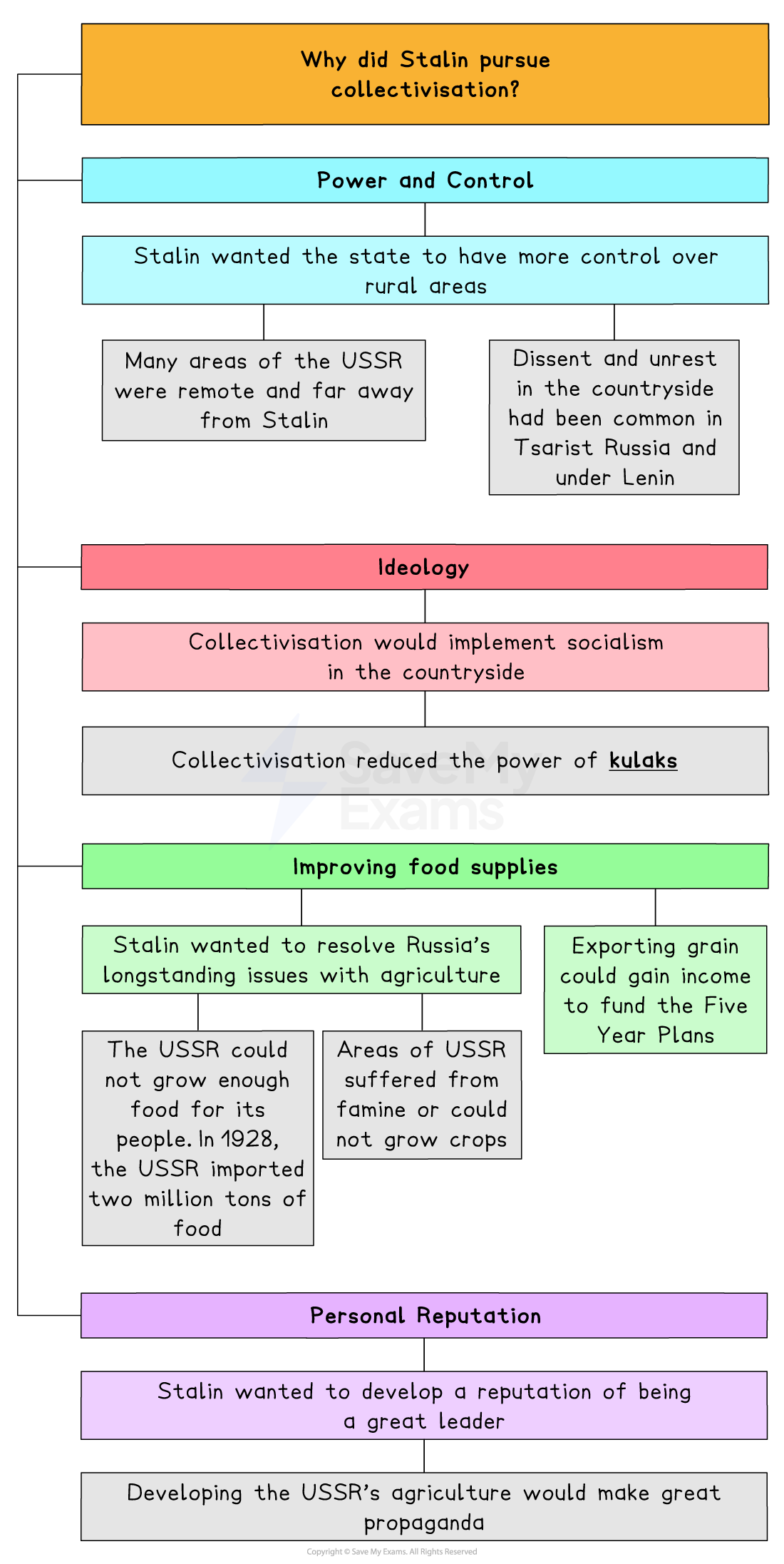
While the Five-Year Plans focused on rapid industrialisation, collectivisation aimed to improve agricultural output
Stalin introduced the concept in 1928
There are many motivations behind collectivisation
Examiner Tips and Tricks
Students sometimes believe that collectivisation and Five-Year Plans are the same policy. They both began in 1928, but they targeted different sectors of the economy. The Five-Year Plans focused on rapid industrialisation. Collectivisation aimed to increase the efficiency of agriculture. The methods used for each policy are also different.
The process of collectivisation
Stalin was forced to introduced collectivisation in two stages
Stage one
Increase the mechanisation of farming and bring the peasants under government control
Stage two
The slowing down of collectivisation and the introduction of Machine Tractor Stations (MTS)
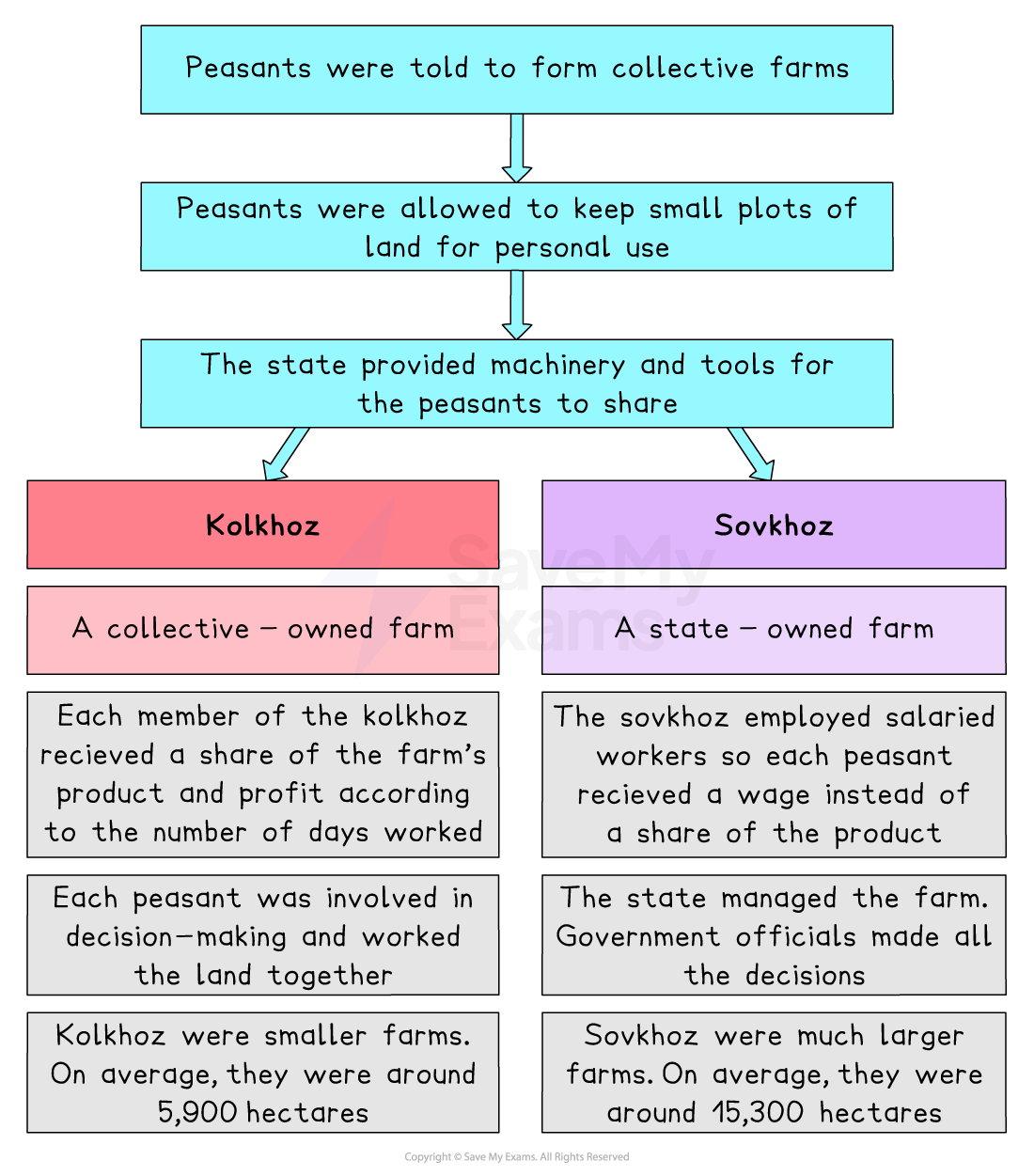
How did collectivisation work?
Dekulakisation
Reasons
Peasants reacted angrily to grain requisitioning and forced collectivisation by:
Attacking officials trying to collectivise farms
Destroying or hiding crops
Killing livestock
The government began blaming kulaks for these actions
Stalin launched a 'liquidation' campaign against the kulaks as a class
This is otherwise known as dekulakisation
Results
Thousands were executed
Around 1.5 million were deported to Siberia or to labour camps
Impacts of collectivisation
Economic
Positive impacts
Grain exports rose, helping to finance industrialisation
In 1928, the USSR exported less than 1 million tons of grain
By 1931, this was 5 million tons
Farming was known widely mechanised
Negative impacts
Agricultural productivity remained low
Collective farms produced 320 kilos of grain per hectare
Private farms produced 410 kilos
There was no incentive for peasants to work hard
Dekulakisation removed the most experienced farmers
Harvests remained poor, causing famine
Livestock numbers took decades to recover
Social
Resistance
Peasants continued to rebel
Peasants destroyed crops and animals rather than hand them over to the government
The Holodomor (1932–33)
Collectivisation had damaging impacts on Ukraine
Ukraine was a profitable agricultural region of the USSR
It grew a vast amount of grain
Ukraine fought back against collectivisation
Ukraine had a strong cultural and national identity
The government punished Ukrainian peasants
They violently repressed the peasants who refused to collectivise
In 1932, they increased the government quota for grain, despite there being a poor harvest
The government's actions caused the Holodomor
This means 'death by hunger'
The government took all food from peasants who could not meet their quota
The exact number of deaths is unknown, but it is within the millions
Political
The state established firm control over the countryside
By 1939, 99% of peasant households had been collectivised
Party officials and MTS workers monitored villages closely
Examiner Tips and Tricks
Try to make comparisons across the course to deepen your understanding. How did the results of collectivisation compare to War Communism and the NEP?
Try to make comparisons based on multiple categories, such as:
Productivity
Ideology
Social and political impacts
How damaging was collectivisation to the USSR?
Historians disagree whether collectivisation was a brutal necessity for modernisation or a catastrophic policy that undermined the USSR
Collectivisation as necessary for modernisation
Some argue collectivisation:
Secured grain for cities
Provided exports to fund industry
Allowed the USSR to prepare for war
They stress its role in enabling the Soviet Union to industrialise rapidly in the 1930s
Key historians
"Within ten years the collective farms were producing significant results. Grain crops were thirty to forty million tons higher than under individual farming. Industry had begun to supply the tractors and combine harvesters to give Russian farming a high degree of mechanization. Large numbers of men and women had been trained to drive tractors and to manage collective farms. All opposition had been crushed and two million Kulaks, deprived of their property and debarred from the new collective farms, had been deported to Siberia or found themselves in forced labour camps." - P.J. Larkin, Revolution in Russia (1965)
"The collective farms, despite all their inefficiencies, did grow more food than the tiny, privately-owned holdings had done. 30–40 million tons of grain was produced every year. Collectivisation also meant the introduction of mechanisation into the countryside where, previously, the peasants had never seen a tractor. Now, two million previously-backward peasants learned to drive a tractor. New methods of farming were taught by 110,000 engineering and agricultural experts. The countryside was indeed transformed." - Elizabeth Roberts, Stalin: Man of Steel (1968)
Collectivisation as a catastrophe
Others argue it was economically inefficient, socially devastating, and caused unnecessary famine and death
They see collectivisation as a reckless exercise in state control rather than rational economic policy
Key historians
"It was a complete disaster from which, it is probably no exaggeration to claim. Russia has not fully recovered even today. There was no problem in collectivising landless labourers, but all peasants who owned any property at all, whether they were kulaks or not, were hostile and had to be forced to join by armies of party members who urged poorer peasants to seize cattle and machinery from the kulaks to be handed over to the collectives. Kulaks often reacted by slaughtering cattle and burning crops rather than allow the state to take them. Peasants who refused to join collective farms were arrested and deported to labour camps or shot; when newly collectivised peasants tried to sabotage the system by producing only enough for their own needs, local officials insisted on seizing the required quotas, resulting in large-scale famine during 1932-3, especially in the Ukraine. Yet one and three-quarter million tons of grain were exported during that period while over five million peasants died of starvation. Some historians have even claimed that Stalin welcomed the famine, since, along with the 10 million kulaks who were removed or executed, it helped to break peasant resistance." - Norman Lowe, Mastering Modern World History (1988)
"The war against the 'kulaks' was not a side-effect but the main driving force of the collectivization campaign. It had two main aims: to remove potential opposition to collectivization; and to serve as an example to the other villagers, encouraging them to join the collective farms in order not to suffer the same fate. As Stalin saw it, there was nothing to be gained from trying to neutralize the 'kulaks', nor from attempting to involve them as farm labourers in the kolkhoz, as some Bolsheviks proposed. 'When the head is cut off,' Stalin argued, 'you do not weep about the hair.' In January 1930, a Politburo commission drew up a target of 60,000 'malicious kulaks' to be sent to labour camps and 150,000 other 'kulak' households to be exiled to the North, Siberia, the Urals and Kazakhstan. The figures were part of an overall plan for 1 million 'kulak' households (about 6 million people) to be dispossessed and sent to labour camps or 'special settlements.'" - Orlando Figes, A People’s Tragedy (1996)

Unlock more, it's free!
Join the 100,000+ Students that ❤️ Save My Exams
the (exam) results speak for themselves:

Was this revision note helpful?