Agriculture & the Virgin Lands Scheme (Edexcel A Level History): Revision Note
Exam code: 9HI0

Summary
This note will examine the success of Khrushchev's agricultural policies
Khrushchev made agriculture a central focus of his leadership
He aimed to end food shortages and modernise the countryside
His policies included higher investment, price incentives, and the ambitious Virgin Lands Scheme
The reforms initially boosted output but ran into serious problems by the early 1960s, leaving agriculture in crisis
Historians disagree whether the failure of agriculture, particularly the Virgin Lands Scheme, was the main reason for Khrushchev’s fall from power in 1964
Why did Khrushchev reform agriculture?
Persistent food shortages
After the Second World War, agriculture lagged behind industry
The 1946–47 famine revealed the system’s weakness, and food shortages continued into the 1950s
Stalin’s legacy
Stalin’s focus on heavy industry left agriculture neglected and under-mechanised
Collective farms remained inefficient, with low yields and poor incentives for peasants
Political aims
Khrushchev defeated Malenkov on agricultural issues
Malenkov promised, but failed, to deliver on higher agricultural productivity
Khrushchev knew that he needed to fulfil agricultural improvements to consolidate his power
Raising living standards through a better food supply was central to his political legitimacy
Agricultural reforms under Khrushchev
Increased investment
Khrushchev promised to raise agricultural investment by over 250% between 1954 and 1959
In 1954, Khrushchev promised to invest in:
New fertiliser factories
Tractors
Price incentives
Khrushchev wanted to motivate farmers to produce more for the state
Under Stalin, each collective farm had:
Quotas
To sell crops for a low wage
Khrushchev reduced quotas and increased prices for crops
Virgin Lands Scheme (1954)
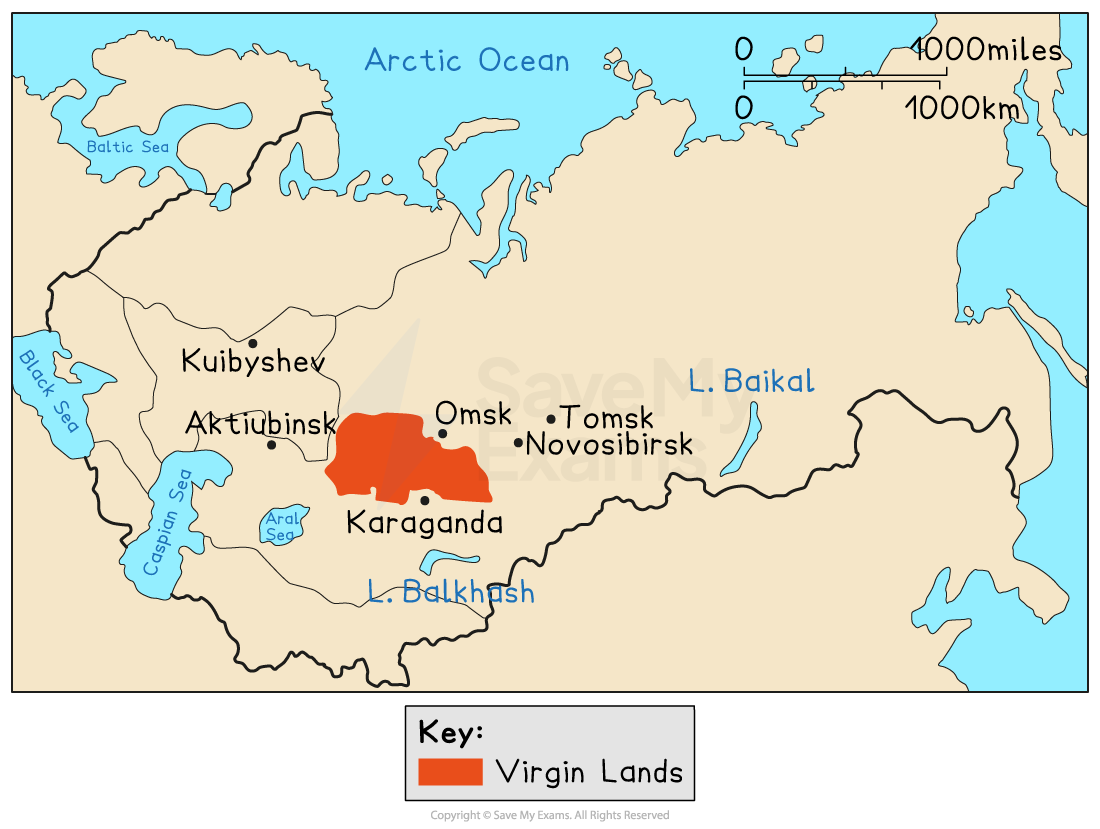
Khrushchev ordered land in Kazakhstan, Siberia, and the Volga region to be ploughed for the first time to grow grain
He hoped this would increase agricultural productivity
The government sent:
Millions of young volunteers to farm the land
Thousands of tractors
Examiner Tips and Tricks
Maps are a really useful resource to visualise where in the USSR each policy or event impacted.
Print a map of the USSR out for your revision and add key events or places to it to help piece together the narrative of the course.
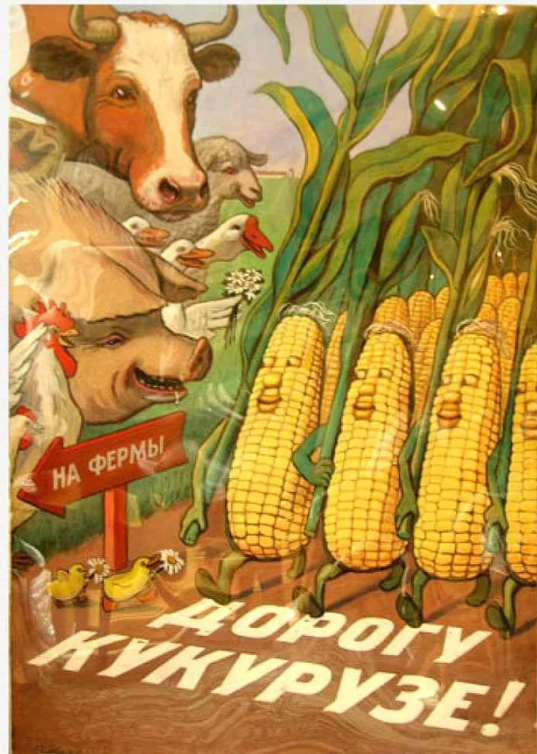
The Corn Campaign
Introduced from September 1958
Khrushchev wanted:
The Virgin Lands farm to grow wheat
Ukraine to prioritise cultivating maize
His aim was to use corn to feed livestock
This would then provide more meat and dairy for the Soviet population
Impact of Khrushchev's agricultural reforms
Positive impacts
Khrushchev's agricultural reforms had positive, short-term impacts
Grain harvests rose dramatically at first
By 1956, the Virgin Lands Scheme produced half of the USSR’s grain
Overall, agricultural production increased by around 35%
Food availability improved, and living standards rose in the mid-1950s
There was a 400% increase in income for farm workers
Negatives impacts
The agricultural reforms failed in the long term
The Virgin Lands Scheme was viewed by the Party as a failure
The 1959 and 1960 harvests were below the 1958 harvest
Agricultural production in 1964 was 15% higher than 1958
This was significantly below Khrushchev's target
The Corn Campaign failed because:
Many farms were unable to grow maize due to having an unsuitable climate
Soviet tractors and fertilisers were not as good as Western versions
Agricultural facilities and supplies remained inadequate
Crops could not be properly stored, causing wastage
Factories either did not deliver the correct fertiliser to the correct farm or it arrived too late
Machine Tractor Stations (MTS) were abolished, causing a lack of modern farming machinery
Khrushchev cut funding to agriculture to just 2% in 1960
A disastrous harvest in 1963 caused severe food shortages
This forced the USSR to import grain from the USA and Canada
Was the Virgin Lands Scheme the biggest reason for Khrushchev's downfall?
Historians debate whether the failures of agriculture, particularly the Virgin Lands Scheme, were decisive in Khrushchev’s fall, or whether other factors mattered more
Agriculture as central to Khrushchev's downfall
Failures in agriculture, especially the Virgin Lands Scheme, discredited Khrushchev’s promises of abundance
The 1963 crisis, when the USSR had to import grain, was deeply embarrassing and weakened his authority
Key historians
"He wilfully promoted extensive farming on immense areas of virgin land in preference to intensive cultivation; and in doing so he disregarded opposition within the party, expert advice, and warnings about the danger of soil erosion and of crop failures on the virgin lands. He was so confident that he had the answer to the chronic shortage of meat- maize-that he forced cultivation of maize all over the country, regard- less of soil and climate. He prescribed the modes of grass cultivation to be adopted throughout the length and breadth of the Soviet Union. By his decision the small plots of land the collective farmers owned and cultivated privately were reduced or confiscated in recent years...Without satisfying the mass of the people, they irritated the bureaucracy which became weary of the all too frequent shake-ups, and turned against Khrushchev." - Isaac Deutscher, The Failure Of Khrushchevism (1965)
"Once he became party leader, he insisted on being treated as the party's reigning expert on agriculture. He was constantly traipsing around cornfields, barking out instructions to farmers and agronomists...Splitting the Communist party in two was Khrushchev's most radical attempt yet to jump-start Soviet agriculture, but the move outraged party officials without increasing the harvest. More than anything else, his failure to energize agriculture left Khrushchev puzzled, frustrated, and angry, still flailing about for solutions, looking for anyone but himself to blame." - William Taubman, Khrushchev: The Man and His Era (2003)
Other factors causing Khrushchev's downfall
Others argue Khrushchev’s downfall was due to a wider combination of problems: his erratic leadership style, foreign policy failures, and alienation of Party elites
Agriculture mattered, but it was not the only or biggest factor
Key historians
"Propaganda trumpeted the achievements of the settlers on the Virgin Lands. But its results were mixed: 40 million hectares of new land were brought into production between 1954 and 1963, and grain output rose as a result, enough to end food shortages in the short term; but harvest yields were variable, and steadily declined from 1958, largely because there was not enough fertilizer to compensate for the poor soil... Khrushchev's programme of de-Stalinization was opposed from the start by senior Party leaders whose careers had been built as Stalin's loyal servitors. By 1964 they had had enough of him. His reforms had weakened the positions of the regional Party secretaries by dividing their responsibilities for economic management and by requiring that at least one quarter of the Central Committee, where they exercised their influence and patronage, be renewed at every election. Khrushchev's erratic leadership, his meddling in affairs where he lacked expertise, and his failure in Cuba lost him the support of Party colleagues who wanted a more stable and collective style of government. Khrushchev was voted out of office in October 1964." - Orlando Figes, A People’s Tragedy (1996)
"His policies towards the party during 1958-64 reflected above all else his desire somehow to fashion the party apparat into an effective instrument of his rule. Personnel turnover remained extraordinarily high throughout most of this period and the political pressure on local officials exerted by Khrushchev was often intense, especially in the agricultural sphere. In 1961, minimum levels of turnover were enshrined in the party rules. Party-state control was strengthened and, in 1962, the territorial party apparatus was divided into agricultural and industrial branches in an effort to improve party guidance of the economy and to enhance central control...His declining popularity with the public and the failure of his attempted alliances with the intelligentsia left him, in Popov's words 'one on one with the apparat'. The apparat resisted his attacks on its hegemony and played the key role in his removal in 1964." - W. J. Tompson, Khrushchev and Gorbachev as Reformers: A Comparison (1993)

Unlock more, it's free!
Join the 100,000+ Students that ❤️ Save My Exams
the (exam) results speak for themselves:

Was this revision note helpful?