New Economic Policy (NEP), 1921 (Edexcel A Level History): Revision Note
Exam code: 9HI0

Summary
This note will examine the causes and impacts of the New Economic Policy (NEP)
The NEP was introduced in 1921 to recover from the economic and political crises caused by War Communism
It reintroduced elements of private trade and small-scale capitalism while keeping state control of the economy
The policy revived production and living standards
However, it created tensions within the Party, especially during the Scissors Crisis (1923)
Historians debate whether the NEP was a pragmatic compromise or a betrayal of communist ideology
Why was the NEP introduced?
Political unrest
Grain requisitioning and repression had sparked widespread uprisings
The Bolsheviks risked losing workers’ and peasants’ backing if harsh policies continued
Economic collapse
War Communism and the Russian Civil War had devastated the economy
By 1921, agricultural and industrial output had fallen dramatically
Famine caused millions of deaths
Lenin needed an economic policy which:
End food shortages
Increase productivity
Build socialism
By 1921, it was clear that a European communist revolution would not happen
Lenin needed to strengthen socialism in Russia without needing foreign aid
Key features of the NEP
Agriculture
Grain requisitioning ended
It was replaced with a tax in kind
Peasants paid the state a portion of produce but could keep the rest
Peasants could sell surplus grain on the market for profit
Industry
Businesses with fewer than 20 workers were returned to private ownership
Larger industries, banking, transport, and foreign trade remained under state control
The government expected nationalised businesses to make a profit
People had to pay for public transport again
Money was reintroduced
Private trade
Private trade was legalised once more, allowing markets to reopen
The government allowed small-scale entrepreneurship
Impacts of the NEP
Economic recovery
Industrial output quickly improved
By 1926, production levels had almost returned to those of 1913
Lenin used money raised by taxing the peasants to improve industry
He funded a mass electrification programme
Factories closed or damaged during the Civil War were re-opened or re-built
However, taxes did not raise enough money to build large-scale factories like those in the West
The NEP ended famine
Free trade encouraged peasants to grow more food
People in towns and villages could access a wider variety of, and more, food than during War Communism
The Scissors Crisis (1923)
Agricultural recovery under the NEP was rapid
Peasants eagerly produced more food now that they could sell it for profit
Industrial recovery was much slower
Heavy industry remained under state control and struggled with low investment and inefficiency
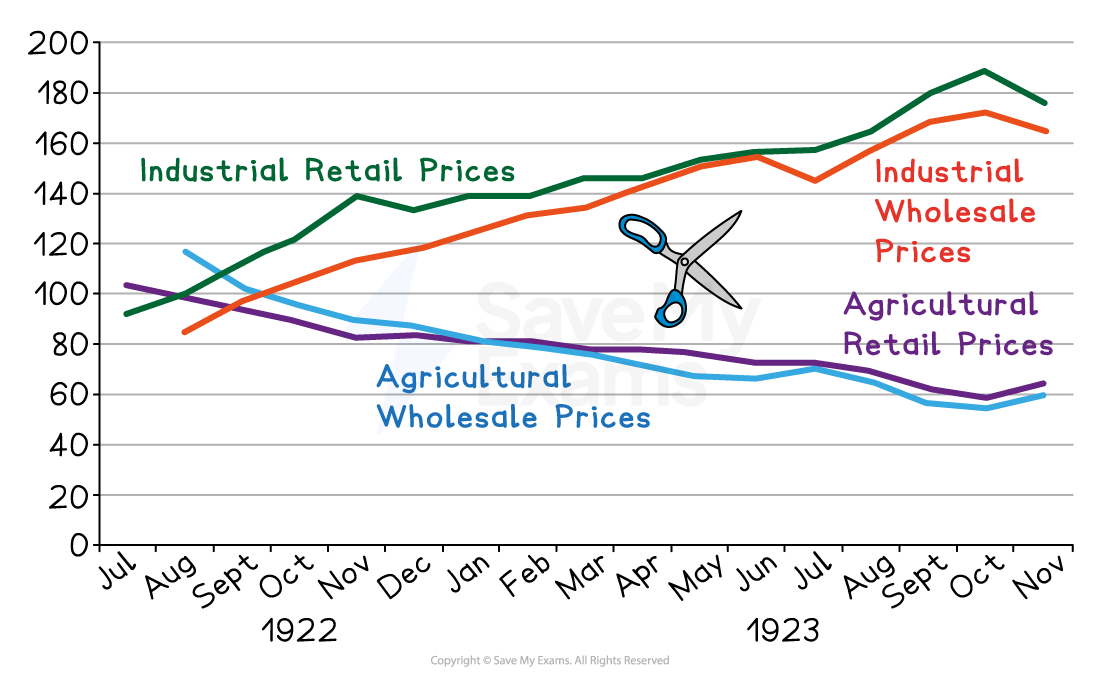
This imbalance meant agricultural prices fell while industrial goods remained expensive and scarce
This caused an effect known as the 'scissors crisis'
Examiner Tips and Tricks
Students often find the 'scissors crisis' quite a confusing concept to understand.
Trotsky created the nickname to explain the shape of the graph.
Try to visualise a pair of scissors. As you open the scissors, the gap between the two blades widen. This represents the widening gap between agricultural and industrial prices during the NEP.
The 'scissors crisis' caused:
Peasants being unable to buy industrial goods
Peasants to stockpile grain rather than sell it
This eventually caused shortages in towns and cities
The state intervened by cutting the prices of industrial goods
The crisis exposed the fragility of the NEP
It shoed that it could not fully satisfy both peasants and workers at the same time
It convinced radicals like Trotsky that the NEP could not 'build socialism with capitalist hands', like Lenin had argued
Political stability
Ending grain requisitioning was a popular measure
The peasants stopped revolting
The workers, being better fed, were more content with the government
Peasants
Peasants benefited from the end of requisitioning and the ability to sell surplus produce
However, richer peasants (kulaks) benefited most, increasing inequality
Workers
Living standards improved as food became more available and wages rose slightly
Unemployment reappeared as small businesses cut inefficient workers
Inequality in society
Nepmen
The NEP allowed private trade and small businesses
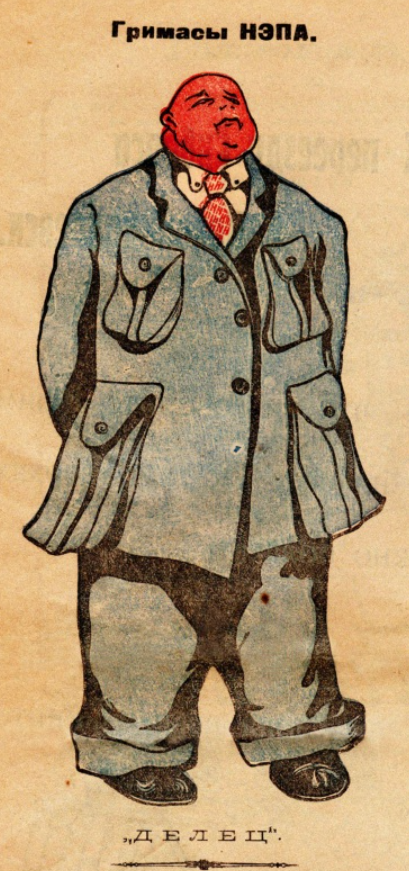
This created a new class of traders and entrepreneurs known as Nepmen
Nepmen often became wealthy by:
Running shops, restaurants, and services
Transporting and selling desirable goods across Russia
To ordinary Russians, Nepmen were visible symbols of new inequality
They lived more comfortably than workers and peasants and worked less
Government reaction to Nepmen
The Bolsheviks saw Nepmen as a disgrace
They went against communist principles
They were not workers who 'produced' for their income
The government tolerated them but also:
Heavily taxed them
Criticised them in propaganda as 'parasites' and 'class enemies'
Occasionally arrested them for profiteering
Corruption in society
With private trade came a surge in gambling, prostitution, and drug dealing, especially in large cities like Moscow and Petrograd
These activities were viewed as signs of “capitalist corruption” returning under the NEP
Many Party members were horrified, believing the NEP betrayed the revolution’s moral as well as economic ideals
How successful was the NEP?
Historians debate whether the NEP saved the Soviet regime or betrayed socialist principles
Pragmatic compromise
Some historians believe that the NEP was a necessary “breathing space” to recover from the devastation caused by the Russian Civil War
Key historians
“The anti-Soviet revolts ceased... There were initial signs of recovery in industry... The New Economic Policy strengthened the alliance between the workers and peasants and secured the victory of the socialist elements over the capitalist ones. And yet to this day many bourgeois historians continue to portray the New Economic Policy as a departure of the Communist Party and Soviet power from the ‘direct road leading to communism’.” - Yu Kukushkin, History of the USSR (1981)
"As Lenin saw it, the NEP was a necessary concession to the market to get the country on its feet again. The survival of the Revolution depended on the smychka, the union of the peasants and the proletariat, which could only be sustained by increasing the exchange of food for manufactured goods. How long the NEP should last was left unclear, although this would be the crucial question dividing party leaders during the 1920s. Lenin talked of 'not less than a decade and probably more' - suggesting that the NEP was not 'a form of political trickery that is only being carried out for the moment' but had to be adopted 'seriously and for a long time.' Lenin saw the NEP as a serious attempt to build socialism on the basis of a mixed economy. As long as the state retained control of the 'commanding heights of the economy' (e.g. steel, coal, the railways), he argued that there was no serious risk in allowing small-scale private farming, trade and handicrafts to grow and create wealth as a tax-base for socialist industrialization." - Orlando Figes, A People’s Tragedy (1996)
Betrayal of socialism
Other historians argue that the NEP was a retreat from socialist principles, showing Bolshevik ideology had failed
Key historians
"Yet, once the danger was over and memories of the privatisations of war communism receded into the past, the mood of relief and acquiescence slowly faded and was overtaken by a sense of uneasiness at so radical a departure from the hopes and expectations of an advance into socialism which had inspired the earlier triumphs of the revolution. In the long run someone carried the cost of concessions made to the peasant; and some consequences of NEP, direct or indirect, were unlooked for and unwelcome. In little more than two years, the country was in the throes of a fresh crisis which, though less dramatic than the crisis preceding the introduction of NEP, deeply affected every sector of a now-expanding economy." - E.H. Carr, The Russian Revolution: From Lenin to Stalin (1979)
"The NEP had saved the regime from destruction, but it had introduced its own grave instabilities into the compound of the Soviet order... Not even Lenin saw the NEP as permanently acceptable... Most Bolshevik leaders had never liked the NEP, regarding it at best as an excrescent boil on the body politic, and at worst a malignant cancer. They detested the reintroduction of capitalism and feared the rise of a new urban and rural bourgeoisie. They resented the corrupt, inefficient administration they headed. They disliked such national, religious and cultural concessions as they had had to make. They were embarrassed that they had not yet eliminated the poverty in Soviet towns and villages. They yearned to accelerate educational expansion and indoctrinate the working class with their ideas. They wanted a society wholly industrialised and equipped with technological dynamism. They desired to match the military preparedness of capitalist powers. What is more, Lenin's NEP had always disconcerted many central and local party leaders." - Robert Service, A History of Modern Russia from Nicholas II to Vladimir Putin (2005)

Unlock more, it's free!
Join the 100,000+ Students that ❤️ Save My Exams
the (exam) results speak for themselves:

Was this revision note helpful?