Stalin's Five-Year Plans, 1928-1941 (Edexcel A Level History): Revision Note
Exam code: 9HI0

Timeline & Summary
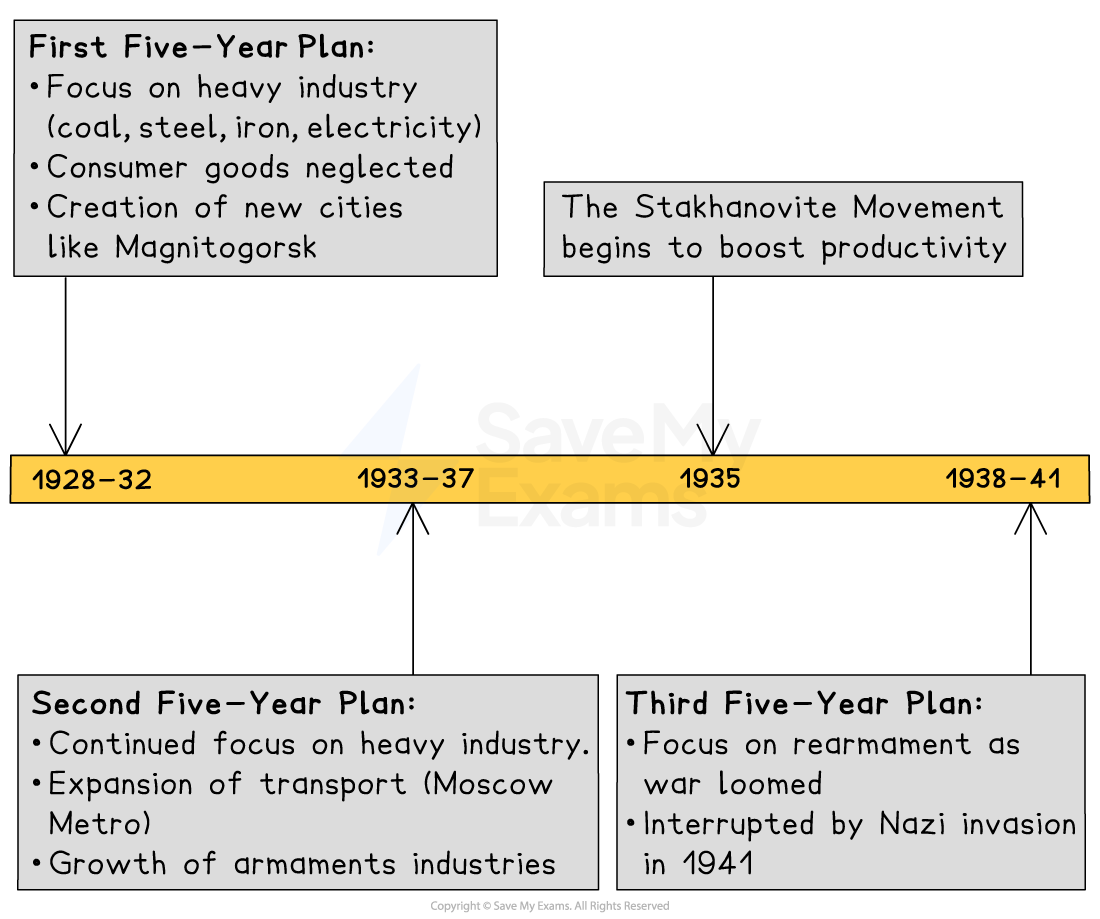
This note will examine the Five-Year Plans under Stalin
The Five-Year Plans transformed the USSR into a major industrial power
Each plan prioritised heavy industry
However, their methods often relied on propaganda, targets, and forced labour
The Stakhanovite movement promoted productivity but also placed intense pressure on workers
Historians debate whether the Plans were a triumph of modernisation or a deeply flawed and destructive experiment
Reasons for the Five-Year Plans
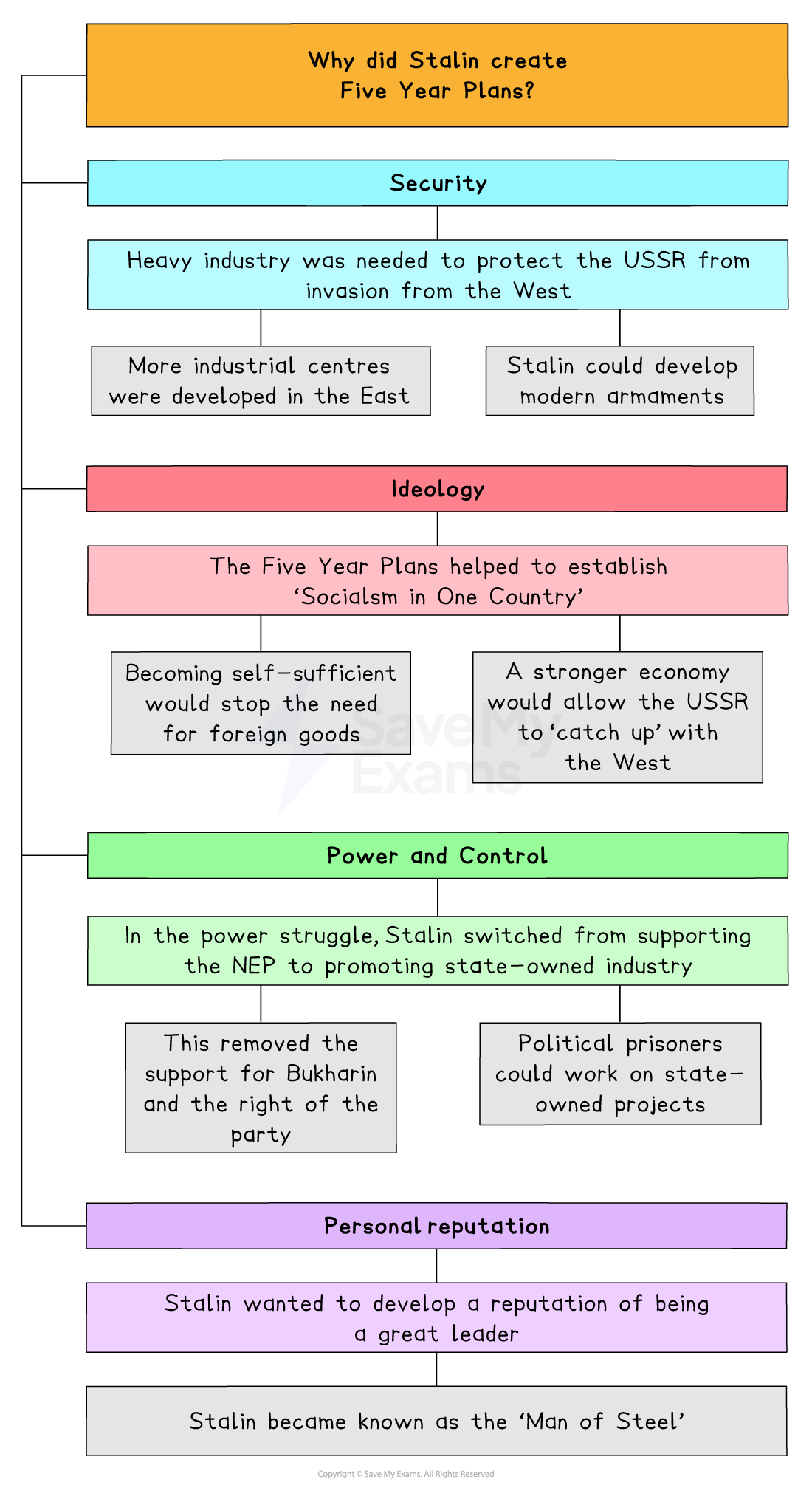
The Five-Year Plans aimed to rapidly industrialise the USSR
Stalin introduced the concept in 1928
There were many motivations behind the Five-Year Plans
We are fifty or a hundred years behind the advanced countries. We must make good this distance in ten years. Either we do it, or we shall be crushed.
Stalin in a speech to industrial managers, February 1931
How did the Five-Year Plans work?
Gosplan
Gosplan stood for 'State Committee for Planning'
It set targets for:
Each region
Each factory
Each manager
Each worker
Targets were ambitious and usually unachievable
Gosplan also did not provide factories with:
Adequate supplies
Customers to buy the goods they produced
Examiner Tips and Tricks
Students often confuse Vesenkha and Gosplan. Vesenkha, created in 1917, was set up to manage nationalised industries after the Bolsheviks seized power. Gosplan, established in 1921, was responsible for planning the economy and later drew up the targets and quotas for the Five-Year Plans.
Foreign aid
Britain and the USA supplied the Soviet Union with:
Money to invest in industry
Experts
Western countries offered to help the USSR because of:
The Great Depression
The USSR was less affected by the Depression, leading to job opportunities
Agreements, such as the Treaty of Rapallo
Loan and trade deals
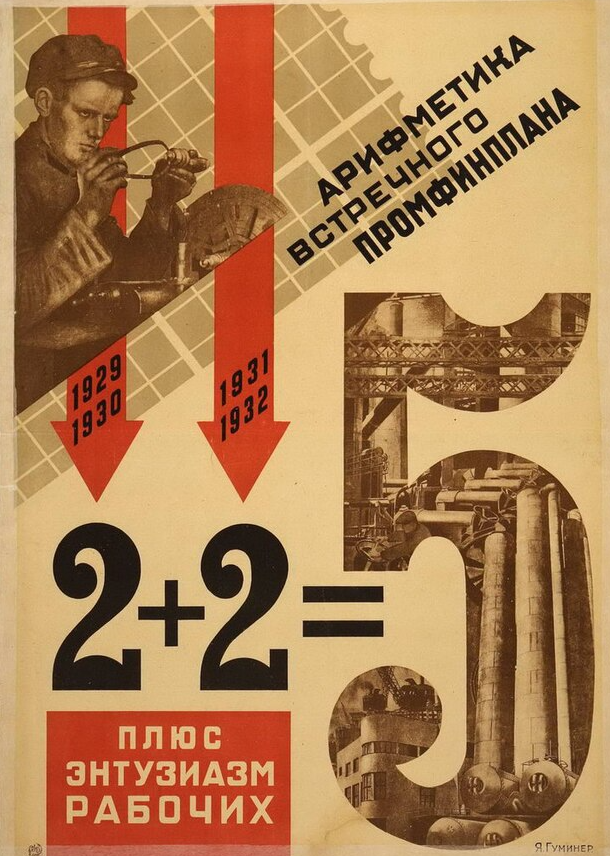
Propaganda
The government started a massive propaganda campaign on the Five Year Plans
Themes of the propaganda included:
Expressing how important its aims were
Celebrating the successes of the Plans
Describing the modern, utopian future the Plans would create
The First Plan, 1928–1932
Dates | Targets | Outcomes |
|---|---|---|
October 1928-December 1932 | To develop heavy industry such as coal, iron, steel and electricity | The building of steelworks such as Magnitogorsk. Coal and iron output doubled. No focus on consumer goods |
Increase production by 300% | Targets were unrealistic so they could not be met. There was a shortage of skilled workers |
Magnitogorsk
Creation
A new industrial city built in the Urals
Construction began in 1929
By 1932, the first blast furnace was in operation
Foreign engineers from the USA and Germany were brought in to advise on planning and building
Achievements
Became one of the largest steel-producing centres in the USSR
Magnitogorsk became a propaganda symbol of socialism’s triumph over backwardness
Problems
Living conditions were extremely harsh
Many workers lived in tents or makeshift huts with poor sanitation
Harsh winters and poor planning meant shortages of food, clean water, and housing
Working conditions were dangerous
Accidents were frequent due to lack of safety equipment
In early April it was still bitterly cold, everything was frozen. By May the city was swimming in mud. Plague had broken out not far away. People were in poor health because of lack of food and overwork. Sanitary conditions were appalling. By the middle of May the heat had become intolerable.
John Scott, Behind the Urals (1942). Scott was an American engineer who voluntarily went to Russia in the 1930s. He worked at Magnitogorsk.

The Second Plan, 1933-1937
Dates | Targets | Outcomes |
|---|---|---|
January 1933 - December 1937 | To further develop heavy industry | Heavy industry production more than doubled. Consumer industries remained neglected |
To focus on lighter industries such as chemicals, railways and communication | The Moscow Metro (1935) and the Moscow-Volga Canal (1937) were completed. However, targets were still too unrealistic, and output was of poor quality |
The Stakhanovite movement
Began in 1935 during the Second Five-Year Plan
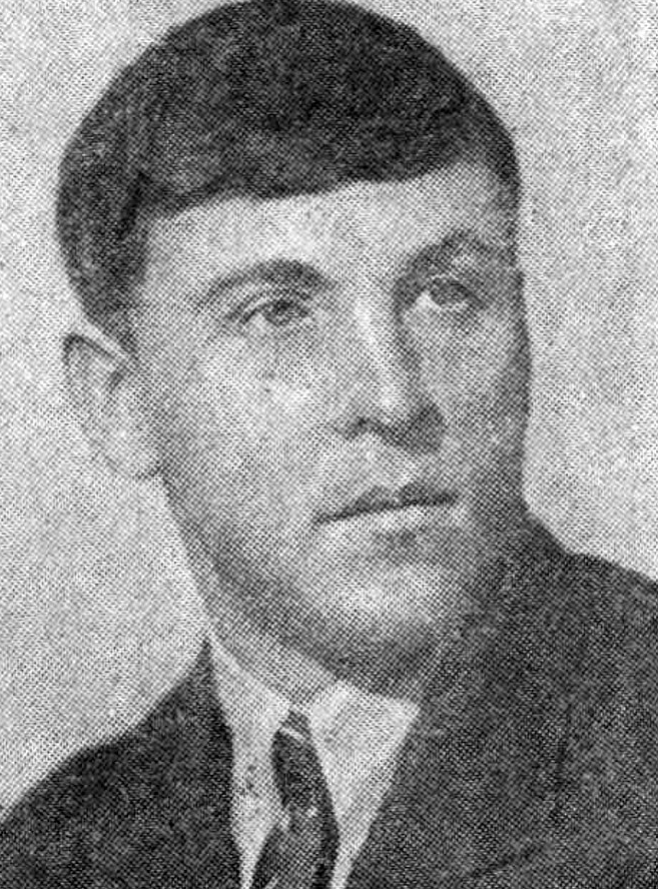
Its name came from Aleksei Stakhanov
Stakhanov reportedly mined 102 tons of coal in less than 6 hours (14 times his quota) on 31 August 1935
He is an example of a 'shock worker'
The government celebrated Stakhanov's achievements
He travelled the country as a national celebrity
He even appeared on the front cover of Time Magazine
The government gave Stakhanov a new apartment, extra pay, a telephone and more holidays
The publicity attracted people to follow Stakhanov's example
'Stakhanovites' were located in multiple industries in towns and the countryside
However, if Stakhanov did achieve this record, he did so through
The help of assistants
The latest technology that many workers did not have
The Third Plan, 1938-1941
Dates | Targets | Outcomes |
|---|---|---|
January 1938 - June 1941 | To mechanise and improve agriculture | The Second World War meant the plan had to be abandoned |
To produce some consumer goods | There was a lack of good managers and specialists due to Stalin's purges. Rationing and goods shortages lead to a thriving black market |
Examiner Tips and Tricks
The examiner is not expecting you to know every detail and achievement from the Five Year Plans.
Focus on memorising one key statistic, one achievement and one weakness of each Plan to ensure you have enough own knowledge to answer an essay question.
How successful were the Five-Year Plans?
Historians debate whether the Five-Year Plans were a remarkable achievement or an inefficient, brutal system.
A triumph of modernisation
Some historians believe that the Plans rapidly built heavy industry, transport, and armaments, turning the USSR into a great power able to defeat Nazi Germany
They acknowledge that the methods were severe but instrumental in meeting urgent security needs
Key historians
"Statistically, through the Five Year Plans the Soviet Union achieved impressive rates of economic growth during the 1930s - a decade of depression in the capitalist states... There were impressive gains in heavy industries, mining and construction. The Soviet Union became the world's leading producer of oil, coal, iron ore, and cement, and it became a major world producer of manganese, gold, natural gas and other minerals. These gains enabled the USSR to develop the defence industries it needed to fight Hitler's armies during World War Two." - Orlando Figes, A People’s Tragedy (1996)
"The Five-Year Plans had a dramatic effect on the Soviet Union, making it the second largest industrial power in the world. Huge new steel plants, hydro-electric power stations, railways and canals were built. Vast numbers of factories in hundreds of new towns poured out manufactured goods. A major symbol of this growth was the new city of Magnitogorsk. Between 1928 and 1932 Magnitogorsk was transformed from a tiny, isolated village to a thriving industrial city, with more than a quarter of a million citizens." - Nigel Kelly, Russia and the USSR 1905–1956 (1996)
An economic disaster
Other historians argue that the Five Year Plans failed in its aims
The Plans often relied on unrealistic targets, harsh punishments, and exaggerated statistics
Everyday needs like clothing, housing, and food were neglected because heavy industry always came first
Millions of ordinary people suffered
Key historians
"Far from being the period of plenty and merriment projected by the State's propaganda machine, the Plan years were a period of chronic shortages of every conceivable item. The well-documented famine of 1933 was simply the most notorious example. These shortages meant that a black economy quickly developed to allow ordinary citizens to survive. One popular proverb from the time observed that 'he who does not steal, robs his family'. Rationing ended in 1934 but supply problems persisted. For the Soviet population, queuing became a way of life. Those with time to spare joined any queues that they encountered, in order to procure whatever was on offer and then to be able to trade it for something else." - Julian Reed-Purvis, Stalin' s Workers, (2003)
"Indeed state violence was already being applied widely under the First and Second Five-Year Plans. 'Kulaks', railwaymen-'wreckers', 'nationalists', and managerial 'saboteurs' were being arrested in large numbers. Nearly a million Soviet citizens languished in the forced labour camps and colonies of the OGPU by 1933, and further millions were in prisons, deportation camps, and compulsory resettlement areas." - Robert Service, A History of Modern Russia from Nicholas II to Vladimir Putin (2005)

Unlock more, it's free!
Join the 100,000+ Students that ❤️ Save My Exams
the (exam) results speak for themselves:

Was this revision note helpful?