State Control of the Economy (Edexcel A Level History): Revision Note
Exam code: 9HI0

Timeline & Summary
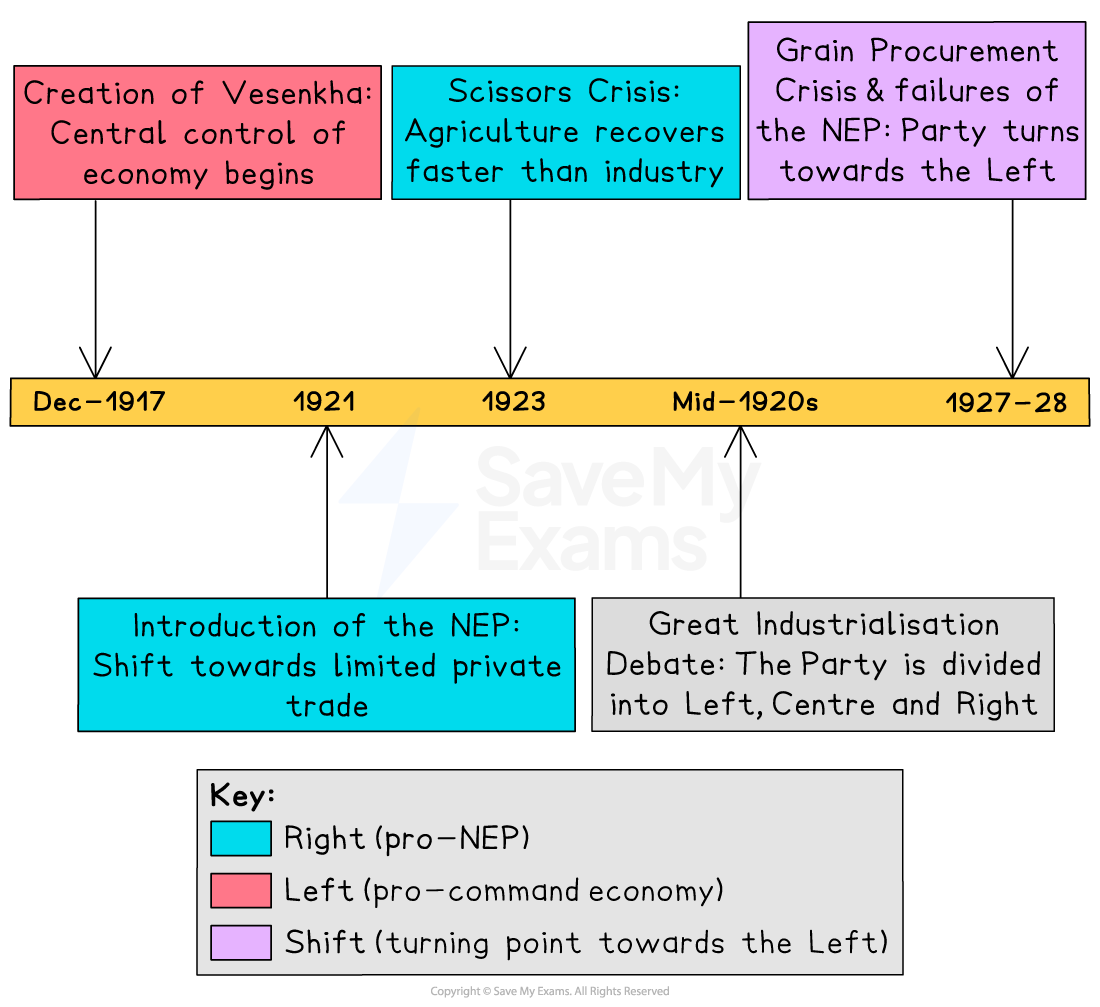
This note will examine why state control of the economy was fundamental in the Soviet state
The Bolsheviks established Vesenkha to centralise and direct the economy after the Revolution
Party debates in the 1920s revealed deep divisions over the pace and method of industrialisation
This is known as the Great Industrialisation Debate
The eventual adoption of a command economy was shaped by:
Political necessity
Ideological arguments
Economic crisis
Historians debate whether the command economy was inevitable or a product of Stalin’s leadership
The Vesenkha
The government established Vesenkha in December 1917
Its full name is the Supreme Council of the National Economy
It was tasked with managing industry and finance
Its roles included:
Reorganising industry to improve efficiency
Nationalising banks, transport, and large-scale industry
Setting production targets and directing resources to key sectors
Vesenkha became the most important institution of economic management
By the 1920s, its role expanded to:
Supervising state-run businesses
Coordinating long-term economic planning
Examiner Tips and Tricks
Students often confuse Vesenkha with other Bolshevik organisations, such as Sovnarkom or the Politburo.
The key difference is Vesenkha was solely focused on the economy, whereas Sovnarkom or the Politburo had broader political responsibilities and oversight.
Party opinions on the economy
The Communist Party was deeply divided in the 1920s over how to rebuild the economy after War Communism and the NEP
The Left: “Dictatorship of Industry”
Key ideas
Rapid industrialisation led by the state
Prioritise heavy industry to build socialism quickly
Forced collectivisation in agriculture
The state could take all of the profits from farms and fund industrialisation
They acknowledged that the policy would anger peasants
Supporters of the Left
Trotsky
Zinoviev
Kamenev
The Right: “Building Socialism with Capitalist Hands”
Key ideas
A continuation of the NEP
Allowing private trade and small-scale capitalism to help the economy recover before socialism could be achieved
Saw peasants as essential allies who should not be alienated
Supporters of the Right
Bukharin
Rykov
Tomsky
The Centre: Pragmatism
Key ideas
Adopted a flexible approach
They believed that 'whatever works' at the time was the right policy
Economic policy should be decided on the nation's demands, not ideology
Initially supported the NEP until 1927, when economic growth slowed
Supporters of the Centre
Stalin
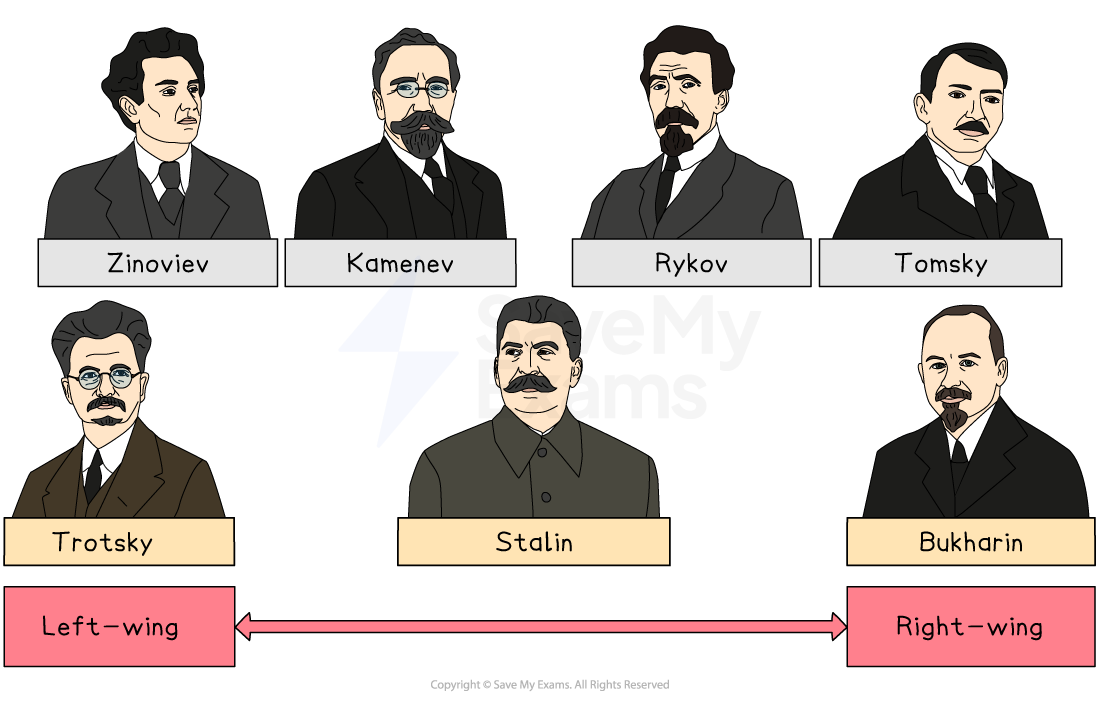
The Great Industrialisation Debate (1920s)
This debate dominated Party politics in the 1920s
It was the basis of the leadership struggle after Lenin's death
During the 1920s, the Right won countless debates in Congress
This made it impossible for supporters of the Left to take power
Economic policy was one of the reasons why the Party turned against Trotsky
As economic problems worsened. the Centre, led by Stalin, eventually shifted towards the Left position
This won a lot of support from most members of the Party
The debate laid the groundwork for:
The beginning of agricultural collectivisation
Examiner Tips and Tricks
Understanding the political Left and Right in the Great Industrialisation Debate is key for essays on Stalin’s rise to power.
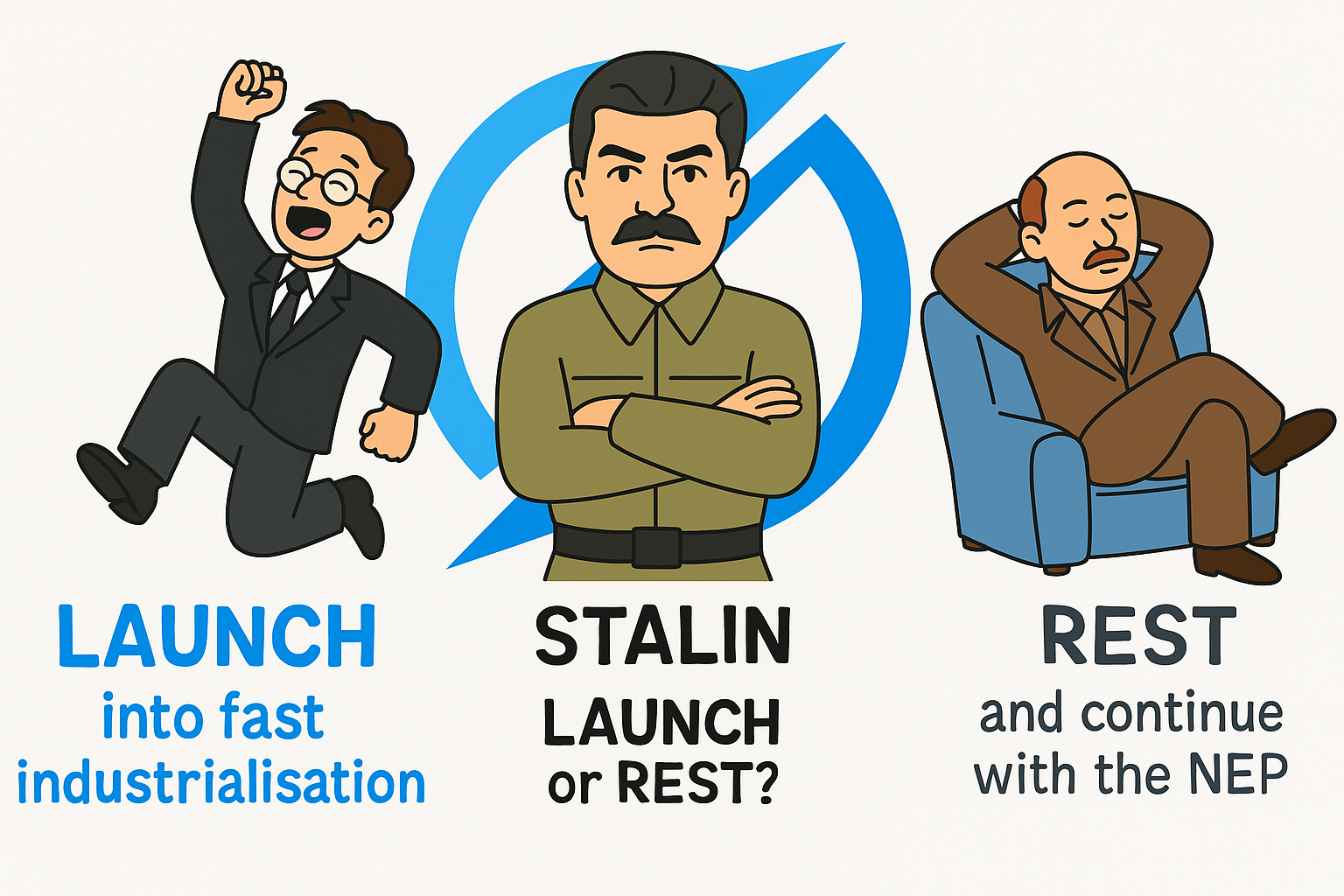
Try creating a revision mnemonic or drawing to help you identify the aims of the Left and Right. An example can be seen below:
"The Left launch, and the Right rest"
Why did the USSR adopt a command economy?
By the late 1920s, the NEP was seen as inadequate to deal with the USSR’s economic challenges
Economic pressures
Agriculture
Peasants were reluctant to sell grain at the low, fixed state prices
In 1927–28, this led to the grain procurement crisis
Peasants hoarded grain instead of selling it, creating shortages in the towns
The crisis revealed that the NEP had not solved the 'grain problem'
The state could not guarantee enough food supplies for the growing urban workforce
Industry
Industrial recovery under the NEP was much slower than agricultural recovery
The gap between agriculture and industry meant peasants had little incentive to trade grain for overpriced manufactured goods
This convinced many Bolsheviks that the NEP could not deliver the rapid industrialisation needed to strengthen socialism
Political pressures
Stalin used the failures of the NEP to:
Discredit the Right
Win the support of the Left and the Centre of the Party
Consolidate his own authority
Ideological goals
Many Bolsheviks saw rapid industrialisation as essential to:
Building socialism
Defending the USSR from capitalist powers
International context
Fear of war with the West made self-sufficiency through industrialisation seem urgent

Unlock more, it's free!
Join the 100,000+ Students that ❤️ Save My Exams
the (exam) results speak for themselves:

Was this revision note helpful?