The Nationalisation of Industry, 1917 (Edexcel A Level History): Revision Note
Exam code: 9HI0

Timeline & Summary
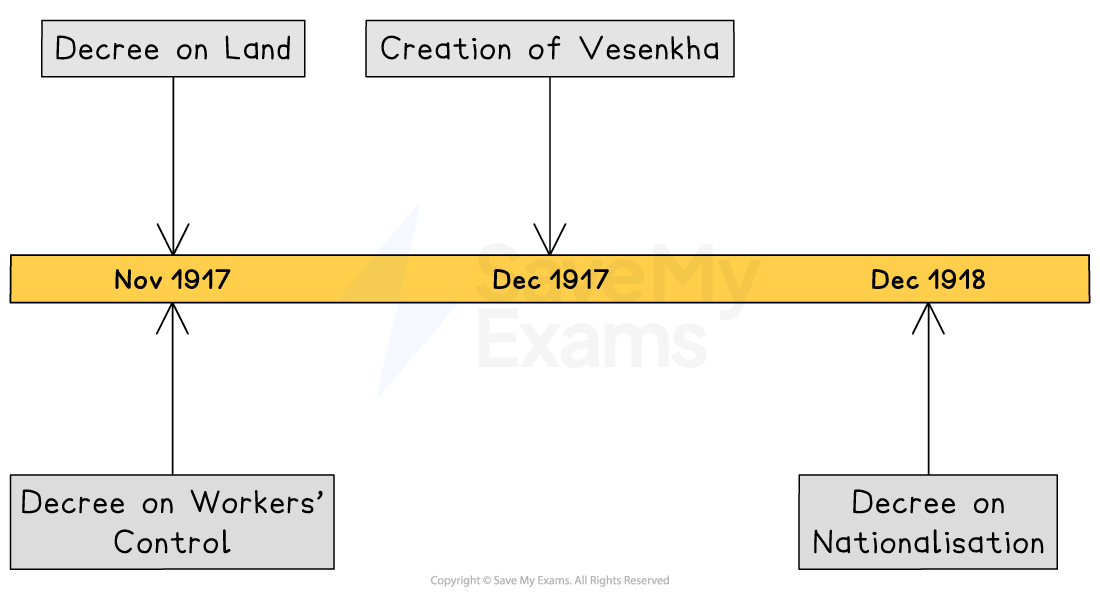
This note will examine the reasons why Lenin nationalised industry in his first year of power
Lenin nationalised industry to bring the economy under Bolshevik control
This went against what the workers wanted
Early decrees in 1917–18 transferred ownership of banks, land, and key industries from private hands to the state
Nationalisation was presented as part of the move toward socialism but also reflected the Bolsheviks’ need to consolidate power
Why did Lenin nationalise industry?
Ideological reasons
Lenin did not believe that the Russian economy in 1917 was advanced or stable enough to move directly into communism
Instead, he developed the idea of 'state capitalism'
This was a transitional phase in which the state would control and manage key parts of the economy
Lenin argued this was necessary because Russia was a backward country compared to the West
Lenin believed from this, the Bolsheviks could build the foundations for socialism in the future
Karl Marx had been vague on how a communist economy should function in practice
He offered little guidance beyond predicting the eventual ending of private property
Political reasons
Nationalisation was not popular with the workers in 1917–18
Many preferred workers’ control
This is where factory committees directly managed production
Lenin briefly allowed this system
However, he decided that the workers lacked the expertise to run industry efficiently
Instead, he insisted that centralised state control was necessary
This secured Bolshevik rule
This also removed power from industrialists and the bourgeoisie, who hated the Bolsheviks
Practical reasons
Russia’s economy in 1917 was collapsing due to;
The First World War
Food and goods shortages
Inflation
Falling production
Nationalisation gave the state power to coordinate production and distribution in order to meet urgent needs
By centralising industry, the Bolsheviks could attempt to stabilise the economy and prevent further issues
Examiner Tips and Tricks
Many students struggle to understand the difference between nationalisation and a communist economy.
In exam answers, avoid writing that nationalisation in 1917 meant that workers gained control of the economy. It was the Bolsheviks who gained control of banks and factories, centralising power in the hands of the new government.
Key decrees on nationalisation
Decree on Land (November 1917)
Abolished private ownership of land
Land was seized from landlords, the Church, and the Tsar’s family and redistributed to the peasants
Decree on Workers’ Control (November 1917)
Gave factory committees the right to supervise management
Workers could set their own:
Production targets
Working hours
Pay
Rules
Creation of Vesenkha (December 1917)
The Supreme Council of the National Economy (Vesenkha) was established to oversee the economy
Vesenkha:
Coordinated production
Set targets
Brought order to the chaotic economy
It symbolised the move from decentralised workers’ control to central state planning
Decree on Nationalisation (June 1918)
Declared that all large-scale industry would come under state control
Industries included:
Banks
Railways
Shipping
Heavy industry
These industries were important to the Bolsheviks during the Civil War
Smaller businesses were also gradually nationalised over time
This marked the end of workers’ control
It laid the foundations for a command economy, where the state directed all major economic decisions

Unlock more, it's free!
Join the 100,000+ Students that ❤️ Save My Exams
the (exam) results speak for themselves:

Was this revision note helpful?