War Communism, 1918 (Edexcel A Level History): Revision Note
Exam code: 9HI0

Summary
This note will examine the causes and impacts of War Communism
War Communism was introduced during the Russian Civil War (1918–21) to keep the Red Army supplied and consolidate Bolshevik control
It involved:
State control of industry
Grain requisitioning
Rationing
The banning of private trade
The policy was closest to communist ideology and prioritised victory in the war
However, War Communism devastated the economy and created huge resentment among peasants and workers
Historians debate whether War Communism was a necessary emergency measure or the beginning of full socialist central planning
Why was War Communism introduced?
The Bolsheviks introduced War Communism in June 1918
There were many reasons for this decision
The Civil War
The Bolsheviks needed to supply the Red Army with food and weapons to win the Civil War
This required a high level of industrial and agricultural efficiency
Economic difficulties
Industrial production and food supplies had already fallen sharply since 1917
Emergency measures were needed to ensure food for soldiers, workers and civilians
Political control
War Communism gave the Bolsheviks tight control over workers and peasants, helping suppress opposition
Ideology
Some radical Bolsheviks saw War Communism as the beginning of a true command economy
They believed its implementation brought Russia closer to socialism
Key features of War Communism
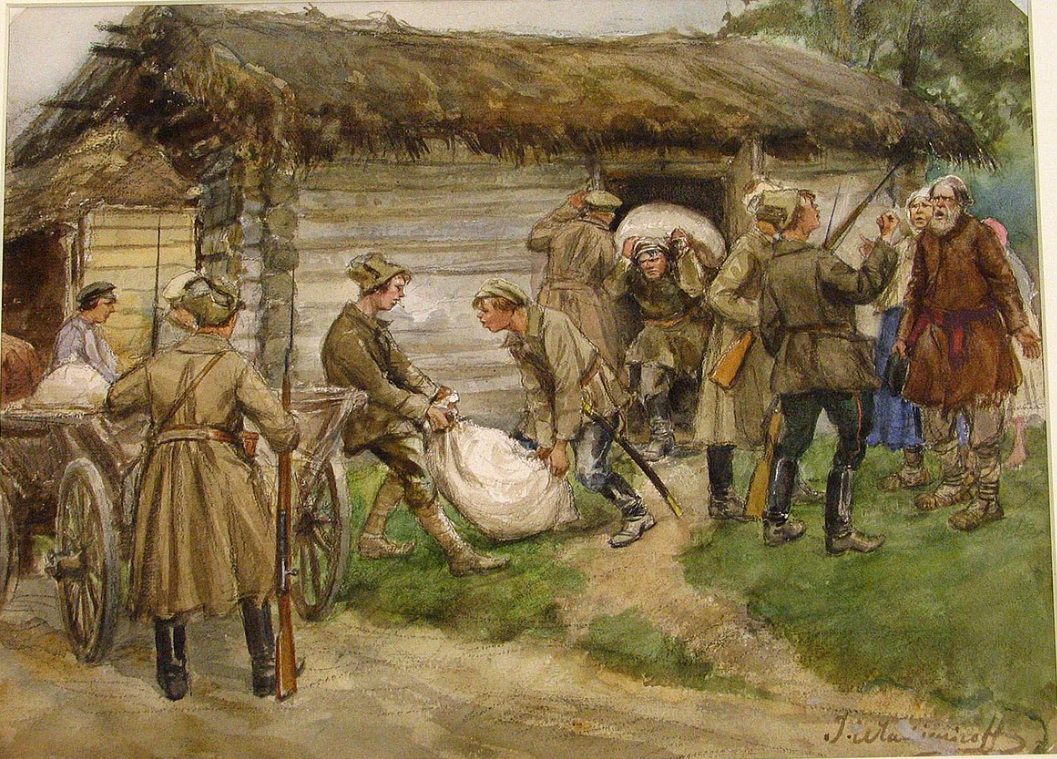
Grain requisitioning
The Cheka seized grain from peasants to feed the cities and army
The peasants did not receive any money for their grain
Rationing
The state distributed food according to class
Workers and soldiers received the largest rations
The smallest rations went to the bourgeoisie
Labour discipline
In 1918, the government extended the working day to 11 hours
In 1919, all physically-able people between 16-50 had to work
They were either conscripted into the army or worked in factories
Workers received harsh punishments for:
Being late
Not meeting production targets
Ban on private trade
The Bolsheviks nationalised all companies
Local markets were made illegal
Goods could only be exchanged through state channels
The government over-printed money, causing hyperinflation
Money became worthless so it was abolished
Companies 'paid' workers through rations
Public transport became free
Bolsheviks such as Lenin and Bukharin argued this was a step towards communism
Impacts of War Communism
On peasants
Grain requisitioning created hostility
Peasants often hid or destroyed crops, rather than give them to the state
By 1921:
The grain harvest was about half of that achieved in 1913
Famine affected large parts of Russia, particularly the Volga region
Estimates suggest around 6 million people died due to the famine
On workers
Industrial output fell drastically
By 1921, production was only 20% of 1913 level
Workers resented harsh discipline and falling living standards
The industrial workforce declined from 3 million in 1917 to 1.2 million in 1922
Urban food shortages led to starvation and population decline in cities
Many workers left the cities to work in farms for food
On the economy
The economy collapsed
Agricultural and industrial productivity both plummeted
Russia had shortages in essential goods, such as fuel
The black market boomed under War Communism
Around 60% of people's food came from the black market
Workers stole government resources to barter for food
On politics
The social and economic impacts of War Communism caused political unrest
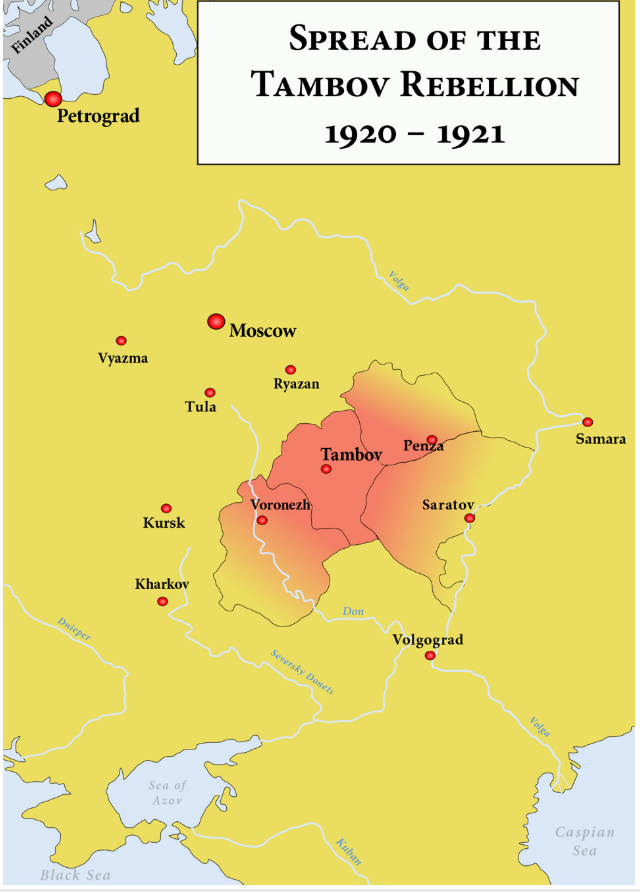
Tambov Rebellion (August 1920– June 1921)
A major peasant uprising in the Tambov region
Sparked by resentment at grain requisitioning and famine conditions
Peasants, led by Alexander Antonov, formed a well-organised guerrilla force of around 50,000 fighters
The rebellion was only suppressed with extreme brutality, including the use of poison gas
Kronstadt Rebellion (1921)
An uprising by sailors at the Kronstadt naval base
They had once been among the strongest supporters of the Bolsheviks in 1917
The rebels demanded “Soviets without Communists”, calling for:
Free elections within the soviets
Free trade
An end to grain requisitioning
The rebellion was crushed by the Red Army under Trotsky
The government killed or imprisoned thousands of the sailors
Its significance lay in the fact that even loyal Bolshevik supporters turned against the regime
Examiner Tips and Tricks
To succeed at A Level History, it is important to look at multiple perspectives before judging if an event or policy was a success.
For War Communism, it caused significant economic, political and social problems. However, consider whether the Bolsheviks could justify this impact in the circumstances of a communist uprising and civil war.
How successful was War Communism?
Historians debate whether War Communism was a necessary emergency policy or a reckless experiment in socialism
War Communism as a necessary measure
Some historians argue War Communism was essential to the Bolsheviks' survival, especially during the Civil War
Key historians
"While War Communism policies were in force, it was natural for Bolsheviks to give them an ideological justification - to assert that the party, armed with the scientific ideology of Marxism, was in full control of events, rather than simply struggling to keep up... The Bolsheviks' first steps were cautious, and so were their pronouncements about the future. However, from the outbreak of the Civil War in the mid-1918, the Bolsheviks' earlier caution began to disappear. To cope with a desperate situation, they turned to more radical policies, and, in the process, tried to extend the sphere of centralised government control much further and faster than they had originally intended. In 1920, as the Bolsheviks headed towards victory in the Civil War, and disaster in the economy, a mood of euphoria and desperation took hold, with the old world disappearing in the flames of Revolution and Civil War. It seemed to many Bolsheviks that a new world was about to arise, phoenix-like from the ashes." - Sheila Fitzpatrick, The Russian Revolution (1994)
"The introduction of War Communism was essentially a political response to the urban crisis of 1918... The Bolsheviks were all too conscious of the fact that their power base, like that of the Communards, was confined to major cities and that they were facing defeat because they were surrounded by a hostile peasantry with whom they had no goods to trade for food. They had convinced themselves that, unless they extended their power to the countryside and launched a crusade against the grain-hoarding peasants, their urban revolution, like that of the Commune, would be destroyed by starvation. The flight of the workers from the cities and their strikes and protests against food shortages were seen as the first signs of this collapse. It was essential, as the Bolsheviks saw it, to seize the peasantry's grain by force, to stem the chaos of the bag-trade, and to get a firm grip on industry if they were to avoid certain defeat." - Orlando Figes, A People’s Tragedy (1996)
War Communism as a failed experiment
Others see it as an attempt to push Russia prematurely toward socialism
They argue that War Communism caused significant social and economic damage
Key historians
"In truth, war communism was a tragic travesty of the Marxist vision of the society of the future. That society was to have as its background highly developed and organized productive resources and a superabundance of goods and services. It was to organize and develop the social wealth which capitalism at its best produced only fitfully and could not rationally control, distribute, and promote. Communism was to abolish economic inequality once for all by levelling up the standards of living. War communism had, on the contrary, resulted from social disintegration, from the destruction and disorganization of productive resources, from an unparalleled scarcity of goods and services. It did indeed try to abolish inequality; but of necessity it did so by levelling down the standards of living and making poverty universal." - Isaac Deutscher, The Prophet Armed. Trotsky : 1879-1921 (1954)
"Until March 1921, the Communists tried, and in some measure succeeded, in placing the national economy under state control. Later, this policy came known as "War Communism" - Lenin himself first used this term in April 1921, as he was abandoning it. It was a misnomer coined to justify the disastrous consequences of economic experimentation by the alleged exigencies of the Civil War and foreign intervention. Scrutiny of contemporary records, however, leaves no doubt that these policies were, in fact, not so much emergency responses to war conditions as an attempt, as rapidly as possible, to construct a communist society... These experiments left Russia's economy in shambles." - Richard Pipes, Russia under the Bolshevik Regime (1994)

Unlock more, it's free!
Join the 100,000+ Students that ❤️ Save My Exams
the (exam) results speak for themselves:

Was this revision note helpful?