Employment in the USSR, 1917–1953 (Edexcel A Level History): Revision Note
Exam code: 9HI0

Summary
This note will examine the importance of employment to the development of the Soviet state
The Bolsheviks promised to create a classless workers’ state where everyone had a job
Lenin initially aimed for worker empowerment
However, Lenin faced huge economic disruption during the Civil War
This led to greater state control and compulsory labour
Under Stalin, employment became a tool of industrial growth and social discipline
The USSR achieved full employment by the 1930s
However, living standards, safety, and welfare remained low
Historians still debate whether this achievement represented genuine social progress or merely another form of state control
The labour market under Lenin
Marxism and work
Marx viewed work as a creative and collective activity
It should not be something exploited for private profit
Under Communism, work was meant to:
Unite workers in shared purpose
Abolish class divisions between workers and owners
Create a society where labour served need, not greed
Work and benefits under Lenin (1917–1918)
Decree on Workers’ Control (1917)
This allowed workers to oversee factory management
Workers’ committees were formed but lacked experience, leading to:
Disruption and conflict with managers
Declines in productivity
In response, Lenin argued for state supervision to bring order
The Declaration of the Rights of the Toiling and Exploited People (1918)
This promised to abolish private ownership
It guaranteed:
The right to employment and rest
Protection through social welfare
The goal of ending exploitation by employers
In theory, this gave workers political and economic rights
Work under War Communism (1918–1921)
Compulsory labour
Economic collapse during the Civil War and War Communism caused mass unemployment and food shortages
The 1918 Constitution declared, “He who does not work shall not eat”
To restore production, the state introduced labour conscription
This meant that all able-bodied people between 16 and 50 were required to work
Labour brigades were formed
The state drafted workers into industries vital to the war effort
Rationing and worker facilities
Rationing determined food supplies based on social class:
Workers and soldiers received the largest rations
Bourgeois professionals received the least
Workers were provided with:
Basic canteens
Communal housing
Crèches
Limited healthcare and welfare services
However, corruption, low morale, and food shortages persisted
Failures of War Communism
Productivity collapsed by over 70%, and factory output plummeted
Many workers fled the cities for food in the countryside
By 1921, the urban population had fallen by almost half
A black market emerged, undermining the state economy
Labour conscription became unpopular and unworkable, contributing to strikes and uprisings
Work and benefits under the NEP (1921–1928)
Employment and productivity
Ended compulsory labour
Allowed some private enterprise
Small workshops and private traders (Nepmen) reappeared
This employed thousands
Agricultural recovery created a surplus of labour, especially as soldiers returned from the Civil War
Urban unemployment rose to around 1.2 million by 1924
This was mostly among young people and women
1922 Labour Law
Introduced to stabilise the post-war economy and formalise workers’ rights
The act:
Legalised collective bargaining
Guaranteed sick pay and maternity leave
Standardised working hours and conditions
However, these rights mostly applied to state workers, not those in private trade
Social insurance (1922–1924)
Lenin’s government introduced social insurance for industrial workers, covering:
Accidents
Sickness
Unemployment
By 1924, over 9 million workers were insured
Funding came from taxes on employers and local soviets, not workers’ contributions
However, peasants did not receive social insurance
This accounts for the majority of the population
Examiner Tips and Tricks
High-level responses at A Level History depend on your ability to interconnect your knowledge of political, social and economic themes across the course.
Therefore, strong answers will connect employment to wider economic policies like War Communism, the NEP, and the Five-Year Plans. This is vital to understanding cause and consequence.
Employment policies under Stalin
The drive for full employment
Stalin’s First Five-Year Plan (1928) transformed employment:
Millions moved from the countryside to cities
New industrial centres like Magnitogorsk and Kuznetsk were built
By the early 1930s, the USSR officially claimed to have eliminated unemployment
Labour discipline and social control
Harsh labour laws ensured obedience:
Absenteeism was criminalised in 1940
Internal passports (1932) restricted movement between jobs or cities
Employment was tied to ration cards, housing, and social status
This made it impossible to survive outside the system
Forced labour through the GULAG system provided a vast supply of manual labour
Work conditions
Factories were often:
Unsafe
Overcrowded
Poorly ventilated
Sanitation and healthcare lagged behind industrial growth
Accidents were frequent
Industrial deaths rose sharply during the first two Five-Year plans
Social conditions
Wages and living standards
Real wages fell in the 1930s despite economic growth
Shortages of food and consumer goods remained common
Health and welfare
Infant mortality was high
Around 160 deaths per 1,000 births in 1930
Limited medical care was available at workplaces,
However, hospitals could not cope with demand
Welfare improved slightly post-1945, but remained uneven
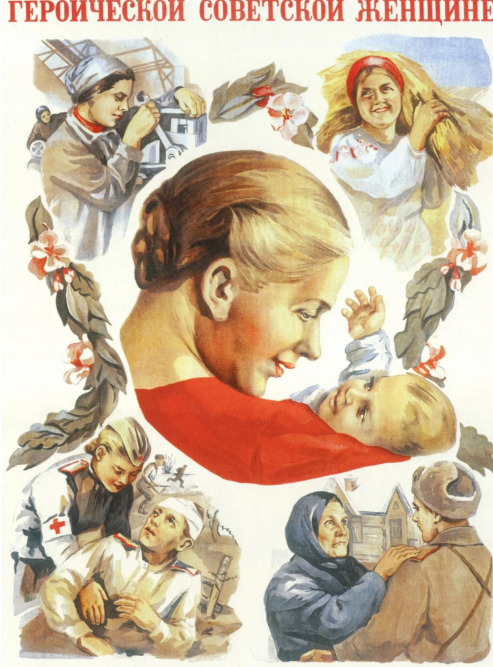
Women in the workforce
Female employment rose dramatically:
By 1940, 43% of industrial workers were women
By 1950, this had risen to 53%
However, women were concentrated in low-paid and unskilled roles, such as:
Textiles
Food production
Propaganda promoted the 'double burden' ideal
Women were expected to work and manage the household
Did the USSR achieve 'full employment'?
By the 1930s, the state declared unemployment abolished
Historians debate whether this was a victory for the state or evidence of state control
Victory for the state - the Soviet perspective
Stalin presented full employment as proof of socialism’s superiority over capitalism during the Great Depression
Key historians
"The labour legislation of 1922 reasserted some of the principles of past decrees, and laid down some new ones. Workers were entitled to an eight-hour day (less in heavy work), two weeks’ holiday with pay, social insurance benefits (including sick pay, unemployment pay, medical aid). Collective agreements between management and unions would regulate wages and working conditions. A disputes commission, with the union strongly represented, would consider grievances. The regime could point with pride to such legal enactments; they were well ahead of their time... Of course, one must also take into account the improvement in social services, the elimination of unemployment, and the undeniable fact that many ex-peasants who moved into industry were earning more than they would have earned had they remained on the farms." - Alec Nove, An Economic History of the USSR, 1917-1991 (1992)
"The Soviet Union was the workers’ state, and while historians have often emphasized the exploitation of the working class during and after Stalinism, worker culture, broadly defined, nevertheless coloured the whole of the Soviet experience. Workers were always celebrated. They were at the centre of the most transformative Soviet project of all, Stalin’s industrial revolution of 1928-41. During especially the first half of that revolution, workers benefited from specific privileges and from affirmative action, though they also suffered the dreadful misery of rapid industrial change. Many in the Brezhnev generation, born in the decade or so before 1917, started their careers as workers before gaining an industrial higher education and entering the ranks of the technical intelligentsia. Later in Soviet history, many such men and women, who had been formed by working class culture, could be found higher in the ruling order. Capable, at a stretch, of remembering what it was like to be a worker, such people had nevertheless risen out of the working class. For this lucky minority, the workers’ state offered a ladder into the technical and administrative elites. For those who remained, by the post-Stalin era, it offered a workers’ standard of living that was much closer to that of the bosses than in capitalist economies." - Mark B. Smith, The Life of the Soviet worker (2014)
State control- the Western perspective
Employment was often compulsory, not voluntary
Forced labour filled gaps, while genuine job satisfaction was rare
Living standards were low, and workers lacked basic freedoms
“Full employment” was achieved, but without dignity or choice
Key historians
"In the early period of Soviet power the Soviet leadership encouraged full employment primarily to bring about economic advance—to create the material basis of communism... There is a tension in Soviet society between the necessary requirements of the economy and the aspirations of many people. The provision of work is a traditional social goal, both for the individual and the society of which he or she is part, and has to be reconciled with the aspirations for different types of work expressed by individuals... Soviet policymakers are therefore constrained by two basic ideological objectives which have not been adopted by governments under capitalism: (a) the provision of work for all the population and (b) the requirement of giving opportunities to people to find satisfaction in work" - David Lane, Labour and employment in the USSR (1986)
"The official Soviet ideology contends that there is no unemployment in the Soviet Union; that every Soviet citizen has the right to work, guaranteed constitutionally; and that full employment of the able-bodied population has been ensured in the country. However, these claims must be taken with caution. The first means in effect merely that registered unemployment is absent, because unemployment benefits are not available. In connection with the second it should be remembered that work is not only a right but also a duty and a matter of honor, and that in practice the former neither eliminates open but unregistered unemployment nor assures employment at skill level and in the desired locality. And the third conceals the fact that full employment is economically irrational, i.e., characterized by considerable under-utilization and waste of working time and qualifications. Since in the Soviet Union full employment is economically irrational in the sense mentioned, it has on the one hand a pronounced social dimension which arises from the nature of command socialism, the regime's policies, and the vested interests of individual role-players; on the other hand, it has adverse economic, behavioral, and attitudinal consequences. And this also raises the question of social deprivation and of official and unofficial response to it." - J. L. Porket, Social deprivation under Soviet full employment (1988)

Unlock more, it's free!
Join the 100,000+ Students that ❤️ Save My Exams
the (exam) results speak for themselves:

Was this revision note helpful?