Housing & Social Benefits in the USSR, 1917–1953 (Edexcel A Level History): Revision Note
Exam code: 9HI0

Summary
This note will examine the changes to living standards in the Soviet Union
The Bolsheviks saw housing and welfare as essential to creating a socialist society
Lenin’s early reforms promised to redistribute space and wealth
However, the Civil War and economic collapse made conditions worse
Stalin transformed cities through industrialisation and mass urbanisation
However, overcrowding and poor living conditions became normal
By 1953, most Soviet citizens had access to basic healthcare and education
Housing shortages and inequality persisted
Historians debate whether these changes were steps towards socialism or evidence of state control disguised as welfare
Housing & social benefits under Lenin
Redistribution of property (1917–1918)
The Decree on Land (1917) gave local soviets authority over private property
Urban housing owned by the bourgeois was seized and redistributed to working-class families
Lenin’s government encouraged collective living
This is where several families shared communal facilities
This was inspired by Marxist ideals of cooperation
In Petrograd and Moscow:
Wealthy families were forced to share their apartments with workers
Each family was allocated one room, while kitchens and bathrooms became communal
Some city soviets experimented with rent-free housing to improve equality
However, funding problems limited success
Denationalisation of housing under the NEP (1921–1928)
Under the NEP, housing management was transferred from central government to:
Local authorities
Cooperatives
Private landlords
Rents were reintroduced
Many wealthier individuals reclaimed property they had lost in 1917
Urban inequality reappeared:
Wealthier Nepmen could afford spacious apartments
Workers and civil servants remained in cramped conditions
Constructivist design
In the early 1920s, avant-garde architects designed constructivist buildings to reflect a new socialist modernity
These buildings used glass, steel, and open layouts to symbolise:
Efficiency
Equality
Progress
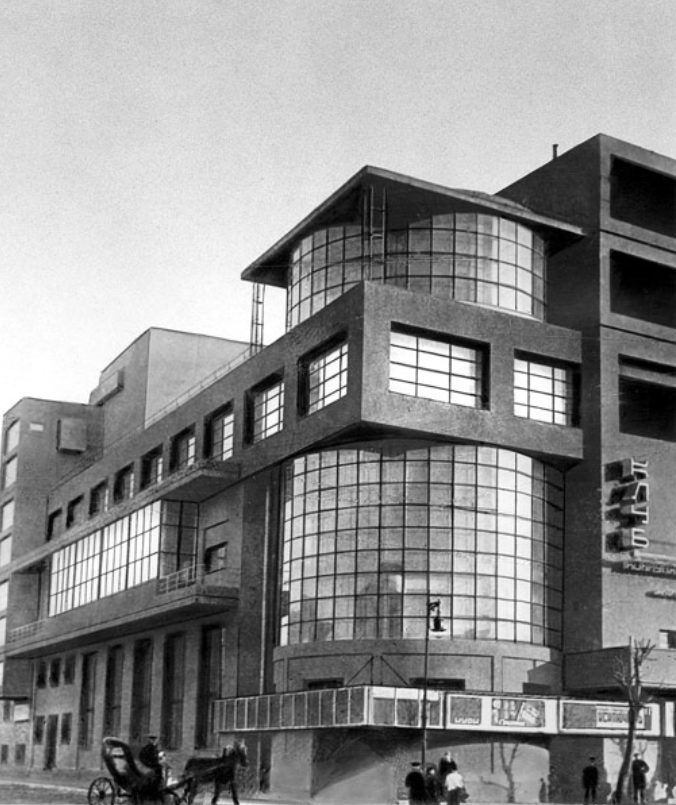
The Zuyev Workers’ Club
The Zuyev Workers’ Club (1928, Moscow) by Ilya Golosov became a model example of Soviet living:
It contained a canteen, gym, reading room, and theatre for workers
It represented a vision of the “new Soviet man” as educated, social, and part of a collective
However, most constructivist projects remained experimental
They were too expensive and impractical to mass-produce
Housing & social benefits under Stalin
Kommunalka: The communal apartment
Stalin’s industrialisation caused mass migration to cities
The urban populations doubled between 1928 and 1939
To house workers quickly, the state divided large bourgeois apartments into communal flats, or kommunalki
Features of kommunalka life
Each family occupied one room, while kitchens, bathrooms, and corridors were shared
There was a lack of privacy was minimal
Families cooked and bathed in shifts
Conflicts commonly occurred over space and noise
The kommunalka symbolised urban socialism in practice, but also overcrowding and inequality
By 1940, the average kommunalka was four square metres
By the late 1930s, over 60% of urban families lived in communal housing
Examiner Tips and Tricks
The examiner is not expecting you to know every detail and statistic about housing in the USSR.
Focus on memorising one key statistic, one achievement and one weakness of housing in Lenin and Stalin's rule to ensure you have enough own knowledge to answer an essay question.
G.À.: So in the first from there was one woman, that's one, in this one three, that's four, we'll count together. Four? In this... room there was one, that's five, in these two, seven, that's ten, in this one three people, thirteen, and our family had, it had four, thirteen and four, that's seventeen, and there were four of them. How much is seventeen and four? Twenty-one. There were twenty-one people living here before the war.
Ilya: And why were there so many after the war, forty?
G.À.: People were moved in into every room, big families too, a small seven-meter room had four people. People were moved in. Then grandma came, so there were five. After the war this apartment had forty people. There were forty people here.
An account from G.À., a woman born in 1932 who lived in a kommunalka. Ilya is an anthropologist doing field work in communal apartments.
Industrial towns and housing (1930s–1940s)
Massive new industrial centres like Magnitogorsk and Kuznetsk were built during the Five-Year Plans
Housing reflected Stalin's priorities:
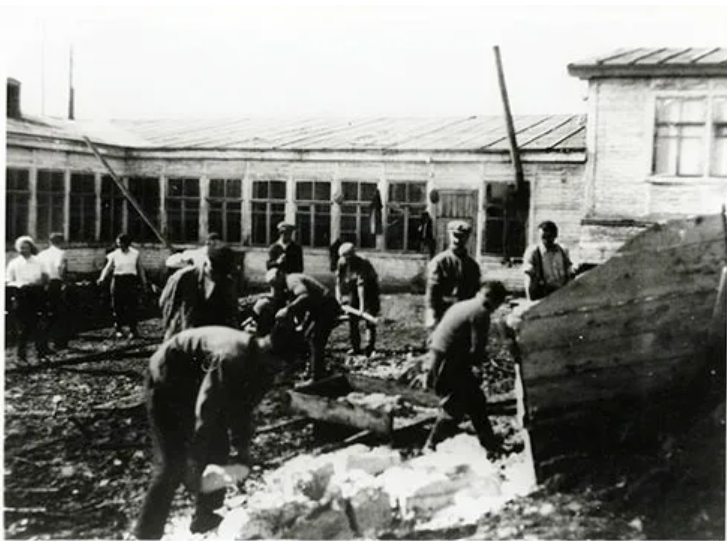
Workers quickly built barracks with minimal facilities
Managers and Party officials received larger, brick-built homes near industrial plants
Many early settlements lacked running water, street lights or sewage systems
Housing after the Second World War (1945–1953)
Urban housing
The Second World War destroyed around one-third of housing in Soviet towns
Reconstruction was slow
The state encouraged workers to build their own housing
The scheme was unsuccessful due to a lack of building supplies and bureaucracy
Workers often lived in temporary wooden huts or reused barracks
New housing prioritised industrial workers over civilians
New housing was of poor quality with no Sanitation
Housing on collective farms
Most rural housing remained poorly developed
Khrushchev's house building project in Ukraine was successful
Between 1945-1950, there were:
4,500 farming villages built
250,000 agricultural production buildings created
Khrushchev wanted to replicate his programme in Moscow
Stalin prevented his plans due to the cost
Had housing & social benefits improved by 1953?
Historians debate whether housing and welfare reforms reflected genuine improvement or were simply tools of social control
Genuine improvement in housing
Some historians argue that the Bolsheviks improved living standards
They highlight Stalin’s housing programmes as a triumph
Workers were housed and cities modernised
Key historians
"The amount of benefits, particularly pensions, remained small, but there was no denying that the Soviet state had embraced a broad conception of social welfare—extending from employment and income to affordable housing, health care, and organized leisure—and had done so without prodding" - Stephen Kotkin, Magnetic Mountain: Stalinism as a Civilization (1995)
"The living conditions of citizens were at last given prominence. Industrial consumer products were planned to increase by 134 per cent and agricultural output by 177 per cent in 1933-7. Housing space was to expand by two fifths... Conditions did not worsen for everyone in the 1930s. Jobs became available offering improved salary, housing and consumer goods for promotees." - Robert Service, Stalin: A Biography (2004)
Housing improvements as a method of control
Other historians argue that a focus on communal living was uncomfortable and degrading
It also encouraged citizens to spy on each other, fuelling the terror state
Key historians
"Despite the extraordinary growth in the Soviet urban population in the 1930s, residential housing construction was almost as neglected as the manufacture of consumer goods. It was not until the Khrushchev period that any thing was done to alleviate the tremendous overcrowding that had characterized Soviet urban living for over a quarter of a century. Meanwhile, people lived in communal apartments, usually one family to a room, and in dormitories and barracks...Life in a communal apartment, side by side with people of different back grounds and classes who were strangers sharing facilities and the responsibility of keeping them clean, without privacy and under constant surveillance by neighbors, was extremely stressful for most people." - Sheila Fitzpatrick, Everyday Stalinism: Ordinary Life in Extraordinary Times: Soviet Russia in the 1930s (2000)
"In Moscow and Leningrad three-quarters of the population lived in communal apartments in the middle of the 1 930s, and that way of living remained the norm for most people in those cities throughout the Stalin period. Along with everything else, the kommunalka, too, changed in nature in the 1930s. Whereas its purpose in the 1920s was to address the housing crisis and at the same time strike a blow against private life, it now became primarily a means of extending the state’s powers of surveillance into the private spaces of the family home. After 1928, the Soviets increasingly tightened their control of the ‘condensation’ policy, deliberately moving Party activists and loyal workers into the homes of the former bourgeoisie so that they could keep an eye on them... Informers were everywhere — in factories and schools and offices, in public places and communal apartments. By any estimate, at the height of the Great Terror millions of people were reporting on their colleagues, friends and neighbours, although it is hard to be precise because there are only scattered data and anecdotal evidence." - Orlando Figes, The Whisperers: Private Life in Stalin's Russia (2007)

Unlock more, it's free!
Join the 100,000+ Students that ❤️ Save My Exams
the (exam) results speak for themselves:

Was this revision note helpful?