What Role did the Rise of Nationalism Play in the Collapse of the USSR? (Edexcel A Level History): Revision Note
Exam code: 9HI0

Summary
This note will examine how the rise of nationalism contributed to the collapse of the USSR
Before Gorbachev, nationalism was tightly controlled through political centralisation, censorship and repression
Although each republic had its own Supreme Soviet, real power rested with the Soviet Communist Party in Moscow
The KGB monitored nationalist groups, punished dissidents and restricted cultural expression
Russian dominance in government, education and culture reinforced the idea of a unified “Soviet people”
Under Brezhnev, limited cultural expression was allowed, but nationalism was still contained through
Incentives
Propaganda
Strict political oversight
Gorbachev’s reforms undermined these controls, such as
Glasnost
Democratisation
Anti-corruption campaigns
Historians debate whether nationalism would have remained manageable without Gorbachev’s reforms
Or whether the Soviet Union’s national tensions made collapse inevitable
Argument 1: Gorbachev could have stopped the rise of nationalism
Some historians argue that Gorbachev could have prevented nationalism from becoming a major threat because it was his own reforms that encouraged nationalist demands for autonomy and independence
The removal of local leaders
Gorbachev argued that an efficient government was more important than a representative government
Claiming that jobs should go to the best candidates
This aimed to remove corruption
Many local non-Russian government officials were sacked and replaced by Russians
People employed in the top positions in the Soviet Government were also sacked and replaced by Russians
Creating resentment and resulting in riots
For example, the riots in Kazakhstan in 1986, when a local First Secretary was replaced by Gennadii Kolbin
Economic failure
The economic reforms introduced by Gorbachev resulted in the decline of the
Economy
Standard of living
Such a decline resulted in growing nationalism
As the people associated this decline with the new government, not the old one
Glasnost
Glasnost resulted in the rise in nationalism, as it
Showed the discrimination that non-Russian people faced during Stalin's government
Showed how high the Western standard of living was in comparison to the Soviet Union
Showing that the Soviet Union did not benefit the people
Allowed for publications of nationalist groups
Asking for more autonomy
The Sinatra Doctrine
Gorbachev rejected the Brezhnev Doctrine in 1989
Renouncing the Soviet Union's right to interfere in other socialist countries
This had previously been the stance of the Soviet Union since the 1940s
Gorbachev announced his own policy, known as the 'Sinatra Doctrine'
Stating that satellite states could follow their own path to Communism
This resulted in the fall of Communism across Eastern Europe between June 1989 and October 1990
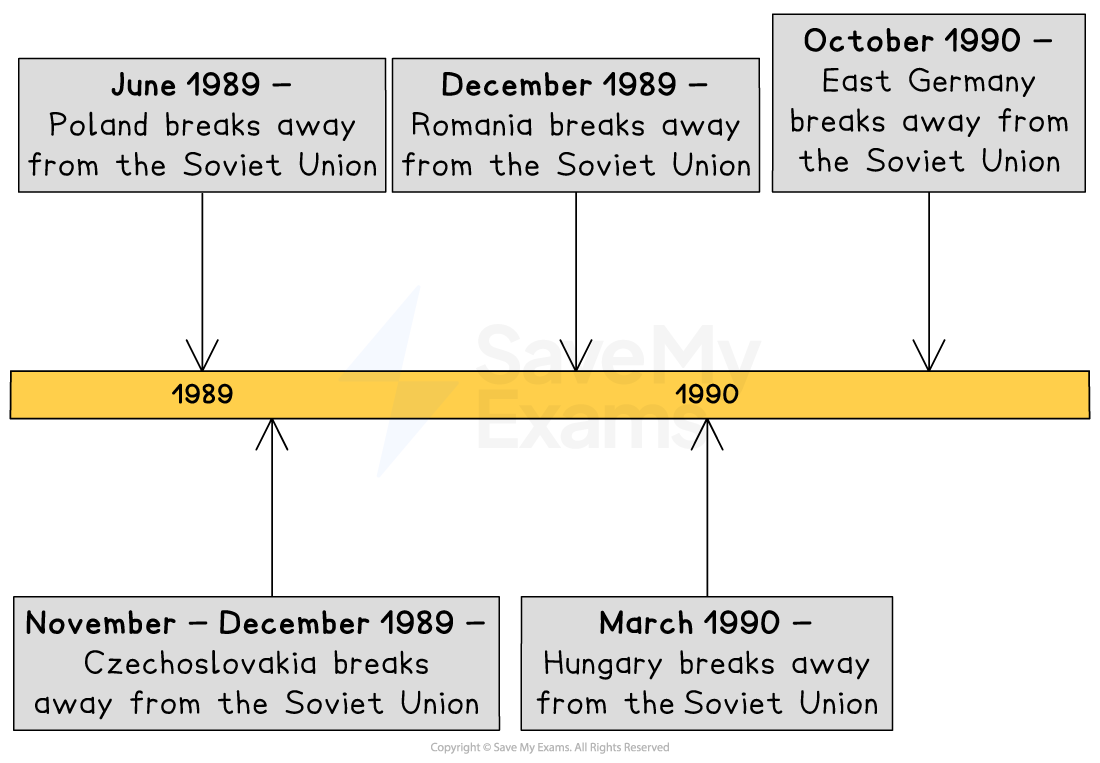
Gorbachev had not anticipated the collapse of Soviet control in Eastern Europe
However, his actions had allowed it to happen, as he did not allow Soviet troops to restore Communist rule
Democratisation
Democratisation allowed for nationalist groups to win elections as Gorbachev introduced competitive elections between 1989 - 1990
Nationalist candidates won in several republics
The first was in Lithuania in 1990, when they declared independence
Gorbachev declared that this was illegal and placed economic sanctions, which were lifted by the summer of 1990
Boris Nikolayevich Yeltsin proceeded to introduce laws which made the Russian parliament superior to Soviet laws in May 1990
Giving Russia independence from the Soviet Union
Overall, nationalism became a major threat because of Gorbachev’s reforms
Suggesting that if he had acted earlier or maintained traditional methods, he could have prevented nationalism from escalating into a crisis.
Key historian
"Gorbachev's most important failure was not to reconcile the results of glasnost with the rise of the national question in the Soviet Union. Problems in the republics emerged almost immediately upon his taking office and were only increased y the more tolerant atmosphere within the media. In the Baltic states, there were widespread protests. Arguably, Gorbachev could have negotiated the departure of the three Baltic states from the USSR and still maintained the union. His hesitation ensured that the initiatives of the Baltic leaders, and particularly the popular fronts, spread to the other republics.
The rise in national sentiments in the republics received a significant boost from the downfall of communist regimes in Eastern Europe. In the first instance, Gorbachev's abandonment of the Brezhnev Doctrine led to the overthrow of the obsolete communist governments in Poland and East Germany, which had almost no popular support. When the Soviet Union did not respond to stop the fall of communism in Eastern Europe, the Soviet republics could act with more confidence." - David R Marples, The Collapse of the Soviet Union, 1985-1991, (2004)
Key historian
"Gorbachev's miscalculations were so enormous that some contemporary observers thought they might be 'deliberate mistakes'. In other words, that he was following a secret agenda and was working to bring down the Soviet regime. First, he authorised the spending spree of 1985-86, which undermined the country's financial stability. The financial stability of the Soviet Union was already more seriously threatened than he realised, since his predecessors had treated financial matters as top secret.
Second, he underestimated the seriousness of national tensions within the Soviet Union, which could not be easily resolved by the rational, common sense methods he applied. Third, although he believed that the socialist option was irreversible, he weakened the party machinery that embodied it.
Finally, in 1990, he refused to endorse the programme of his adviser Shatalin for transition to a free market. All of these miscalculations were rooted in a failure to appreciate the true nature of the Soviet political system, which, being totalitarian, was held together ultimately by coercion and deceitful propaganda." - John Keep, A History of the Soviet Union 1945-1991, (1995)
Examiner Tips and Tricks
When evaluating interpretations, show how historians place different levels of responsibility on Gorbachev.
Some emphasise that his reforms, such as democratisation, anti-corruption campaigns and the Sinatra Doctrine, removed the controls that had previously kept nationalism contained.
Others argue that Gorbachev simply exposed long-standing national grievances that had been suppressed for decades.
Explaining why historians disagree demonstrates high-level evaluative skill.
Argument 2: Nationalism in the republics was the most important reason for the collapse of the USSR
Some historians argue that nationalism in the Soviet republics was the key reason for the collapse of the USSR
As national groups across the Union demanded autonomy and independence, the government lost the ability to keep the republics together
Nationalist protests and violence
Nationalist protests and violence happened across many of the republics
A protest happened in Karabagh, Azerbaijan, for the unification of Armenia in 1988
Resulting in Gorbachev introducing direct rule of Karabagh
This did not please nationalists, which led to massacres and mass migration of Armenians
Both Armenia and Azerbaijan denounced the corruption of the Soviet Union
By the end of 1989, the Communist Party lost control of the Republic of Azerbaijan
In 1990, nationalists effectively controlled the republic
In 1989, Soviet authorities were unable to restore peace in the Fergana Valley
After Uzbeki nationalists massacred Muslim Meskhetians
This resulted in the loss of faith in the Soviet government
In April 1989, Georgian nationalists protested against the rights of the Abkhazian minority
Soviet troops were able to restore peace by force
Killing 19 Georgia protestors, and thousands were wounded
This resulted in the loss of trust in Soviet authorities by Georgian nationalists as
The Soviet government refused to take responsibility and blamed local officials
The actions of the Soviet government showed that they were willing to use lethal force to stop nationalism
After the Tbilisi Massacre, military commanders refused to use force against protestors
Weakening the government position
Baltic independence
Nationalists in the Baltic states of Latvia, Lithuania and Estonia wanted independence by 1988
Estonia declared itself sovereign from the Soviet Union in November 1988
However, it did not leave but claimed the right to use their old flag and educated citizens in Estonian
Lithuania declared independence after an election in March 1990
Gorbachev refused to accept the outcome of the election and imposed economic sanctions
The sanctions did not force Lithuania to accept their rule, and in January 1991, Soviet soldiers killed 14 people
Yeltsin ordered Russian soldiers to refuse orders to suppress political protest, undermining Soviet rule
Reforming the Soviet Union
Gorbachev proposed a new Union Treaty in 1990 to give republics more power and independence
Nationalist leaders refused to accept the reforms, and Gorbachev was unelected
Leaving him unable to deal with nationalist leaders as an equal
In March 1991, Gorbachev proposed a referendum to all the people in the Soviet Union
Hoping this would strengthen his position
However, six republics refused to take part, and 76% of the voters supported a new union
By July 1991, a draft treaty known as the '9+1 agreement' was designed
Created a federation of independent states with a president
In June 1991, the people voted for Boris Nikolayevich Yeltsin with 57% of the vote
In July 1991, a new draft of the treaty was ready, creating a Union of Sovereign States
Gorbachev agreed this would be signed on 21st August
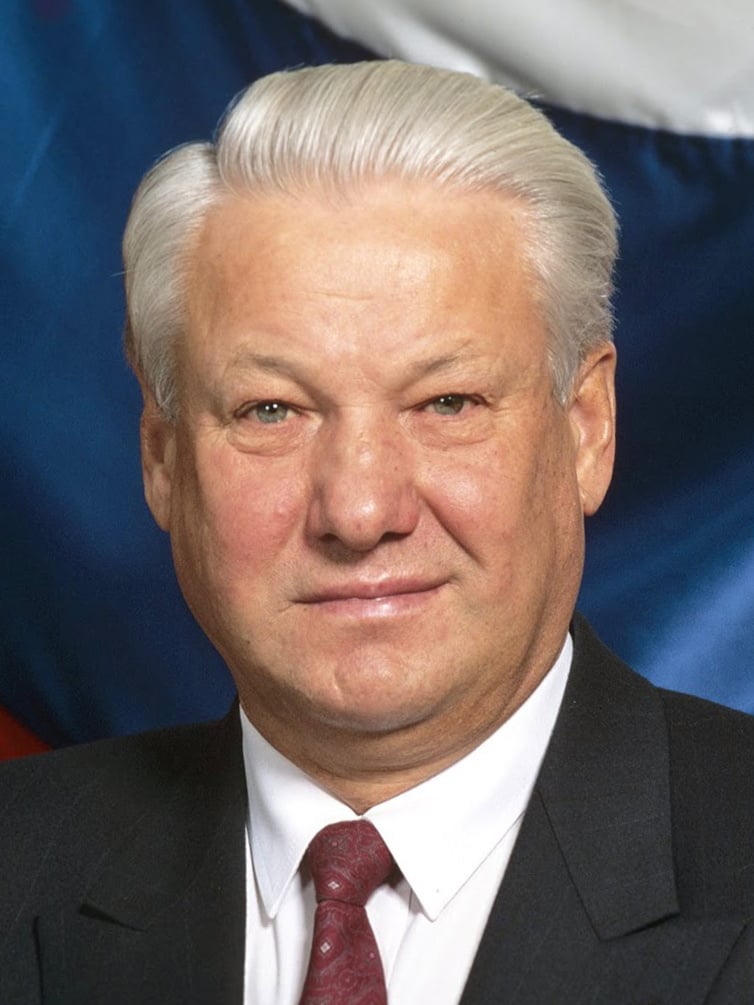
Overall, nationalism made it impossible in the USSR to preserve the Union
The Soviet republics fatally weakened the USSR through
Widespread unrest
Independence movements
The rejection of Gorbachev’s reforms
Key historian
“Came to power in March 1995, the Soviet state was already in a profoundly weakened condition. The Soviet Union had experienced not only years of political and economic stagnation but also a frustrating absence of able and stable leadership in the first half of the 1980s. Weakness in the centre had enabled the local ethnic and regional mafias within the Party-state apparatus to increase their power.
In nearly every Transcaucasian and Central Asian republic, a series of purges (1985 - 1988) eliminated the top leaders, although not without resistance. In Kazakhstan, the removal of long-time party Chief Dinmukhammed Kunaev and his replacement by a Russian brought demonstrators onto the streets.
When these ‘democratic’ forces began to act, the emergence of nationalistic politics burst the bounds of old politics in a number of republics. In a number of Republics - Armenia, Georgia, the Baltic - this rapidly undermined the power of local communist parties. In other Republics, however - in central Asia most particularly - perestroika was contained, and Communist apparatchiks maintained their hold on both state and society.” - Gigor Suny, the Revenge of the Past: Nationalism, Revolution, and the Collapse of the Soviet Union, (1993)
Key historian
“From the end of 1986, at the onset of the period of change, representatives of non-Russian peoples began to express in the press complaints about the Soviet nationality policy, specifically its abuses of non-Russian cultures. Estonian economists and reform-minded officials began to insist on economic and financial independence for their republics. In 1987, groups sprang into various republics to address social, cultural and ecological problems that were often connected with national interests of these people. Ecological movements were particularly active in Armenia, Georgia, Azerbaijan, Estonia and Moldova. In September and October 1987 in Armenia, the greens organised mass demonstrations- an uncommon phenomenon in the Soviet Union at the time. By 1988, the economic and political crisis of the Soviet Union began to be accompanied by an explosion of nationalism and tension in interethnic relations.” - Anatoly Michailovich Khazanoc, After the USSR: Ethnicity, Nationalism, and Politics in the Commonwealth of Independent States, (1995)
Argument 3: Russian nationalism was the most important reason for the collapse of the USSR
Some historians argue that Russian nationalism was decisive in destroying the USSR
As the largest republic, Russia’s shift away from supporting the Union made it impossible for the Soviet state to survive
Russian nationalism
Russian nationalism grew rapidly in the 1980s
Due to the economic crisis in the late 1980s, many Russians no longer believed that the USSR benefited Russia
They blamed the Soviet leaders and demanded change
Nationalists wished for a Russia-first policy, rather than a Soviet one
Nationalist groups began to protect:
Monuments
Historic buildings
Traditional culture
The economic and political crisis led some nationalists to
Argue that Tsarism had been better than Communism
Adopt more openly anti-Semitic and Nationalistic beliefs
Environmental movement and Russian identity
Russian citizens first learned of the scale of the environmental impact of Communism after Chernobyl in 1986
Due to the policy of glasnost, information was made public, which stated that:
Soviet industries had polluted air and water
Used agricultural chemicals that poisoned the land
Created an ecological disaster in the Aral Sea
The use of chemical weapons testing, and oil and gas extraction
The environment became a nationalist issue
Arguing that Soviet rule was harmful to Russia itself
Environmentalists argued that Soviet Communism had damaged Russia's landscape and culture
The coup of 1991 and Yeltsin’s rise
The coup of 1991
Gorbachev was unpopular by 1991, and the new Union Treaty made him more unpopular with hardliners in the Party
On 18th August 1991, it was announced that an Emergency Committee would be created to replace Gorbachev's government
They announced that Gorbachev had resigned due to poor health
However, Gorbachev refused to resign
Yeltsin called for a general strike to resist the coup
The plotters stated that they wanted to prevent the breakup of the Soviet Union
They also insisted that they did not take power in the name of the Communist Party
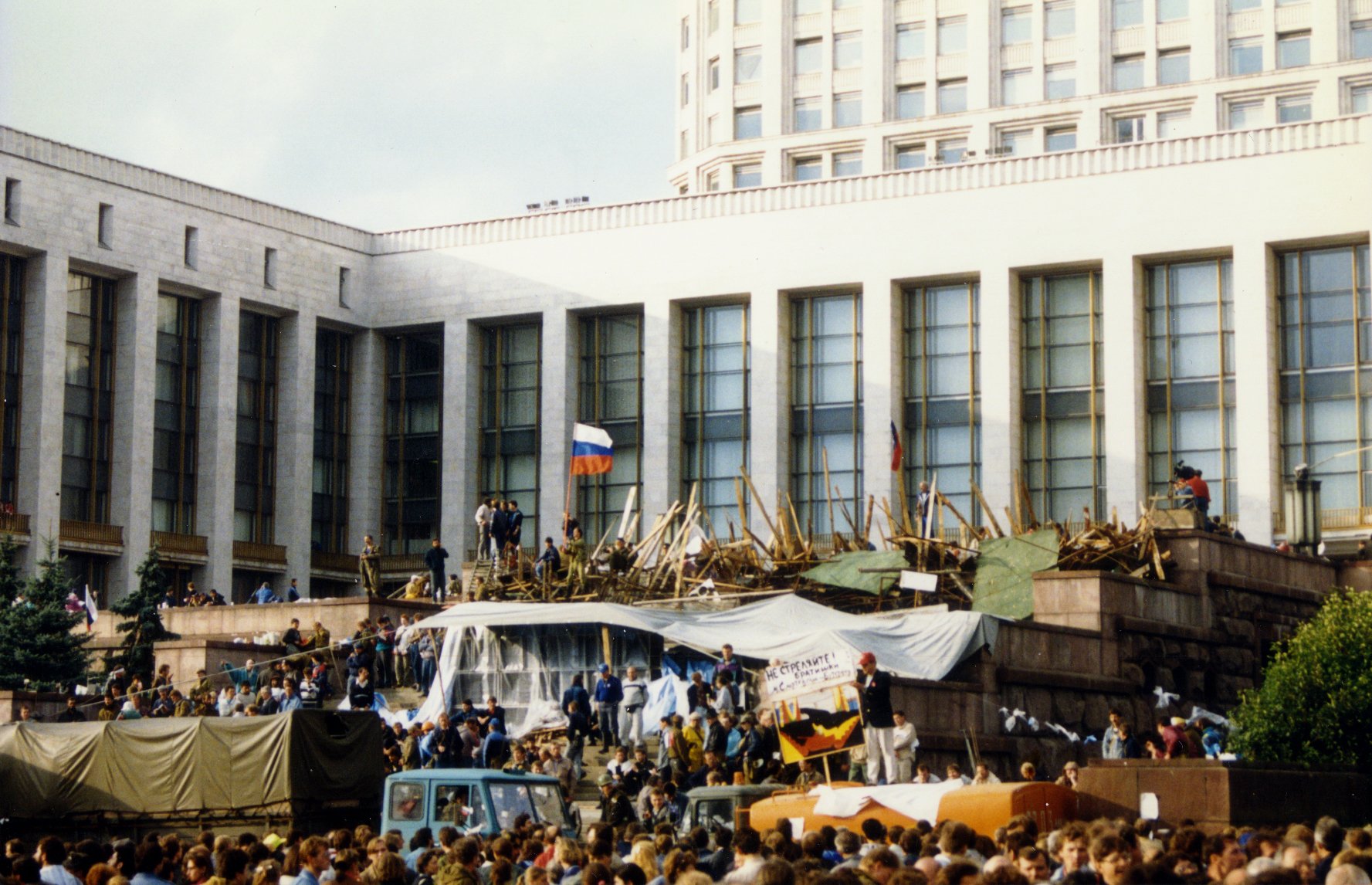
Yeltsin led the resistance against the coup
The Emergency Committee sent army units to the White House to arrest him
However, the soldiers refused to follow orders
Yeltsin demanded that Gorbachev return as president of the Party
Without the support of the army, the coup failed on August 21st
Yeltsin's rise to power
Despite Gorbachev's return to power, the public had lost faith in him
As the Party, the army, and the KGB were involved in the 1991 coup, they were all discredited
Due to Yeltsin's actions during the coup, he gained a lot of support
On 23rd August, Yeltsin suspended the Communist Party in Russia
He later banned the Communist Party on November 6th 1991
The end of the Communist Party resulted in many republics declaring independence
Yeltsin and the leaders of Belorussia and Ukraine signed the Minsk Agreement
Formally creating the Commonwealth of Independent States (CIS)
By December 1991, 11 out of the 15 former Soviet republics joined the CIS
Overall, Russian nationalism was the most important factor in the collapse of the USSR
Once Russia rejected Soviet authority under Yeltsin, the Union could no longer function
As the largest and most powerful republic, Russia’s nationalist turn made the USSR’s collapse unavoidable
Key historian
“On August 19th, 1991, the premier, the vice president, and the head of the KGB, among others - all Gorbachev appointees - formed a ‘state Committee on the state of emergency’, which assumed all governmental powers, banned strikes and demonstrations, and introduced censorship - that is to say, they staged a coup d’état. The conspirators were ludicrously inept, lacking both charisma and political sense. Beyond a dislike of Gorbachev's reforms and a desire for a return to the defunct Soviet order, they had no political program. Worst of all, from their point of view, they took no serious measures to disarm the opposition. Within two days of the coup had failed.
The putschists accomplished the opposite of what they had intended: by their actions, they demonstrated that there was no force behind them, and that the old order could not be reconstructed. Their press conference, in which they allowed themselves to be ridiculed and showed themselves to be helpless, drunken, and fearful men, was a demonstration of the bankruptcy of the old order. Although the regime managed to hang on for four more months, this ill-considered conspiracy was the real end of the Soviet era.” - Peter Kenez, A History of the Soviet Union from Beginning to the End, (2006)
Key historian
“Had Yeltsin and his aides been arrested on the first day of the coup, it would probably have succeeded. KGB officers watched him leave his dacha but did not arrest him because they had not been given a written order to do so. Yeltsin was a brilliant populist and knew how to arouse passions. He was astute enough to demand the return of Gorbachev. He avoided the impression of going for power himself. The legal, constitutional norms had to be observed. Yeltsin appeared to Russian patriotism. The coup was anti-Russian as the Committee wanted to force Russia back into the old Soviet Union. This message struck a responsive chord among the intelligentsia. They knew that their lives would be blighted if the Committee secured power. Many workers were indifferent. Things had been going from bad to worse in the late Gorbachev era. Why should they suddenly improve if the leader came back? Yeltsin's answer was that we Russians can do it, if we are permitted to. Let us regenerate Russia together.” - Martin McCauley, The Rise and Fall of the Soviet Union, (2008)

Unlock more, it's free!
Join the 100,000+ Students that ❤️ Save My Exams
the (exam) results speak for themselves:

Was this revision note helpful?