Rights in Context (Edexcel A Level Politics): Revision Note
Exam code: 9PL0

Milestones in the development of rights
Rights in the UK have developed over many centuries
Key documents and Acts of Parliament have expanded individual liberties, strengthened equality protections and increased citizens’ ability to challenge the state
These milestones reflect the shift from monarchical power to a modern rights-based culture
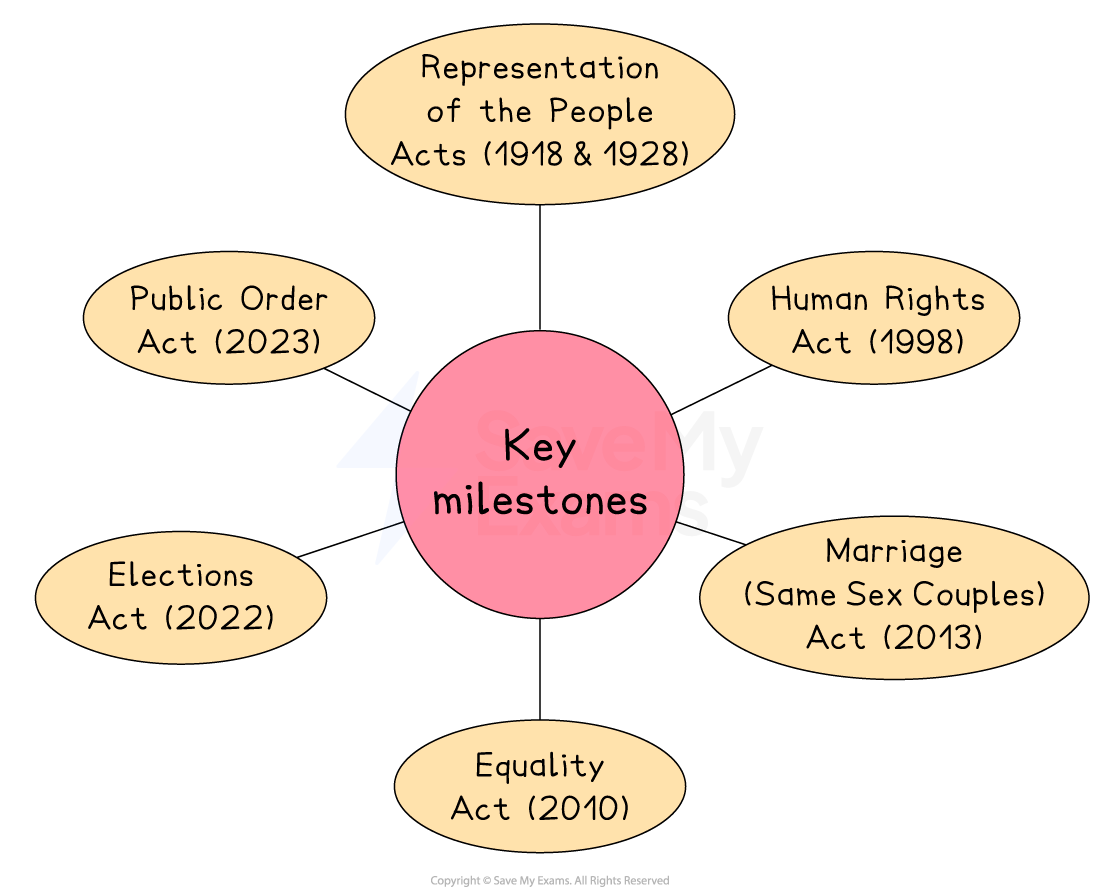
Key milestones
Magna Carta (1215)
Limited the power of the monarch
Established the principle of due process and protection from arbitrary imprisonment
Guaranteed basic rights for nobles but became a symbolic foundation of the UK’s constitutional tradition
Bill of Rights (1689)
Asserted Parliamentary sovereignty over the monarchy
Guaranteed frequent elections and Parliamentary Privilege
Prohibited cruel and unusual punishment
Representation of the People Acts (1918 & 1928)
1918 Act extended the vote to all men over 21 and women over 30 with property
1928 Act extended equal suffrage, giving women the vote on the same terms as men
Marked a major advance in political equality and democratic rights
Human Rights Act (1998)
Incorporated the European Convention on Human Rights (ECHR) into UK law
Allowed individuals to challenge rights breaches in UK courts rather than going to Strasbourg
Made public bodies legally accountable for protecting human rights
Equality Act (2010)
Combined over 100 anti-discrimination laws into one Act
Protects people with nine protected characteristics, including age, race, sex, disability, religion and sexual orientation
Strengthened equal treatment in employment, education and access to services
Marriage (Same-Sex Couples) Act (2013)
Legalised same-sex marriage in England and Wales
Marked a major development in LGBT rights
Police, Crime, Sentencing and Courts Act (2022)
Gave the police greater powers to restrict protests based on noise, location and disruption
Raised concerns about limits on the right to protest
Elections Act (2022)
Introduced mandatory voter ID at elections
Criticised for potentially disenfranchising some groups
Public Order Act (2023)
Created new protest-related offences such as “locking on”
Strengthened police powers but raised concerns about freedom of assembly
Debates on rights in the UK
The UK has a strong rights-based culture, but rights can conflict with each other and with wider public interests
Debates focus on:
The balance between individual and collective rights
The role of the courts
The actions of civil liberties groups that campaign to protect rights
1. The balance between individual and collective rights
Individual rights include free speech, privacy, freedom of religion
Collective rights include minority protections, trade union rights, national security
How rights can conflict
Individual rights threatening collective rights
Free speech vs anti-hate speech protections, e.g., Holocaust denial restrictions
Religious freedom vs equality rights, e.g., the Ashers Bakery case (2018)
Collective rights threatening individual rights
Strikes reducing access to essential services, e.g., junior doctors’ strikes 2022–25
Covid-19 restrictions limiting movement, assembly and protest
2. The role of the courts
How the judiciary protects rights
Enforces the rule of law through judicial review
Can block unlawful government actions
Interprets the Human Rights Act and Equality Act
Judicial outcomes can strengthen or limit rights
Examples of courts protecting rights | Examples where courts have not expanded rights |
|---|---|
|
|
Case Study
Shamima Begum
Background
Begum left the UK in 2015 aged 15, to join ISIS in Syria
Later found in a refugee camp after ISIS territory collapsed
Government action
Home Secretary revoked her British citizenship in 2019
Justified on national security grounds
Legal challenge
Begum argued she could not effectively appeal from a refugee camp
Case went to the Supreme Court in 2021
Outcome
Supreme Court ruled the government acted lawfully
Demonstrates tension between individual rights and national security
3. The actions of civil liberties groups that campaign to protect rights
Civil liberties pressure groups play a central role in defending rights through campaigning, legal challenges and public advocacy
Case Study
Liberty
A leading UK civil liberties organisation
Liberty Human Rights (opens in a new tab)
Campaigns on privacy, protest rights, migrant rights and surveillance
Uses strategic litigation to challenge the state
Challenged the Investigatory Powers Act
Raised concerns about citizenship removal cases such as Shamima Begum
Briefs Parliament on rights-restricting bills including the Public Order Act 2023
Case Study
Big Brother Watch
A civil liberties group focused on technology and policing
Investigates the state’s use of facial recognition and AI
Exposed unlawful uses of live facial recognition by police
Challenged disproportionate Covid policing
Works cross-party in Parliament on data and surveillance law reform
How well are rights protected in the UK?
Parliament
Parliament is sovereign and can create new legislation to protect rights, for example, the Equality Act 2010
However, Parliament can also overturn existing legislation that protects rights or create legislation that challenges rights’ protection, for example the Public Order Act 2023
Devolved bodies
Devolved bodies can also create legislation to protect rights, for example the Scottish Government created the Gender Recognition Act in 2023
However, Parliament remains sovereign and therefore devolved legislation is subservient to parliamentary law
For example Parliament vetoed the Gender Recognition Act from Scotland
Judiciary
Through judicial review, government action can be challenged and the rule of law upheld
For example the Supreme Court blocked the prorogation of Parliament in 2019 (Miller v PM), protecting parliamentary sovereignty
However, whilst judicial review is binding, there is no guarantee of a favourable outcome regarding rights
Rulings on ‘sex’ in For Women Scotland Ltd. v Scottish Ministers can be seen to both challenge and protect rights depending on the view of the individual
Executive dominance
The 'First Past the Post' system in the UK means the government usually has a large majority and can enact legislation easily
For example Labour’s commitment to repealing the Strikes (Minimum Service Level) Act
However, this also means that the government can easily push through legislation which challenges rights without heavy scrutiny
For example, Covid restrictions or the Public Order Act 2023
European Court of Human Rights (Council of Europe)
The UK remains a member of the Council of Europe and therefore citizens can take cases to the European Court of Human Rights
For example the ECHR granted an interim measure preventing the removal of an Iraqi national to Rwanda in 2022
However, the UK has been known to ignore rulings from the ECHR, such as Hirst v UK (2005) on giving prisoners the vote
Case Study
British Bill of Rights
The Conservative Party manifesto of 2015 contained proposals for a British Bill of Rights aimed at replacing the Human Rights Act 1998, giving Parliament more control over rights interpretation.
Supporters argued it would strengthen parliamentary sovereignty and tailor rights to the UK context.
Critics warned it could weaken rights protection, reduce judicial independence, and undermine compliance with the European Convention on Human Rights.

Unlock more, it's free!
Join the 100,000+ Students that ❤️ Save My Exams
the (exam) results speak for themselves:

Was this revision note helpful?