Funding of Political Parties (Edexcel A Level Politics): Revision Note
Exam code: 9PL0

How are UK political parties funded?
Political parties need money to function, campaign and compete in elections
The UK has a mixed funding model involving private donations, membership fees and limited public funding
This has created ongoing debates about fairness, influence and transparency
Funding sources
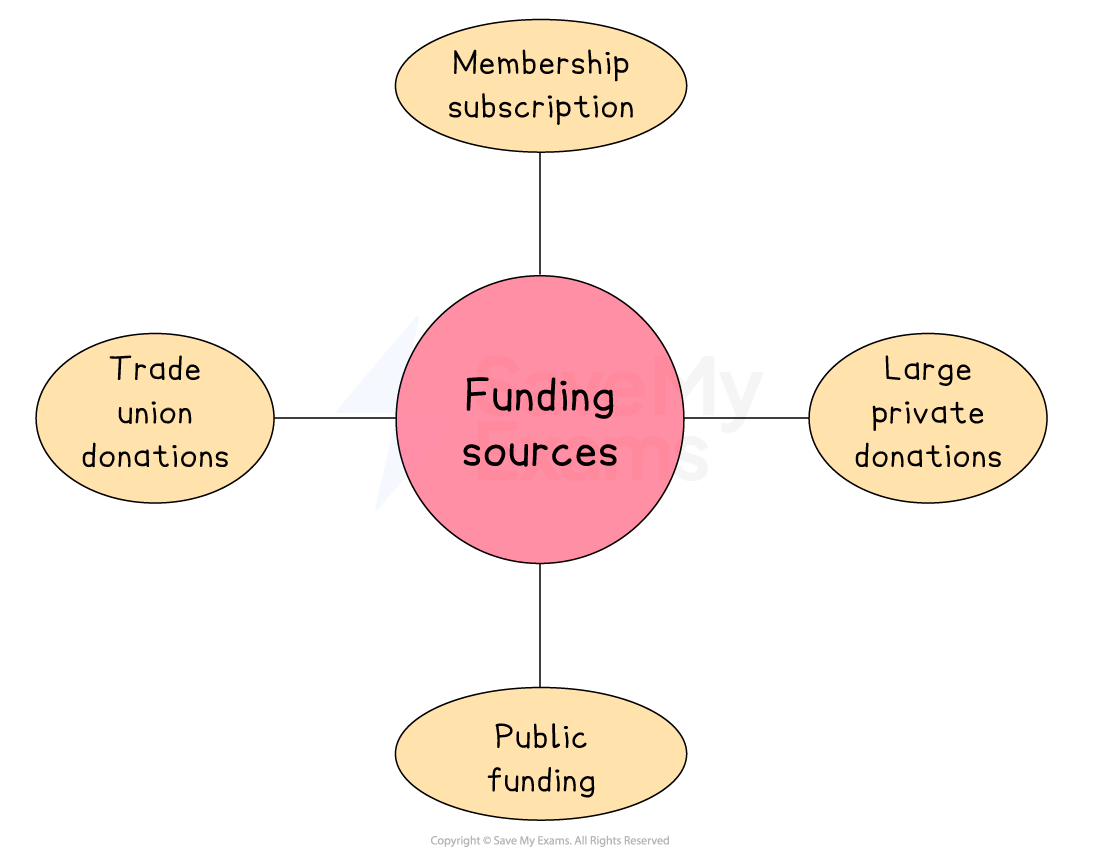
Membership subscriptions
Members pay annual fees
Important for Labour, which gained over £18 million from membership in 2024
Large private donations
Wealthy individuals and companies can donate significant sums
E.g., Businessman Frank Hester and his company TPP gave the Conservatives £15 million for the 2024 general election
Trade union donations
Especially important for Labour
Major unions (Unite, GMB, Unison) each donate around £1 million annually
Public funding
No public money for general election campaigning
But opposition parties receive:
Short Money, to support parliamentary work
Policy Development Grants, for research and policy work
This funding is distributed by the Electoral Commission
Case Study
Case Study: Labour Party Income, 2024
Income Source | Amount (£) |
|---|---|
Membership | £18,321,000 |
Miscellaneous | £7,162,000 |
Donations | £40,288,000 |
Commercial Activities | £13,489,000 |
Fundraising | £2,194,000 |
Grant | £4,063,000 |
Total | £90,748,000 |
Case Study
Political Parties, Elections and Referendums Act (PPERA) 2000
The PPERA (2000) tightened UK election rules by creating the Electoral Commission (opens in a new tab), introducing strict donation and spending limits for parties, and increasing transparency.
It aimed to curb undue influence, ensure fairer campaigning, and strengthen public trust in political funding and electoral processes.
Enforcement Example
March 2024: Conservatives fined £10,750 for inaccurate and late donation reporting
Strengths
Increases transparency
Helps regulate spending
Criticisms
Fines are small compared to multimillion-pound donations
Limited deterrent effect
Debates on state funding
State funding refers to political parties receiving money from the public purse to support their operations, policy development and election activity
The UK currently uses a limited model called short money
This has created debate about whether expanding state funding would make politics fairer and more transparent, or whether it would waste public money and distance parties from voters
Arguments FOR State Funding | Arguments AGAINST State Funding |
|---|---|
Reduces influence of big donors
| Expensive and low public priority
|
Promotes party pluralism
| Could entrench larger parties
|
Improves representation
| Unfair to taxpayers
|
Greater transparency
| Reduced public engagement
|
Public opinion values the issue
| Blurs line between party and state
|

Unlock more, it's free!
Join the 100,000+ Students that ❤️ Save My Exams
the (exam) results speak for themselves:

Was this revision note helpful?