UK Political Parties in Context (Edexcel A Level Politics): Revision Note
Exam code: 9PL0

The development of a multi-party system
The UK is usually described as having a dominant two-party system at Westminster
However, devolution, electoral reform in devolved bodies, and changing voting behaviour have created features of a multi-party system
This has consequences for how governments are formed and how parties compete
Party success is shaped by factors ranging from leadership and funding to national circumstances and media influence
Party systems in the UK
What is a party system?
A party system refers to the number of parties with a realistic chance of forming a government
The number of parties that have a chance of forming government is a result of the electoral system chosen
Majoritarian and plurality electoral systems generally returning two-party systems
Proportional electoral systems generally returning multi-party systems
Types of party systems
One-party system | Two-party system |
|---|---|
|
|
Two-and-a-half party system | Multi-party system |
|
|
Arguments the UK is (or remains) a two-party system
UK government at Westminster is dominated by Labour and Conservatives and has been for around 100 years
Even in 2024, the most disproportionate election ever, Labour and Conservatives gained 57% of the vote but 82% of the seats
Labour and Conservative spend considerably more on elections than other parties, spending between 5 and 6 times more each than the Liberal Democrats in 2024
Even when minor parties influence policy, these policies are enacted by one of the two major parties, for example Brexit in 2016
Labour and Conservative continue to do relatively well in the devolved region elections and in the elections for mayors
Arguments the UK is becoming more of a multi-party system
Since 2010: more coalition, minority or small-majority governments
Scottish Parliament 2007: Greens (2 seats) held the balance of power between Labour (56) and SNP (57)
Northern Ireland: power-sharing since the Good Friday Agreement (1998)
Wales: no single-party majority in Senedd elections since 1999; all resulted in coalition or minority governments
Implications of a multi-party system for Government
More negotiations and agreements needed to form a government
Coalitions, minority governments, confidence-and-supply deals more likely
Smaller parties may gain leverage even with few MPs
E.g, Greens holding balance of power in Scottish Parliament (2007)
E.g, DUP confidence-and-supply deal (2017)
Policies may reflect influence of several parties rather than one dominant party
Governments can be less stable or shorter-lived
Multi-level politics (devolved parliaments) encourages more parties to be viable
Factors affecting party success
A range of political, organisational and external factors shape whether parties succeed or fail in UK elections
These include leadership, funding, policies, national circumstances and performance in office
The media also plays a major role, influencing how parties and leaders are perceived and shaping voter behaviour
No single factor guarantees success - different factors matter more or less depending on the political context
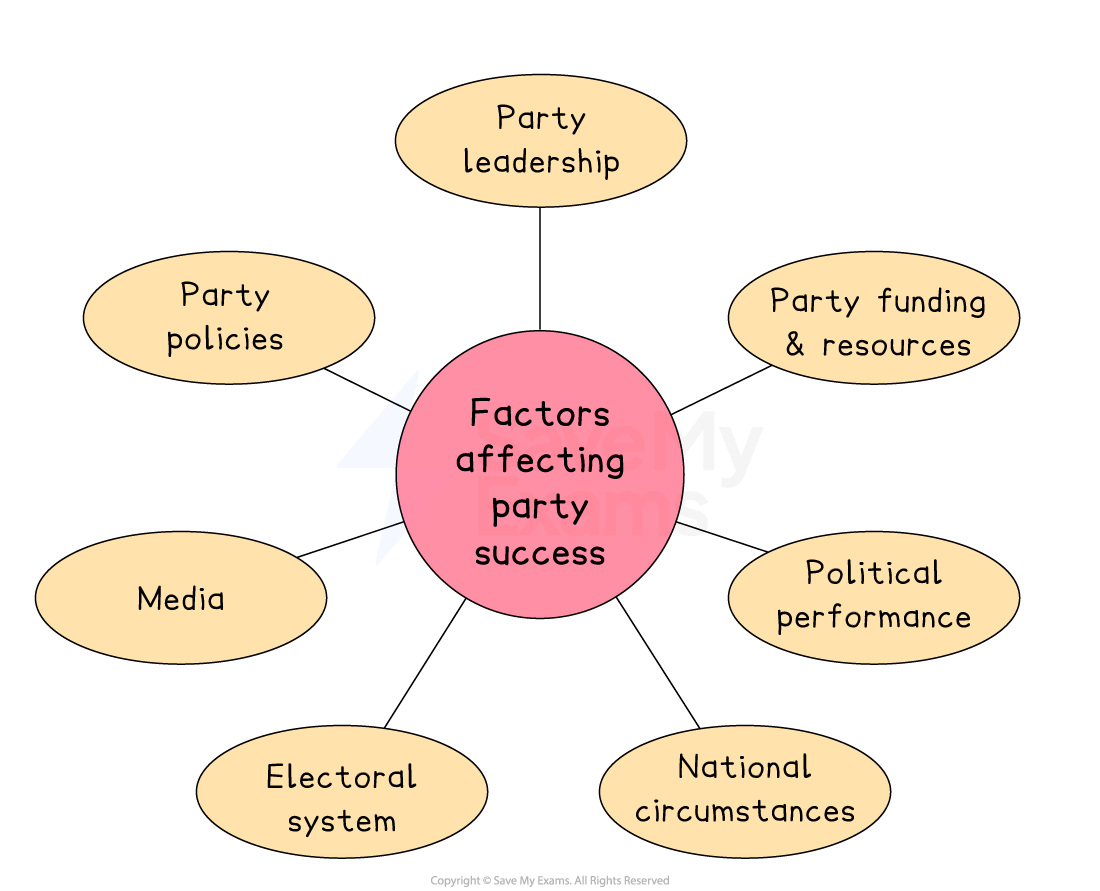
Factors affecting party success
Factor | Theory | Example of importance | Example of limited importance |
|---|---|---|---|
Party leadership |
|
|
|
Party funding & resources |
|
|
|
Political performance |
|
|
|
National circumstances |
|
|
|
Party policies |
|
|
|
Media |
|
|
|
Electoral system |
|
|
|
Parties and democracy
Parties are good for democracy
They:
Provide genuine political choice, encouraging participation
Allow voters to hold governments accountable
Simplify complex issues, improving political education
Recruit and train political leaders
Organise government and opposition, creating stability
Adversary politics ensures scrutiny between elections
Parties are bad for democracy
They:
Risk becoming narrow elites dominated by wealthy donors
Polarisation undermines consensus
Reliance on funding raises transparency concerns
Whips limit MP independence and local representation
Internal factions undermine unity and policy delivery
Declining membership suggests weakening public engagement

Unlock more, it's free!
Join the 100,000+ Students that ❤️ Save My Exams
the (exam) results speak for themselves:

Was this revision note helpful?