Electoral Systems: First Past the Post (Edexcel A Level Politics): Revision Note
Exam code: 9PL0

How First Past the Post works
First Past the Post (FPTP) is a plurality electoral system used to elect MPs to the UK House of Commons
The candidate with the most votes in a constituency wins the seat, even if they do not have a majority
Features of FPTP
1. Single-member constituencies
The UK is divided into 650 constituencies, each represented by one MP.
This creates a clear link between voters and their representative.
2. Plurality system
The winning candidate only needs one more vote than their nearest rival.
They do not need to win over 50% of the vote.
3. Each voter has one vote
Voters select one candidate only, keeping the system simple and familiar.
How FPTP works
Each voter votes for one candidate in their constituency
Votes are counted locally and the candidate with the most votes wins that seat
All 650 constituency results are added together to see how many seats each party has gained
The party with 326+ seats is invited to form a majority government
If no party reaches this threshold, a coalition or minority government may form
The Prime Minister is normally the leader of the party with the most seats
In a coalition, a deputy is usually selected from another of the coalition parties
Evaluation of First Past the Post
FPTP has faced significant criticism for being outdated and unrepresentative
However, it remains the system used to elect representatives in UK general elections and in most local elections in England
Its simplicity and long-standing use have helped it endure, even while debates about electoral reform continue
Advantages and disadvantages of FPTP
Advantages | Disadvantages |
|---|---|
|
|
|
|
|
|
|
|
|
|
|
|
|
|
Case Study
The 2024 UK General Election is widely regarded by political scientists and election analysts as one of the most disproportionate results in modern British history

Key outcomes
Party | Vote Share & Seats Won | Explanation |
|---|---|---|
Labour | 34% 411 |
|
Conservatives | 24% 121 |
|
Reform UK | 14% 5 |
|
Liberal Democrats | 12% 72 |
|
Green Party | 7% 4 |
|
Scottish National Party (SNP) | 2.2% 9 |
|
What 2024 shows about FPTP
FPTP tends to convert pluralities into decisive majorities, even when parties have modest public support
It rewards parties with geographically efficient vote distribution, not necessarily the highest overall support
It can produce sharp regional contrasts, such as Labour dominance in England and Wales, the SNP collapse in Scotland, and Reform UK’s widespread but shallow support
It raises questions about fairness and legitimacy, especially when millions of voters see their party gain few or no seats
Should FPTP be replaced?
The question of whether to replace FPTP centres on whether the UK needs a system that is more proportional, more inclusive and more reflective of modern voting behaviour
Supporters of FPTP argue that it delivers clarity, simplicity and stability
Critics believe it distorts public preferences and undermines fairness
Yes - FPTP should be replaced
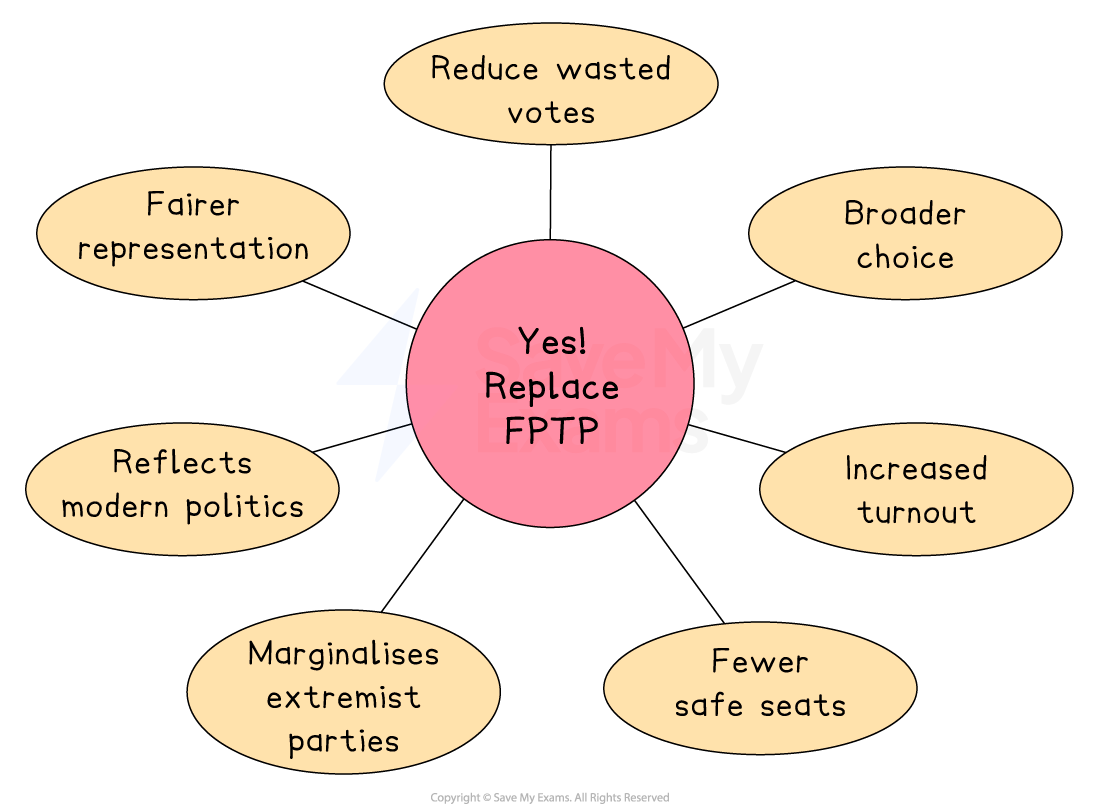
Fairer representation
Proportional systems convert votes into seats more accurately, helping to produce a government that reflects public preferences
Reducing wasted votes
Proportional systems minimise wasted ballots by allocating seats more accurately or by redistributing votes in line with voter preferences
Broader choice
Voters are more willing to vote for smaller parties when they know these votes are more likely to be reflected in the final outcome
Increased turnout
Turnout tends to be higher when voters feel their vote matters; for example, turnout in Scotland under AMS was 63.5% in 2021, higher than the 2024 UK General Election
Fewer safe seats
Proportional systems reduce the dominance of safe seats, increasing competitiveness and voter influence
Marginalises extremist parties
Coalition politics encourages moderation, making it harder for extremist parties to gain influence
Reflects modern politics
FPTP no longer reliably delivers strong or stable governments, making the weaknesses of proportional systems less significant
No - FPTP should not be replaced
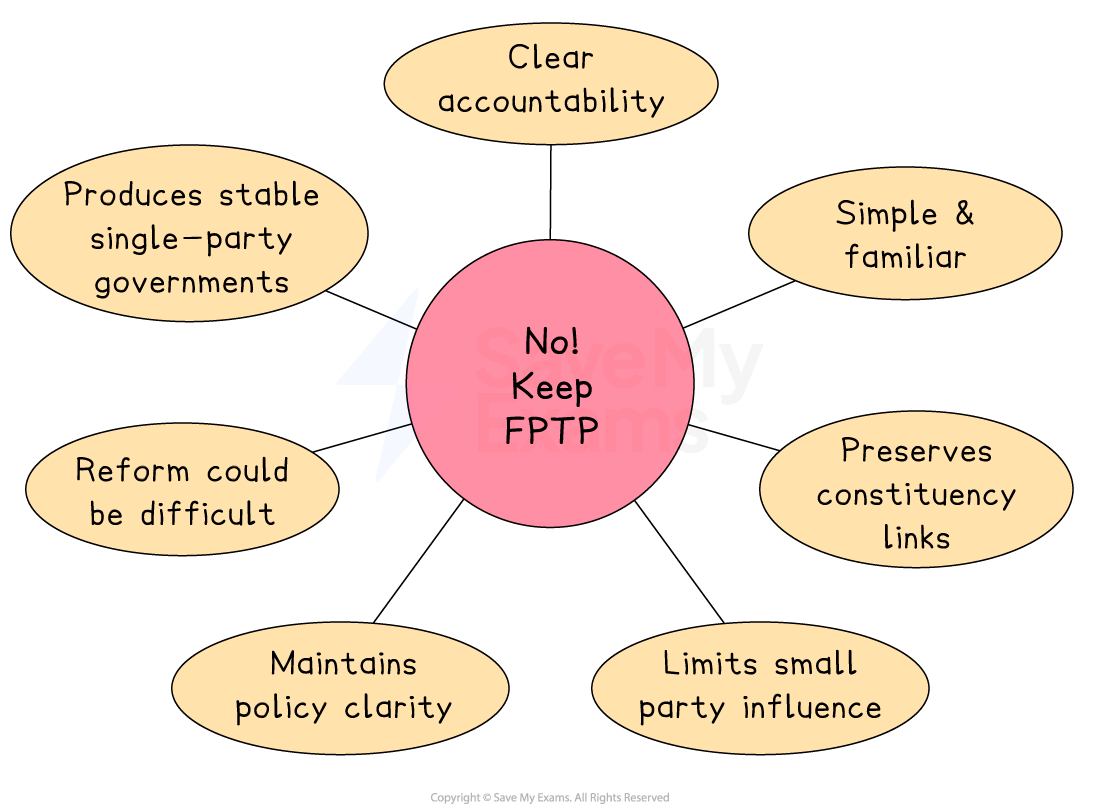
Produces stable single-party governments
FPTP often produces decisive outcomes, as seen in 2019 and 2024, which can strengthen government actions
Clear accountability
Voters know exactly who to reward or punish, such as how the 2019 Conservative government was judged over Covid policies and Partygate
Simple and familiar
FPTP is easy to understand and provides quick, clear results that voters recognise and trust
Preserves constituency links
Each MP represents a defined area, improving accountability and helping constituents feel represented
Limits small-party influence
FPTP prevents very small parties from gaining disproportionate power in coalition negotiations
Maintains policy clarity
Coalition agreements can dilute or contradict manifesto pledges, reducing transparency for voters
Reform could be difficult
The 2011 AV referendum rejected change (42% turnout; 67.9% voted No), suggesting limited public support for electoral reform

Unlock more, it's free!
Join the 100,000+ Students that ❤️ Save My Exams
the (exam) results speak for themselves:

Was this revision note helpful?
