Media & Election Outcomes (Edexcel A Level Politics): Revision Note
Exam code: 9PL0

Role of the media in elections
The media is a key source for voters to obtain information about political parties and their policies during, and between, elections
UK media sources
1. Television news (e.g. BBC, ITV, Sky, etc.)
Television news media is the primary source of information for older voters
Its popularity is falling amongst young voters
70% of UK adults report broadcast TV as the most used form of news consumption
This rises to 75% if on-demand sources are included
85% of over-55s said TV news was their favoured platform
2. Newspapers
Print newspaper circulation has been in decline since 2010
In 2018 its reach was around 40% of the population, but by 2023 it had fallen to just 26%
Online newspaper readership remains influential among older voters
In 2023, 68% of UK adults said they used online news sources
3. Social media
There has been a significant increase in the use of social media by younger voters for political news
The use of social media by adults to access news rose to 52% in 2024, from 44% in 2018
Under-35s use social platforms more for political news than other sources
In 2023, 83% of 16-24-year-olds used online sources for news and 71% used social media specifically, whilst only 47% watched broadcast TV
4. Broadcast debates and live events
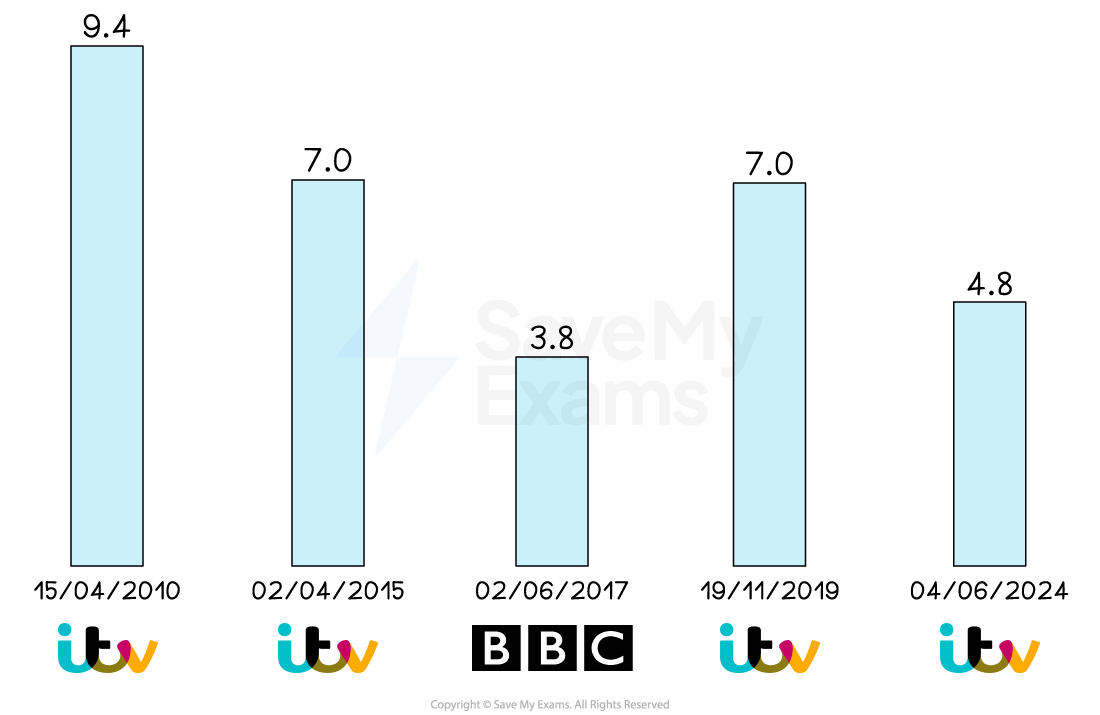
Televised leadership debates may sway undecided voters
However, their popularity has declined over time, with just 4.8 million voters watching the 2024 televised debate
5. Radio
Radio is a less significant source of news for voters, with only two radio stations appearing in the top 20 news sources
Around one in four BBC Radio 2 listeners use it specifically for news, and around one in five BBC Radio 1 and BBC Radio 4 listeners
All other stations report significant lower usage for news
Opinion polls
An opinion poll is a survey that asks a sample of people about their views on political issues, parties or their leaders, to estimate what the wider population thinks
They are usually undertaken by companies specialising in political polling, such as YouGov
Arguments for the use of opinion polls
To guide party campaign strategy
Parties reallocate resources to marginals when polls show shifts
In 2017, polls showing that the Conservative lead had narrowed pushed Labour to target youth turnout
2015 polls showing the rise of UKIP influenced Conservative Party policy on the inclusion of a Brexit referendum in their election manifesto
Provide early warning of swings by voters
Polls can indicate the potential outcome in swing seats and can therefore help parties to target their canvassing
Polls in 2019 signalled a Conservative surge in many of these seats
Help voters judge party momentum
Perception of momentum can influence undecided voters, known as the bandwagon effect
This can help to increase turnout or the majority that a party gains at an election
Arguments against the use of opinion polls
Polls can demobilise supporters
Polls that indicate the dominance and likely victory of one party can reduce turnout for both the anticipated victor and for the opposition
Turnout in 2024 was historically low, with polling indicating a likely Labour landslide
Polling on the Brexit referendum suggested a remain victory, which may have depressed the turnout of ‘remain’ voters and mobilised ‘leave’ voters
Recent General Elections have all seen websites that argue for tactical voting
Margin of error and methodology failures
Polls can misestimate parties with shy supporters or turnout differences
2015 and 2017 polling errors led to surprise results
In 2015, the ‘shy Tory’ phenomenon was used to explain why the Conservatives were polling quite low but went on to victory
Polls can create self-fulfilling prophecies
When the media reports poll leads, it can shape the narrative irrespective of reality
2010 and 2015 coverage sometimes amplified small leads, skewing the perception of voters
How important is the media?
During election times, the media is often dominated by election coverage
It is, however, unclear whether this coverage has an impact on voters
The media is important
Agenda setting
Newspaper front pages and broadcast news stories shape what voters think on particular issues
The Daily Mail headline ‘Enemies of the People’ referring to UK Supreme Court judges in ruling on Miller V Brexit Secretary (2017) created a huge debate on the role of the judiciary
E.g. Miller v. Brexit Secretary (2017) was a case around whether Parliament had to have a vote on Brexit before the UK left the EU, and the Supreme Court decided that that did
Televised debates
These can change perceptions of leaders
Most famously in 2010, Nick Clegg’s success in the televised debates led to him being called ‘Super Nick’
Investigations
Investigative journalism has uncovered scandals that has impacted elections
The 2009 expenses scandal led to a number of MPs losing their seats in 2010
The ‘Partygate’ scandals of Boris Johnson during Covid-19 led to his resignation and had a huge role in the Conservative 2024 defeat
Endorsements
There remains a focus on which party specific newspapers will give their support to in an election
Advertising
Political parties have increasingly taken to social media for advertising purposes
So even if people are taking their news from social media, they may well find themselves directly hearing from parties through advertising
The media is not important
Party loyalty
Despite a growth in rational choice theory, there is some evidence that factors other than media headlines influence voting choice
Demographic voting patterns by age, for example, tend to defy media headlines
Televised debates
Measuring the impact of these is challenging
Even in 2010, despite Nick Clegg’s success, his party did not have huge success in the election
Both May and Corbyn avoided leaders' debates in 2017
Echo chambers
The number of news outlets has grown and social media has greater influence
Voters self-select the news they want to hear rather than being influenced by a range of news outlets offering differing views
Social media
Younger voters rely on social media rather than traditional media, which dilutes their impact
Nearly half of UK adults use social media for news, no longer limited to just younger voters
In 2023, 10% of UK adults got their news from TikTok
Endorsements
Falling sales and readerships of traditional media lessens the importance of endorsements of parties by newspapers

Unlock more, it's free!
Join the 100,000+ Students that ❤️ Save My Exams
the (exam) results speak for themselves:

Was this revision note helpful?
