Differing Views & Tensions in Socialism (Edexcel A Level Politics): Revision Note
Exam code: 9PL0

Introduction to the strands of socialism
Socialism contains several different strands that developed in response to industrialisation, capitalism and debates about how to achieve equality and social justice
All strands share core assumptions
A belief in human cooperation
The importance of social equality
The need to challenge or manage the inequalities created by capitalism
However, they differ in several ways, including:
How far capitalism must be changed or replaced
The best route to achieving socialism
The appropriate balance between state intervention and individual freedom
The three strands of socialism
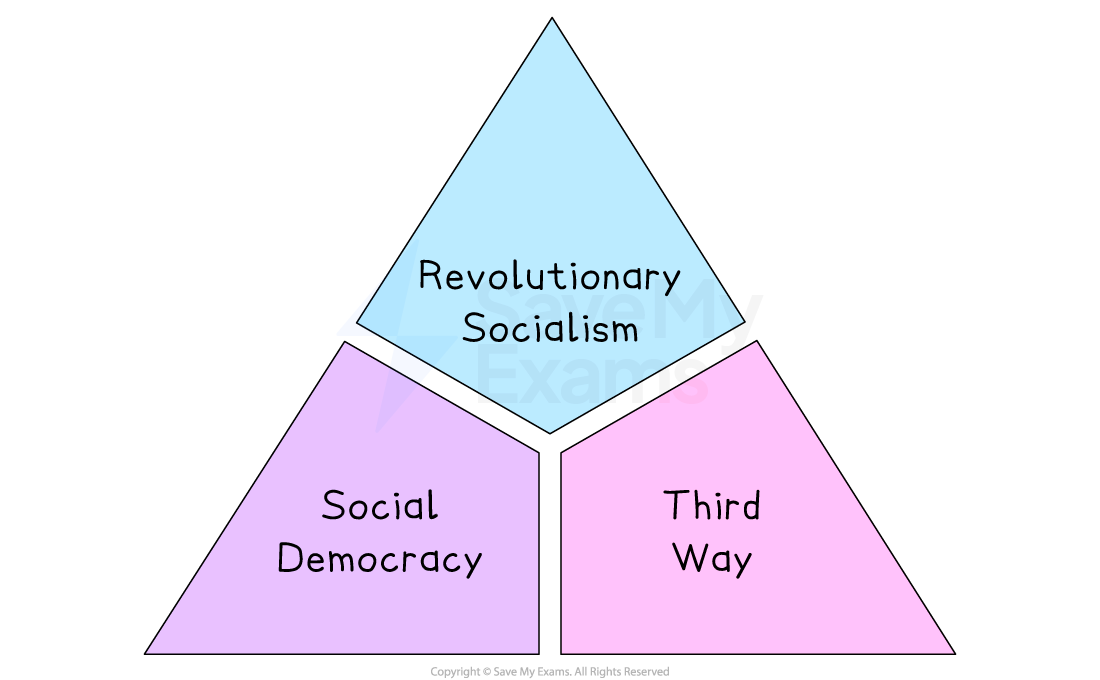
Revolutionary socialism
Argues that capitalism must be overthrown and replaced with collective ownership through a workers’ revolution
Social democracy
Supports gradual reform of capitalism through elections, legislation, welfare provision and regulated markets
The Third Way
Seeks to combine a free-market economy with equality of opportunity, social mobility and partnership between the state, business and individuals
Revolutionary socialism
Revolutionary socialists believe capitalism must be overthrown, not reformed
The working class is exploited under capitalism
The system corrupts human nature and undermines common humanity
Revolution is necessary
Existing political systems are too entrenched to be changed gradually
Revolutionary socialists emphasise class struggle as the driving force of history
They call for the abolition of private property
It should be replaced with collective ownership to ensure fairness and equality
Internationalism is central, as workers across the world share common interests
Key thinkers
Marx and Engels
Argued for a proletarian revolution to abolish capitalism
Rosa Luxemburg
Supported spontaneous mass action and strikes to challenge state and capitalist power
Social democracy
Social democracy supports gradual, evolutionary change rather than revolution
It aims to reform capitalism through elections and legislation to achieve socialism’s goals
Social democrats promote a mixed economy, which is where the state regulates markets but allows private enterprise
They also support a strong welfare state funded by progressive taxation to reduce inequality and promote social justice
Key thinkers
Beatrice Webb
Advocated state planning, cooperative structures and the inevitability of gradualness
Anthony Crosland
Argued that modern capitalism could deliver equality and justice when managed by welfare and education reforms
The Third Way
Third Way socialism seeks to modernise socialist ideas by accepting a market economy and focusing on equality of opportunity rather than equality of outcome
It argues economic efficiency can be combined with social justice
The Third Way values meritocratic advancement, individual empowerment and partnership between government, businesses and individuals
It supports a reduced but strategic welfare state, aimed at education, training and childcare to promote opportunity
Third Way thinkers prioritise pragmatism over ideology, adapting socialism to the realities of globalisation and modern capitalism
Key Thinkers
Anthony Giddens
Argued for the Third Way as a balance between market forces and state intervention, focusing on empowering individuals rather than redistributing wealth

Unlock more, it's free!
Join the 100,000+ Students that ❤️ Save My Exams
the (exam) results speak for themselves:

Was this revision note helpful?
