The Legislative Process (Edexcel A Level Politics): Revision Note

Exam code: 9PL0

Sarra Jenkins

Written by: Sarra Jenkins

Reviewed by: Steve Vorster

Updated on

What is the legislative process?

  • The legislative process is the series of stages a bill must pass through in Parliament before it becomes law

  • Most legislation is introduced by the government, although some bills are proposed by backbench MPs or the House of Lords

Types of bill

Type of bill

Description

Public bills

  • Apply to the whole population and usually reflect government policy

Private bills

  • Apply to specific individuals, organisations or localities

Private Members’ Bills

  • Introduced by backbench MPs or Lords, often to raise awareness rather than pass into law

Stages of the legislative process

  • Most bills begin in the House of Commons, although some begin in the House of Lords

  • Once a bill has completed these stages in one House, it goes through the same process in the other House
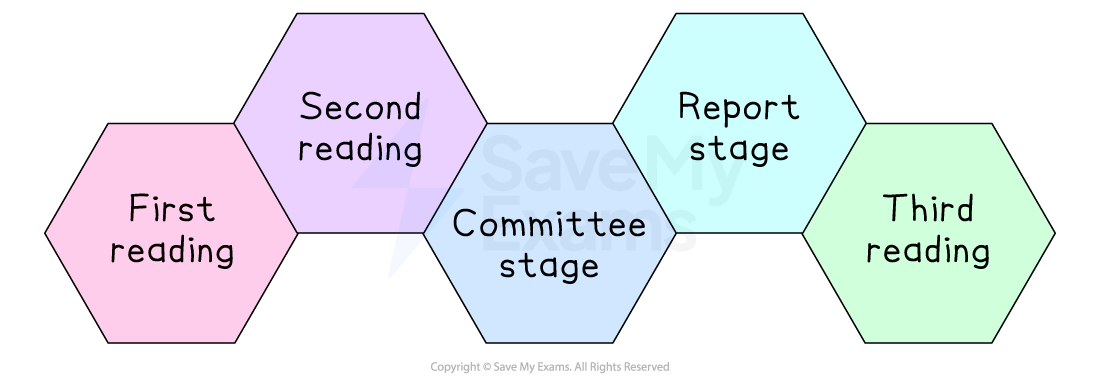
Five hexagons showing legislative stages: First Reading, Second Reading, Committee Stage, Report Stage, Third Reading, in a linear sequence.
Steps in the legislative process

Explaining the steps in the legislative process

Stage

What happens

First reading

  • Formal introduction of the bill into the House

  • The title of the bill is read out

  • A date for the Second Reading is announced

Second reading

  • A general debate on the principles of the bill

  • Followed by a vote on whether the bill should proceed

  • The detail of the bill is not discussed at this stage

  • MPs debate whether they agree with the overarching purpose of the bill

Committee stage

  • A detailed, line-by-line examination of the bill conducted either by:

    • a Public Bill Committee, or

    • a Committee of the Whole House

Report stage

  • MPs consider the amendments made during Committee Stage

  • Votes may be taken on whether to accept or reject amendments

Third reading

  • The final debate on the bill

  • No further amendments can be made

  • Ends with a final vote, which approves the bill in that House

Consideration of amendments (‘ping-pong’)

  • If the second House amends the bill, it returns to the first House for consideration

    • This process is known as parliamentary ping-pong

    • The bill may pass back and forth several times until agreement is reached

  • If agreement cannot be reached, the government may use the Parliament Acts to force the bill through the House of Lords

Royal assent

  • Once both Houses agree on the final text, the bill is sent for royal assent

    • Royal assent is a formality and has not been refused since 1708

  • Once granted, the bill becomes an Act of Parliament

Evaluating the legislative process

Strengths of the legislative process

  • Multiple stages allow detailed scrutiny of legislation

  • The Committee stage enables line-by-line examination and amendment

  • The House of Lords can improve legislation through expertise and independence

  • The process allows compromise between the government and Parliament

Weaknesses of the legislative process

Weakness

Explanation

Executive dominance

  • Government controls much of the parliamentary timetable

  • Party discipline limits backbench independence

Limited scrutiny

  • Large volumes of legislation can reduce the time available for examination

Use of Parliament Acts

  • Allows the government to override the House of Lords

Ineffectiveness of Private Members’ Bills

  • Few become law due to lack of time and government support

Examiner Tips and Tricks

The legislative process is thorough in theory, with multiple opportunities for scrutiny and amendment

However, in practice, its effectiveness is often limited by Executive dominance and time pressures, meaning that Parliament does not always fully scrutinise legislation

Unlock more, it's free!

Join the 100,000+ Students that ❤️ Save My Exams

the (exam) results speak for themselves:

Sarra Jenkins

Author: Sarra Jenkins

Expertise: Content Writer

Sarra is a highly experienced A-Level Politics educator with over two decades of teaching and examining experience. She was part of the team that wrote the Edexcel 2017 Politics Specification and currently works as a Senior Examiner. A published author of 14 textbooks and revision guides, her expertise lies in UK and US politics, exam skills, and career guidance. She continues to teach, driven by her passion for this "evolving and dynamic subject".

Steve Vorster

Reviewer: Steve Vorster

Expertise: Economics & Business Subject Lead

Steve has taught A Level, GCSE, IGCSE Business and Economics - as well as IBDP Economics and Business Management. He is an IBDP Examiner and IGCSE textbook author. His students regularly achieve 90-100% in their final exams. Steve has been the Assistant Head of Sixth Form for a school in Devon, and Head of Economics at the world's largest International school in Singapore. He loves to create resources which speed up student learning and are easily accessible by all.