Structure, Power & Roles of the Executive (Edexcel A Level Politics): Revision Note
Exam code: 9PL0

The structure of the UK Executive
The executive is the branch of government responsible for running the country and making policy
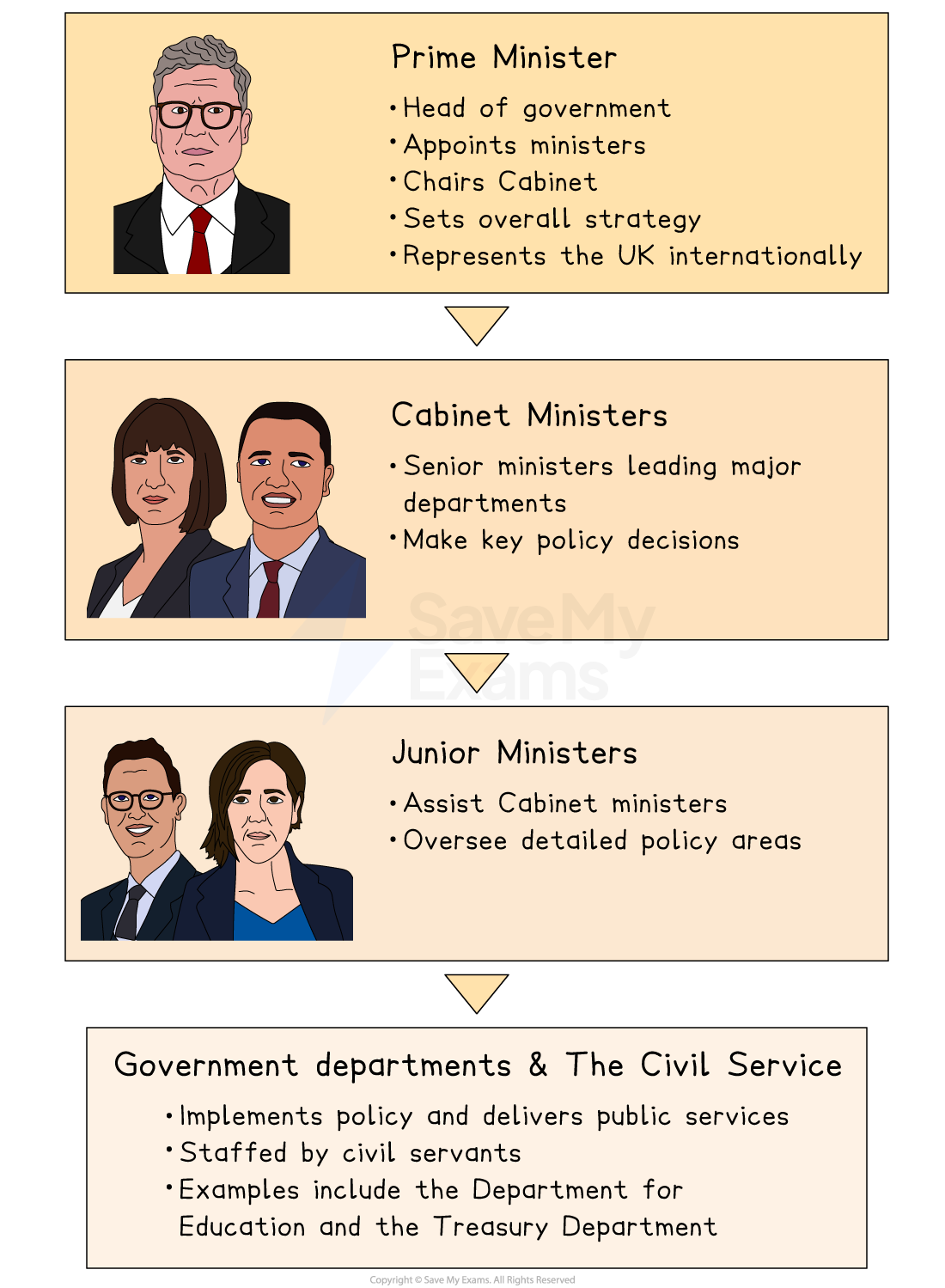
Prime Minister (PM)
The Head of Government, responsible for overall direction of the executive
Appoints ministers, chairs Cabinet, sets strategic priorities, represents the UK globally
Leads the Cabinet and has significant authority over policy, communication, and political strategy
Cabinet Ministers
Senior ministers in charge of major government departments such as the Department for Education and Department for Health
Responsible for collective government policy discussions and high-level decision-making
Junior Ministers
Ensure that departments function daily and manage detailed policy work
Answer questions in Parliament
Support Cabinet ministers
Government departments (including the Civil Service)
Responsible for delivering public services and implementing policy
Headed by a Cabinet Secretary of State and supported by junior ministers and civil servants
The roles of the UK Executive
The Prime Minister and cabinet have a number of key roles to ensure the smooth running of the UK government
1. Proposing legislation
The executive controls most of the parliamentary timetable and introduces the majority of bills into Parliament
Case Study
The Public Order Act 2023 was introduced by the Sunak government (Conservative) to give police new powers over disruptive protests (such as locking on), reflecting a government commitment to law and order
2. Proposing the budget
The Chancellor presents the annual Budget to Parliament, outlining spending, taxation, and borrowing plans, setting the economic strategy for the government
Case Study
Despite some earlier rumours in the press, Chancellor Rachel Reeves’ 2025 budget froze income tax thresholds until 2031, trying to stick to the manifesto pledge of not raising taxes
3. Making policy decisions and secondary legislation
The PM and Cabinet sets strategic policy direction, developing and implementing policies across areas such as health, defence, education and transport
Although policy can be proposed through legislation, the executive can also create policy within departments to achieve the aim of legislation
For example, PM Johnson’s executive made rapid policy announcements over Covid-19 such as the introduction of furlough
4. Conducting foreign policy
The executive have control over diplomacy, international agreements, military action and relations with other states
For example, The UK signed the Windsor Framework under Sunak, reshaping post-Brexit relations with the EU
This includes the movement of troops and declarations of war or other military operations (although Prime Ministers may choose to get the approval of Parliament for this)
5. Crisis management
The executive must respond to unforeseen circumstances such as pandemics, economic shocks or security events
Case Study
Crisis management and the Covid pandemic
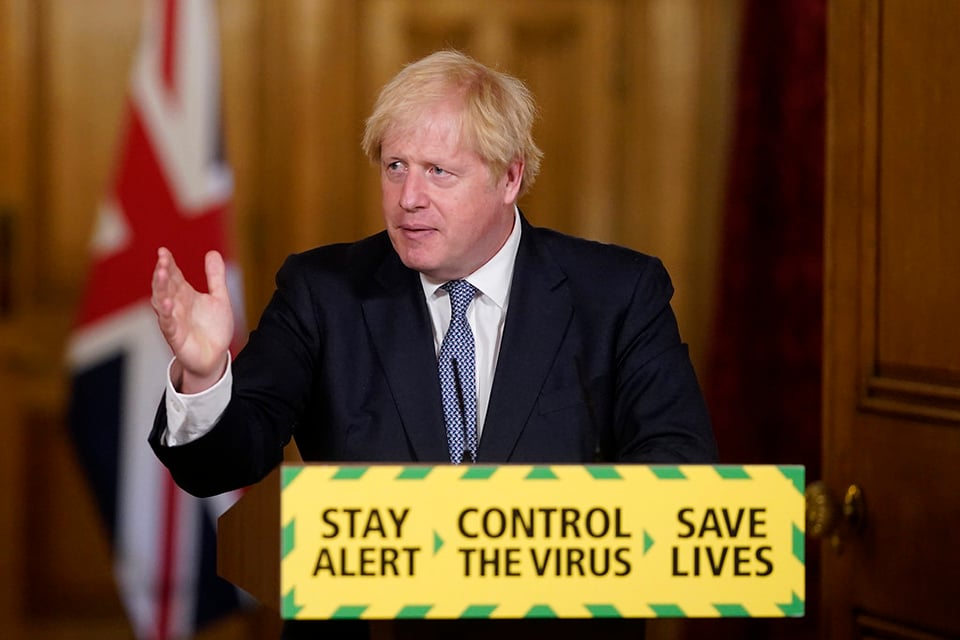
The UK faced the Covid-19 pandemic, a major public health emergency requiring rapid and coordinated government action
The crisis created unprecedented pressure on the executive to respond quickly to protect public health and the economy
Actions taken
Prime Minister Boris Johnson chaired emergency COBRA meetings
These meetings brought together senior ministers, officials and advisers
COBRA was used to coordinate the national response, including lockdowns, public health measures, and economic support such as furlough
Outcome
COBRA meetings enabled rapid executive decision-making during the crisis
They demonstrated the executive’s central role in crisis management
The case also highlighted how emergencies can concentrate power around the Prime Minister and the core executive, sometimes reducing wider Cabinet involvement
The powers of the UK Executive
Whilst the UK executive is collective – meaning that it includes the Prime Minister and cabinet – sometimes these powers are seen as being exercised by the Prime Minister alone
To allow it to carry out its roles, the executive has a range of powers
1. Royal prerogative powers
Historic powers are exercised by ministers on behalf of the Monarch, allowing the executive to act without parliamentary approval
PM Sunak used prerogative powers to sign the Windsor Framework with the EU, revising the Northern Ireland Protocol
2. Foreign affairs
Government have the right to negotiate treaties, recognise states, and deploy armed forces
In 2024, PM Sunak authorised air strikes on Yemen without parliamentary approval (although this did raise some controversy!)
3. Deployment of armed forces
The PM can commit troops without parliamentary approval
In 2021, the UK deployed forces for the Afghanistan evacuation under PM Johnson without a prior vote
4. Ministerial appointments
The PM can appoint and dismiss ministers
PM Sunak appointed Jeremy Hunt as Chancellor immediately upon taking office
5. Initiation of legislation and control of the legislative timetable
The executive controls most of the parliamentary agenda and proposes the majority of bills
In 2022, PM Truss prioritised her mini-Budget tax reforms, bypassing OBR scrutiny
6. Control of the Budget
The Chancellor presents the Budget and Spending Review, giving the executive strong fiscal control
7. Patronage and party management
The PM can reward loyalty with promotions, enforcing government unity
In 2021, PM Johnson promoted those loyal to him in his cabinet reshuffle including Nadine Dorries at the Department of Media, Culture and Sport (DCMS)

Unlock more, it's free!
Join the 100,000+ Students that ❤️ Save My Exams
the (exam) results speak for themselves:

Was this revision note helpful?