The Executive & Parliament (Edexcel A Level Politics): Revision Note
Exam code: 9PL0

The Executive and Parliament
The relationship between the executive and Parliament is central to the UK political system
Parliament is legally sovereign and is intended to hold the executive to account
However, because the executive is usually drawn from the largest party in the House of Commons, it often dominates Parliament in practice
How Parliament holds the executive to account
A key role of Parliament is to hold the executive accountable for its actions, usually through scrutiny
This can occur in a number of ways
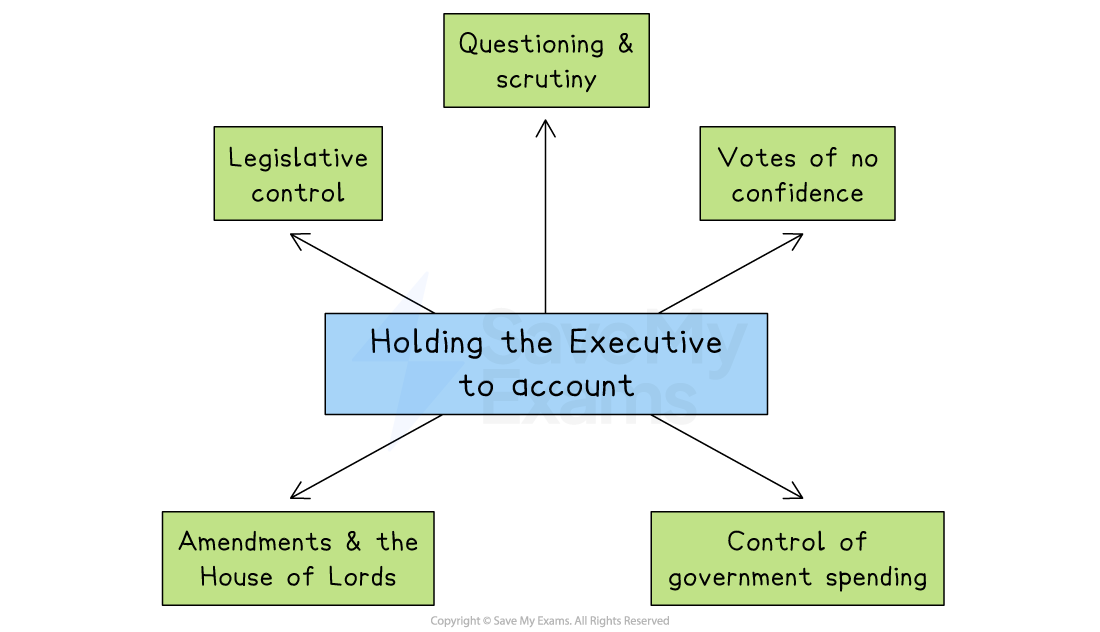
1. Legislative control
Parliament must pass Acts to authorise certain executive powers
After the Supreme Court’s decision in Miller v Brexit Secretary (2017), Parliament passed the necessary Act to authorise EU withdrawal under Article 50
However:
due to fused powers in the UK, the government usually holds a majority in the House of Commons
this makes it possible for the executive to pass legislation with relative ease
2. Questioning and scrutiny
MPs can challenge ministers and force them to defend their policies
Methods include:
Prime Minister’s Questions
urgent questions
select committees
parliamentary debates
Effectiveness | Limitations |
|---|---|
|
|
3. Votes of no confidence
Parliament can remove a government that loses the confidence of the House of Commons
Effectiveness | Limitations |
|---|---|
|
|
4. Amendments and the House of Lords
Parliament can propose amendments to bills or block legislation temporarily
The House of Lords can delay bills by up to one year
Effectiveness | Limitations |
|---|---|
|
|
5. Control of government spending
Parliament must approve government spending and the Budget
MPs can scrutinise the allocation of resources
Effectiveness | Limitations |
|---|---|
|
|
Dominance of the executive over Parliament
Control of the parliamentary agenda
The government controls the timetable and agenda
This allows it to prioritise its own legislation and limit scrutiny
Effectiveness | Limitation |
|---|---|
|
|
Whipping and party discipline
The whip system is used to ensure MPs vote in line with the government
Effectiveness | Limitation |
|---|---|
|
|
Prerogative powers
The executive can act without parliamentary consent in some areas
Effectiveness | Limitation |
|---|---|
|
|
Size of the government majority
A large majority allows governments to pass controversial legislation
Effectiveness | Limitation |
|---|---|
|
|
The balance of power between Parliament and the executive
The balance of power between Parliament and the executive is not static. It varies with governments and national circumstances
Key changes
Since 2009, there has been a rise in judicial review and court challenges
Miller v Brexit Secretary (2017) strengthened parliamentary sovereignty
Reduction in prerogative dominance
Miller v PM (2019) limited the power to prorogue Parliament
Increased assertiveness of the House of Lords
Strong opposition to the Rwanda Bill
National crises can shift power
Covid-19 increased executive dominance
Partygate led to intense scrutiny and Johnson’s resignation
MPs now make greater use of procedures such as urgent questions
Overall assessment
Parliament remains legally sovereign
The executive often dominates Parliament in practice
However, scrutiny mechanisms mean executive power is not unchecked
The relationship between Parliament and the executive is therefore best understood as executive dominance constrained by parliamentary scrutiny

Unlock more, it's free!
Join the 100,000+ Students that ❤️ Save My Exams
the (exam) results speak for themselves:

Was this revision note helpful?
