Sovereignty in the UK Political System (Edexcel A Level Politics): Revision Note
Exam code: 9PL0

Legal versus political sovereignty
Whilst sovereignty refers to the supreme political authority in a political system, it can be broken down into legal sovereignty and political sovereignty
Legal sovereignty
Refers to where the law says ultimate political authority resides within a state
In the UK, legal sovereignty resides in Parliament
Parliament can make and unmake law on any topic
Parliament cannot be overridden by any higher authority
Political sovereignty
Refers to where power lies in practice, beyond legal theories
Focuses on who can actively exercise political power
In the UK, a range of institutions may claim political sovereignty, including:
Devolved assemblies
Elected mayors
Other political bodies
Sovereignty and different branches of government
Whilst Parliament in the UK is legally sovereign, there are debates over whether political sovereignty always lies with Parliament, or whether other branches are able to exercise political sovereignty
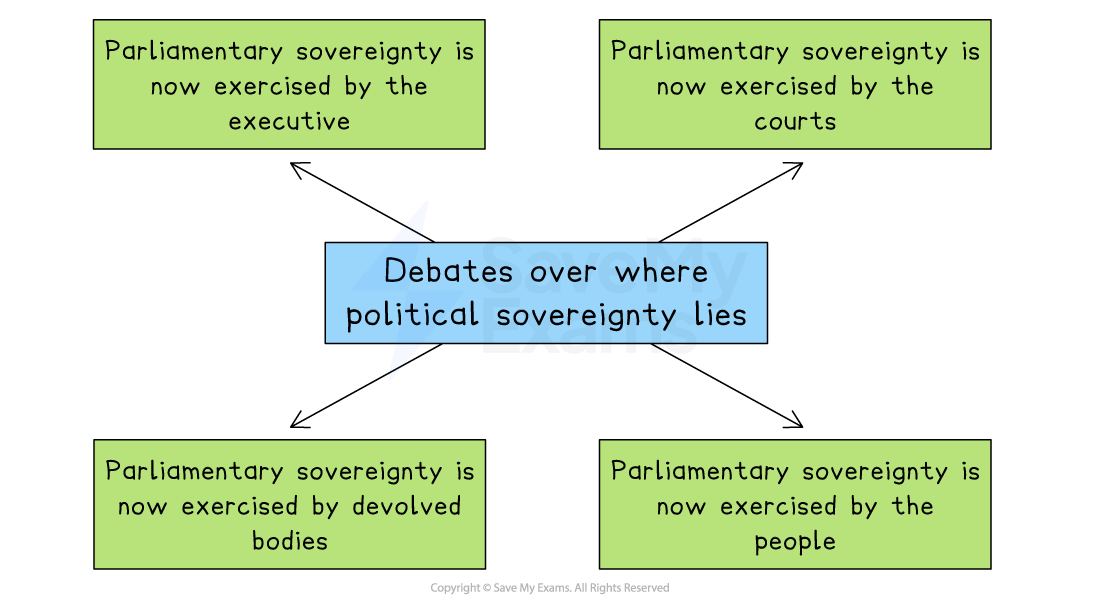
Debate 1
Parliamentary sovereignty is now exercised by the executive
The executive controls the parliamentary timetable and legislative agenda
The executive usually commands a majority in the House of Commons
This majority can be enforced through the whip system
The executive can overcome challenges from the House of Lords using:
Parliament Acts 1911 and 1949
The Salisbury Convention
However:
Backbench power has increased since 2010
Greater use of urgent questions
Creation of the Backbench Business Committee
A cross-party committee of MPs that decides when time is given in the House of Commons for debates chosen by backbench MPs, rather than by the government
Debate 2
Parliamentary sovereignty is now exercised by the courts
The creation of the Supreme Court in the Constitutional Reform Act 2005 has led to:
Increased judicial review
More frequent challenges to government action
The courts have become a more reliable check on government
However:
In Miller v Brexit Secretary (2017) and Miller v PM (2019), the Supreme Court upheld the sovereignty of Parliament over the executive
Nonetheless, the need for Supreme Court intervention raises questions over the sovereignty of Parliament
Debate 3
Parliamentary sovereignty is now exercised by devolved bodies
The creation of the Scottish and Welsh Parliaments
The reopening of the Northern Ireland Assembly at Stormont
The creation of elected mayors
Increasing political power located outside Westminster
These bodies can claim a democratic mandate, as they are elected
However:
Parliament retains supremacy
Demonstrated by vetoing the Scottish Gender Recognition Act
Turnout is often higher in parliamentary elections than devolved elections
This arguably gives Parliament a stronger mandate
Debate 4
Parliamentary sovereignty is now exercised by the people
Increased use of referendums
Referendums have become a constitutionally expected convention for major constitutional reform
This places policy-making decisions in the hands of the people
However:
Referendums are not legally binding
They can only be called by Parliament
This underpins parliamentary sovereignty rather than undermining it
Where does sovereignty lie?
Whilst there is debate over the movement of sovereignty between branches, it remains difficult to pinpoint exactly where sovereignty in the UK lies, particularly political sovereignty
1. Sovereignty may lie in the executive
Due to prerogative powers such as:
Treaty making
Prorogation
Allows the executive to act without parliamentary approval
Bypasses legislative scrutiny
2. Sovereignty may lie in the Supreme Court
Through interpretation of statutes
Through constraining executive action
Effectively shapes public policy
This raises concerns
Judges are unelected
There are relatively few checks on judicial power
3. Sovereignty may lie in international treaties and agreements
International treaties bind future UK governments
UK policy-making must operate within these frameworks
Exiting treaties is difficult and time-consuming
As demonstrated by Brexit
4. Sovereignty may lie in devolved bodies
Devolved institutions have primary legislative power over large policy areas
Policy differences now exist across the UK
This creates challenges:
The West Lothian Question
Further tension over parliamentary sovereignty
5.Sovereignty may lie in international organisations
UK obligations to organisations such as:
NATO
The United Nations
The Council of Europe
Membership places constraints on UK action
Particularly regarding human rights protection
6. Sovereignty may lie in the people
Power exercised through:
Elections
Referendums
Recall elections
Petitions
Media pressure
Public opinion has led to government U-turns
For example, Starmer’s two-child benefit cap
Overall judgement on sovereignty in the UK
Ultimately, sovereignty in the UK today is flexible and shared
Parliamentary sovereignty remains the core location of sovereignty
Parliament remains the home of legal sovereignty
Political sovereignty is more negotiated and dispersed

Unlock more, it's free!
Join the 100,000+ Students that ❤️ Save My Exams
the (exam) results speak for themselves:

Was this revision note helpful?
