Feminism: Core Ideas & Principles (Edexcel A Level Politics): Revision Note
Exam code: 9PL0

The core ideas of feminism
Examiner Tips and Tricks
For Component 2, Non-Core Political Ideas, students only need to study one idea from the following:
anarchism, ecologism, feminism, multiculturalism, nationalism
Feminism is a political ideology that seeks to achieve equality between men and women by challenging and ending gender-based inequality and oppression in society
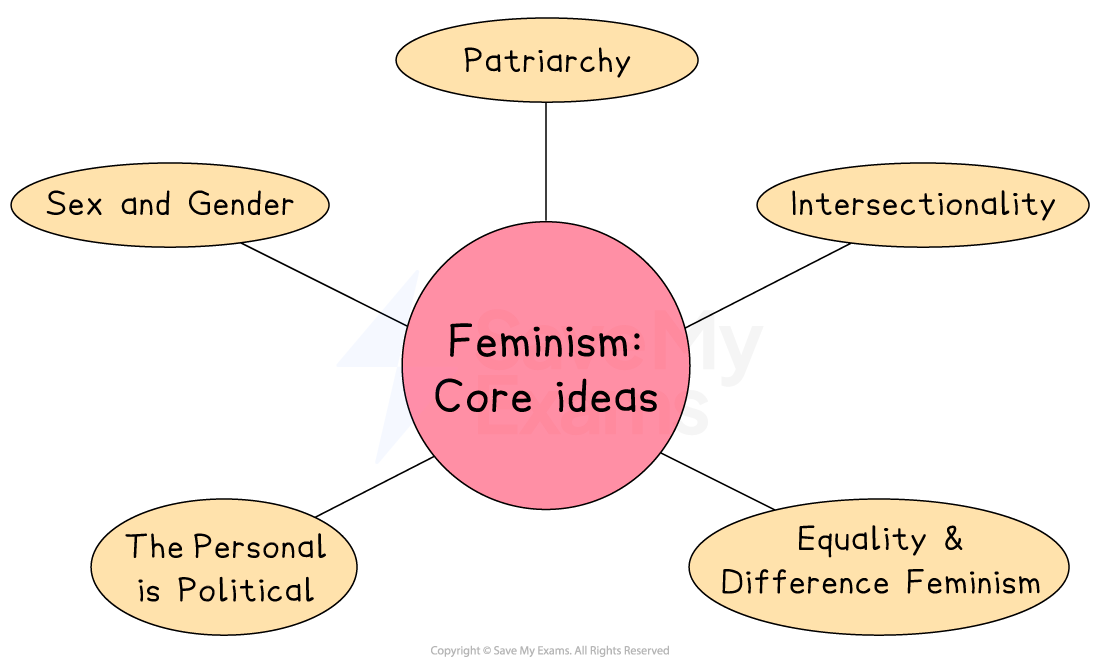
Sex and gender
For feminists, sex and gender are not synonymous terms
Sex refers to biological differences, whilst gender is socially constructed through norms, roles and expectations
For feminists, 'sex' and 'gender' mean
Biological vs social
Sex is biological
Gender is socially constructed
Gender roles and norms
Society assigns expectations to men and women
These norms shape behaviour and opportunities
Fluidity and choice
Gender identity is diverse and not fixed at birth
Women should have the freedom to define their own identities
Critique of gender expectations
Feminism aims to dismantle rigid gender roles and constraints
Key thinkers
Simone de Beauvoir | bell hooks | Charlotte Perkins Gilman |
|---|---|---|
|
|
|
Agreement within feminism
All strands recognise that gender is socially constructed
All strands accept that gender roles contribute to the oppression of women
Disagreement within feminism
Liberal feminism
Focuses on achieving equality within existing political and social structures
Radical feminism
Sees gender roles as the root of patriarchy
Socialist feminism
Integrates class and capitalism into explanations of gender roles
Post-modern feminism
Challenges universal definitions of gender
Rejects fixed or singular experiences of womanhood
Patriarchy
Patriarchy refers to a system of male dominance in which social, political and economic structures privilege men over women, resulting in systematic oppression
For feminists, patriarchy means
Male dominance
Society is structured to privilege men over women
Institutional power
Patriarchal norms operate in the family, workplace and politics
Cultural reinforcement
Laws, traditions and social norms maintain male authority
Systemic oppression
Discrimination against women is embedded within societal structures
Need for dismantling
Patriarchal norms must be challenged and removed
Key thinkers
Kate Millett | bell hooks | Charlotte Perkins Gilman |
|---|---|---|
|
|
|
Agreement within feminism
All strands recognise patriarchy as a core source of women’s oppression
Disagreement within feminism
Radical feminism
Sees patriarchy as universal
Argues it can only be removed through revolutionary change
Socialist feminism
Emphasises the intersection between patriarchy and class
Liberal feminism
Focuses on legal equality and reform within existing structures
Post-modern feminism
Critiques the idea of a single, universal patriarchal system
The personal is political
For feminists, the idea that the personal is political challenges the belief that women’s private lives are apolitical, arguing instead that personal experiences reflect wider systems of oppression
For feminists, the personal is political means
Private life reflects systemic oppression
Domestic experiences mirror wider social inequalities
Household labour
Domestic work is politically and socially structured
Women are disproportionately disadvantaged
Sexual politics
Relationships and sexuality are shaped by power dynamics
Consciousness and empowerment
Awareness of oppression leads to political action
Recognising the political nature of private life enables change
Key thinkers
Sheila Rowbotham | Charlotte Perkins Gilman | Kate Millett |
|---|---|---|
|
|
|
Agreement within feminism
All strands agree that private experiences can reflect and entrench wider social inequalities
Disagreement within feminism
Radical feminism
Prioritises dismantling traditional family structures and gender roles
Socialist feminism
Emphasises class, capitalism and domestic labour as shaping personal experience
Liberal feminism
Focuses more heavily on workplace equality and reform in the public sphere
Equality and difference feminism
Equality and difference feminism represent two contrasting approaches within feminism to understanding gender equality
Whether women should be treated the same as men or
Whether gender differences should be recognised and valued
For feminists, equality and difference feminism mean
Equality feminism
Women and men should be treated identically under law and society
Gender should not justify different rights or opportunities
Difference feminism
Recognises gender differences as inherent or socially significant
Values traits traditionally associated with women
Influence on policy
Both approaches shape views on law, welfare and workplace norms
Different understandings of equality lead to different policy priorities
Dominance of equality feminism
The majority of feminists support equality feminism
Key thinkers
bell hooks | Sheila Rowbotham | Kate Millett |
|---|---|---|
|
|
|
Agreement within feminism
All strands support legal and social equality for women
Disagreement within feminism
Equality feminists
Argue women and men should be treated the same in law and society
Difference feminists
Emphasise distinct gender traits
Believe these differences should be recognised and valued
Intersectionality
For feminists, intersectionality refers to the idea that women experience oppression in different ways depending on how gender intersects with factors such as race, class, sexuality and disability
For feminists, intersectionality means
Multiple identities
Women do not share a single, universal experience of oppression
Overlapping oppression
Individuals may experience multiple forms of discrimination simultaneously
Complex systems of inequality
Gender oppression interacts with race, class, sexuality and other social factors
Empowerment through recognition
Understanding intersectional oppression allows inequality to be challenged more effectively
Social change should include all marginalised groups
bell hooks | Sheila Rowbotham | Kate Millett |
|---|---|---|
|
|
|
Agreement within feminism
All strands recognise the need to address overlapping and intersecting forms of oppression
Disagreement within feminism
Radical feminism
Prioritises patriarchy as the primary source of oppression
Liberal feminism
Emphasises legal equality as the main route to tackling inequality
Socialist feminism
Focuses on class and labour inequality
Post-modern feminism
Rejects the idea of a typical or universal experience of women

Unlock more, it's free!
Join the 100,000+ Students that ❤️ Save My Exams
the (exam) results speak for themselves:

Was this revision note helpful?