Comparative Approaches: The UK & US Constitutions (Edexcel A Level Politics): Revision Note

Exam code: 9PL0

Sarra Jenkins

Written by: Sarra Jenkins

Reviewed by: Steve Vorster

Updated on

The UK and US Constitutions

Examiner Tips and Tricks

In each of the similarities and differences below, a suggestion is given as to which theory might explain this

  • This does not mean this is the ‘right’ answer – in most cases, multiple theories can be used to explain a similarity or difference

  • For Question 1a and 1b, no theories are required – they are only required in Question 2

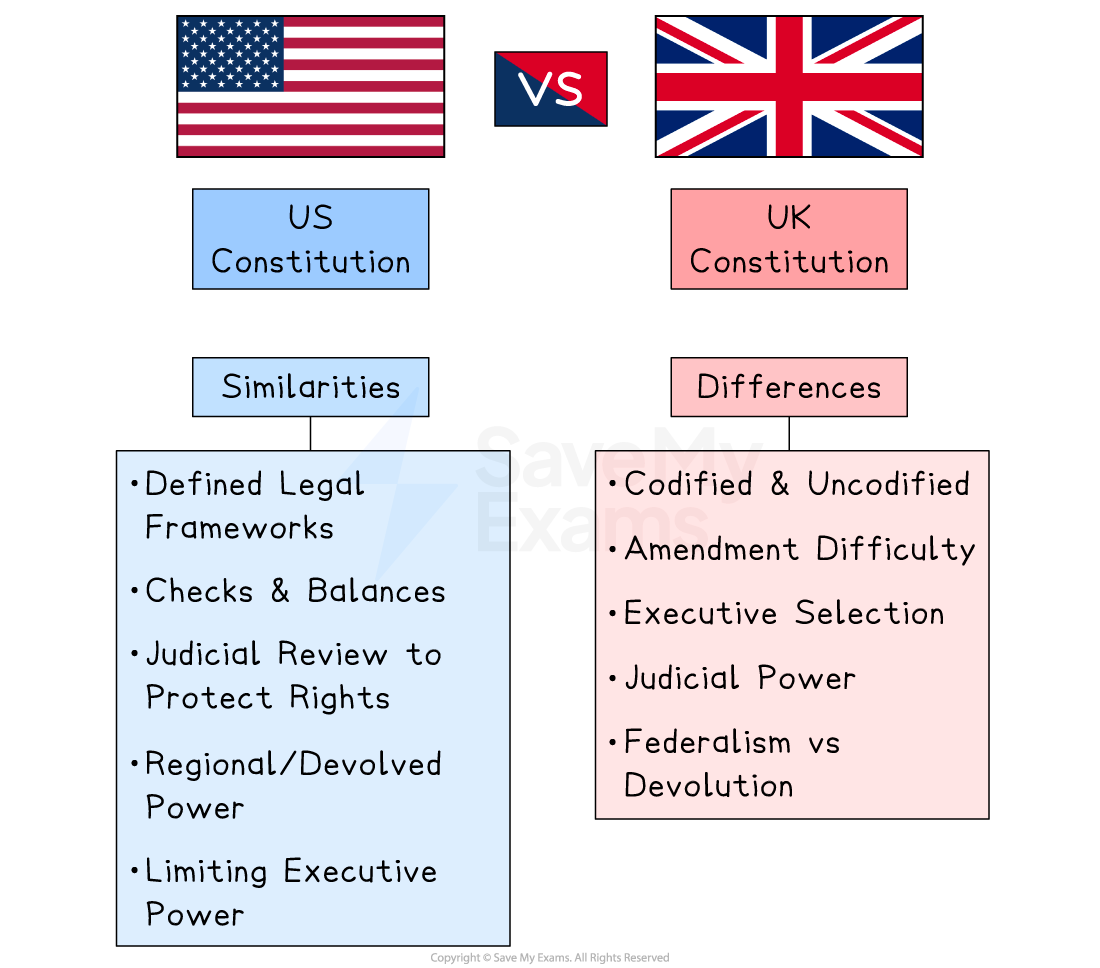
Comparison of US and UK constitutions. Similarities: legal frameworks, checks, judicial review, regional power, limiting executive. Differences: codification, amendments, executive selection, judicial power, federalism.
US vs UK Constitution

Similarities

Similarity

Explanation & example

Which theory to use?

Defined legal frameworks

  • Both the US and UK have defined legal frameworks governing political behaviour

  • In the US, the Constitution (1787) establishes the federal system

  • In the UK, key statutes such as the Human Rights Act (1998) and Constitutional Reform Act (2005) define parliamentary and judicial structures

  • These rules guide government action and constrain government decision-making

  • This could be explained by structural theory, as institutions shape political outcomes

Checks and balances / scrutiny

  • In the US, the Constitution divides power between the executive, legislature and judiciary

  • Congress can override presidential vetoes and impeach presidents

  • In the UK, the executive is drawn from Parliament

  • Backbench MPs and committees provide scrutiny, such as parliamentary investigations into the Iraq War (2003)

  • This could be explained by rational theory, as politicians strategically use institutional mechanisms to protect their interests, including popularity and re-election chances

Judicial review to protect rights

  • US courts have power to strike down unconstitutional legislation (Dobbs v Jackson, 2022)

  • The UK Supreme Court can also review executive action for legality (Miller v Secretary of State, 2017)

  • They cannot strike down primary legislation

  • This could be explained by cultural theory, reflecting societal norms of the value of rights protection

Devolved / regional power

  • US federalism gives states control over key policy areas, such as abortion laws in Texas post-Dobbs

  • UK devolution gives powers to Scotland, Wales, and Northern Ireland

  • Such as Scottish Parliament’s health and education powers

  • This could be explained by cultural theory, as identity and local traditions shapes local policies decisions

Checks on government through law-making and oversight

  • Both constitutions limit executive power through formal procedures

  • In the US, the Senate confirmation of judicial appointments

  • In the UK, select committees conduct scrutiny

  • This could be explained by structural theory, as institutional rules determine power allocation

Differences

Difference

Explanation & example

Theory explanation

Codified vs uncodified constitution

  • The US Constitution is written and entrenched

  • The UK constitution is uncodified, relying on statutes, conventions and common law

  • This difference explains rigidity in the US versus flexibility in the UK

  • This could be explained by structural theory, with legal frameworks shaping different political processes

Amendment difficulty

  • US amendments require two-thirds of Congress and three-fourths of states

  • In the UK, Parliament can pass new statutes with a simple majority

  • This could be explained by structural theory with different institutional constraints on constitutional change

Executive selection

  • The US president is directly elected via the people and the Electoral College

  • The UK prime minister is the leader of the majority party

  • This could be explained by cultural theory, with both systems being a product of historical developments and cultural understanding

Judicial power

  • US Supreme Court can overturn legislation (Citizens United v FEC, 2010)

  • UK courts cannot strike down primary legislation

  • This could be explained by structural theory, with the US Supreme Court’s power being a product of the Constitution whilst the UK Supreme Court was a product of parliamentary legislation

Federalism vs devolution

  • US state powers are constitutionally protected

  • UK devolution is statutory and theoretically revocable by Parliament

  • For example Westminster temporarily intervened in Northern Ireland budget issues (2017–18)

  • This could be explained by cultural theory, with US citizens being highly focussed on local issues through federalism, whilst UK politics typically has focussed on actions from Westminster

Unlock more, it's free!

Join the 100,000+ Students that ❤️ Save My Exams

the (exam) results speak for themselves:

Sarra Jenkins

Author: Sarra Jenkins

Expertise: Content Writer

Sarra is a highly experienced A-Level Politics educator with over two decades of teaching and examining experience. She was part of the team that wrote the Edexcel 2017 Politics Specification and currently works as a Senior Examiner. A published author of 14 textbooks and revision guides, her expertise lies in UK and US politics, exam skills, and career guidance. She continues to teach, driven by her passion for this "evolving and dynamic subject".

Steve Vorster

Reviewer: Steve Vorster

Expertise: Economics & Business Subject Lead

Steve has taught A Level, GCSE, IGCSE Business and Economics - as well as IBDP Economics and Business Management. He is an IBDP Examiner and IGCSE textbook author. His students regularly achieve 90-100% in their final exams. Steve has been the Assistant Head of Sixth Form for a school in Devon, and Head of Economics at the world's largest International school in Singapore. He loves to create resources which speed up student learning and are easily accessible by all.