Comparative Approaches: UK and US Legislative Branches (Edexcel A Level Politics): Revision Note

Exam code: 9PL0

Sarra Jenkins

Written by: Sarra Jenkins

Reviewed by: Steve Vorster

Updated on

Comparing the UK and US Legislative Branches

Examiner Tips and Tricks

In each of the similarities and differences below, a suggestion is given as to which theory might explain this

  • This does not mean this is the ‘right’ answer – in most cases, multiple theories can be used to explain a similarity or difference

  • For Question 1a and 1b, no theories are required – they are only required in Question 2

Comparing the nature of the UK and US legislative branches

  • Both the UK and the US have legislatures responsible for:

    • Making laws

    • Scrutinising the executive

    • Debating policy and representing citizens

  • However, the way each legislature is structured and how effectively it can operate differ significantly
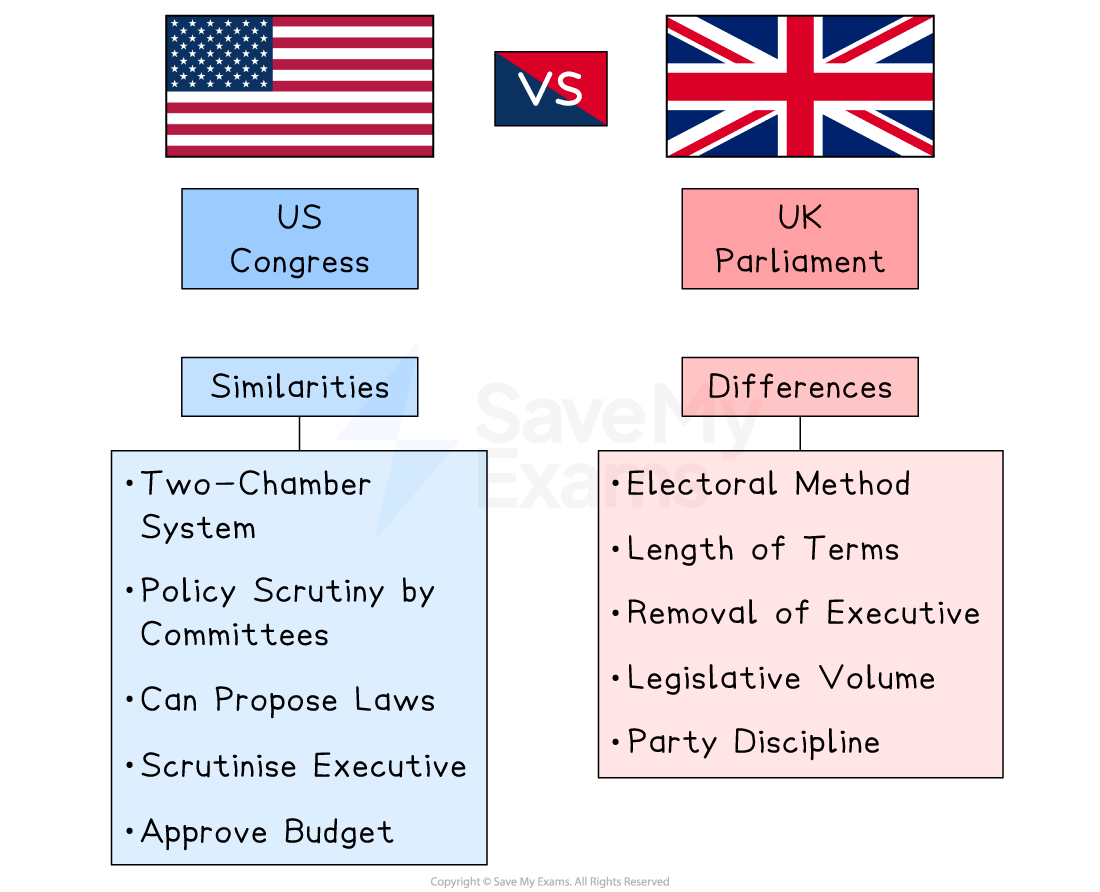
Legislative differences and similarities

Similarities

  • Both legislatures have two chambers

    • US: Congress (Senate and House of Representatives)

    • UK: Parliament (House of Lords and House of Commons)

  • Both rely on committees to scrutinise policy

    • US committees investigate legislation and oversee the executive

    • UK select committees run inquiries and publish reports

  • Both can propose laws

    • In the UK, most bills come from the government

  • Both scrutinise the executive

    • US Congress uses hearings

    • UK Parliament uses mechanisms like PMQs

  • Both approve budgets

    • But the Commons is dominant in UK finance bills

Differences

Difference

Explanation + example

Theory explanation

Electoral method

  • Both houses in the US are elected

  • The UK House of Lords is mostly appointed

  • Cultural theory, as institutions reflect historical development

Length of terms

  • US Representatives serve 2 years, Senators serve 6 years

  • UK MPs serve up to 5 years depending on when an election is called

  • Structural theory, as the US electoral cycle is constitutionally fixed

Removal of executive

  • UK Parliament can remove a PM via a vote of no confidence

  • US Congress can remove a president only through impeachment, which is rare and requires a supermajority

  • Structural theory, due to constitutional rules

Legislative volume

  • US Congress passes fewer but more detailed laws due to checks and balances

  • UK Parliament can pass more legislation quickly

  • Structural theory, because UK fused powers allows executive control

Party discipline

  • UK MPs show higher party discipline

  • US legislators vote more independently

  • Rational theory, as loyalty is owed to different sources (party vs constituents)

Comparing the extent to which each of the Houses are equal

  • This comparison allows you to weigh up how far bicameralism is meaningful in both systems
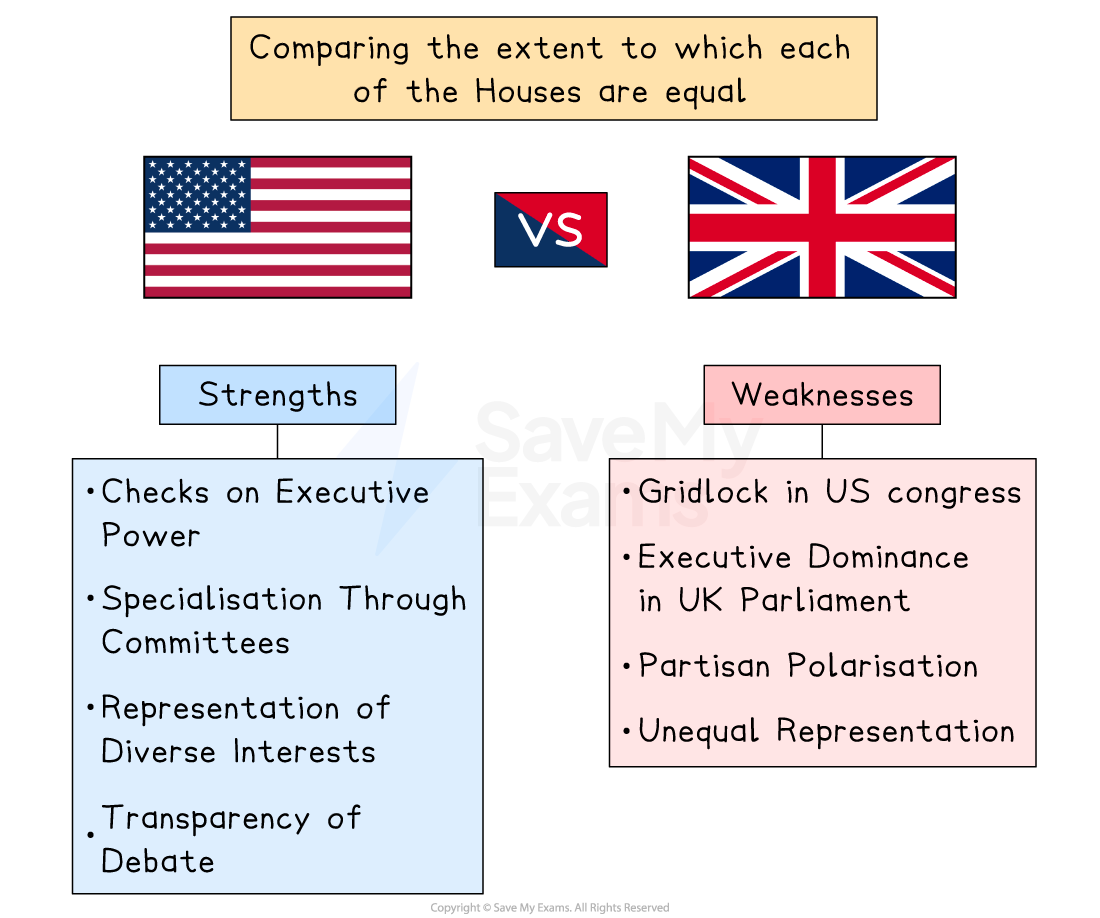
How equal are the houses

Strengths (ways the houses are meaningfully powerful)

Strength

Explanation + example

Theory explanation

Checks on executive power

  • US Congress can block presidential proposals (e.g. opposition to parts of Build Back Better, 2021)

  • UK Parliament can challenge the PM via debates and no-confidence motions

  • Structural theory, as both have formal limiting powers

Specialisation through committees

  • US Ways and Means Committee (tax)

  • UK Health Committee (health policy)

  • Rational theory, as legislators build expertise and influence

Representation of diverse interests

  • US: Senate (states equally) and House (population)

  • UK Commons represents constituencies

  • Rational theory, as representatives respond to voter demands

Transparency of debate

  • US: C-SPAN

  • UK: Hansard records proceedings

  • Cultural theory, reflecting norms of accountability

Emergency flexibility

  • US CARES Act (2020) and UK Coronavirus Act (2020)

  • Rational theory, as institutions adapt to crises

Weaknesses (ways equality is limited)

Weakness

Explanation + example

Theory explanation

Gridlock in US Congress

  • Filibusters and divided government slow law-making

  • UK can overcome the Lords' power via Parliament Acts and Salisbury Convention

  • Structural theory, due to institutional design

Executive dominance in UK Parliament

  • Party discipline allows PMs to push legislation quickly

  • US separation allows Congress to ignore presidential pressure

  • Cultural theory, reflecting party vs constituency loyalty

Partisan polarisation

  • US hyperpartisanship reduces compromise

  • UK Lords can provide less partisan scrutiny

  • Cultural theory, reflecting wider US political spectrum

Unequal representation

  • US Senate over-represents small states

  • UK constituencies are more equal in size

  • Structural theory, as the US Constitution was designed this way

Limited power of some chambers

  • UK Lords cannot block finance bills

  • In the US, appropriations must begin in the House, but the Senate has equal say after that

  • Structural theory, as mandate affects power

Unlock more, it's free!

Join the 100,000+ Students that ❤️ Save My Exams

the (exam) results speak for themselves:

Sarra Jenkins

Author: Sarra Jenkins

Expertise: Content Writer

Sarra is a highly experienced A-Level Politics educator with over two decades of teaching and examining experience. She was part of the team that wrote the Edexcel 2017 Politics Specification and currently works as a Senior Examiner. A published author of 14 textbooks and revision guides, her expertise lies in UK and US politics, exam skills, and career guidance. She continues to teach, driven by her passion for this "evolving and dynamic subject".

Steve Vorster

Reviewer: Steve Vorster

Expertise: Economics & Business Subject Lead

Steve has taught A Level, GCSE, IGCSE Business and Economics - as well as IBDP Economics and Business Management. He is an IBDP Examiner and IGCSE textbook author. His students regularly achieve 90-100% in their final exams. Steve has been the Assistant Head of Sixth Form for a school in Devon, and Head of Economics at the world's largest International school in Singapore. He loves to create resources which speed up student learning and are easily accessible by all.