The Functions of Congress (Edexcel A Level Politics): Revision Note
Exam code: 9PL0

The functions of Congress
Congress has three key functions – legislation, representation and oversight
These are the same three functions as UK Parliament, although oversight is often called scrutiny in the UK
Representation
Members of Congress represent multiple interests simultaneously, which can create tension between competing demands
Caucuses
Caucuses are informal groups within Congress based on ideology, identity or policy interests
The Congressional Black Caucus has taken part in the ‘no bill, no break’ protest on the floor of the House of Representatives to try and achieve changes to gun control
However, caucuses in Congress lack formal legislative power, and members must balance other interests that they might represent
State or district representation
Members represent geographic interests that may include economic interests of their state or cultural issues relevant to their state or district
Senators often vote to protect state industries, such as agriculture in Iowa, or Lauren Boebert’s (R-CO) support of the water project that President Trump vetoed in 2025
However, national party loyalty can override local needs, such as some Republicans supporting national abortion bans despite local opposition
Party representation
Members often vote along party lines to support their party leadership and potentially gain promotion
Party unity helped pass Biden’s American Rescue Plan (2021) and prevented veto overrides of President Trump’s vetoes in 2025 despite being initially unanimously passed
However, hyperpartisanship in Congress prevents compromise and can often make it difficult for Congress to function effectively
Lobbyists and interest groups
Lobbyists and interest groups influence policy through donations to electoral campaigns and by providing expertise
The National Rifle Association spent $6.3m supporting Republicans in 2024 and $3.8m opposing Democratic candidates in 2024
However, this raises concerns about the role of money in congressional elections and challenges members’ ability to represent their district or state
Why is incumbency so high in Congress?
Incumbency rates regularly exceed 90% in both the House and the Senate, reflecting the structural advantages held by sitting members
Name recognition gives incumbents visibility
Long-serving members dominate local media
Fundraising advantages deter challengers
In 2017, the average House incumbent raised $655,000 compared to $111,000 raised by challengers
Constituency service builds voter loyalty
Members secure federal grants for districts, such as Lauren Boebert’s advocacy of the Colorado water project vetoed by President Trump in 2025
Gerrymandering protects incumbents
Post-2020 redistricting in Texas attempted to favour Republican incumbents before being struck down by US courts
Weak challengers are discouraged from running
In 2024, 37 districts were uncontested, and in 2022, 35 districts were uncontested
Legislation
A key function of Congress is to suggest, amend and delay legislation
For a bill to become law, it must pass through a deliberately complex process designed to prevent rushed lawmaking
Legislative process
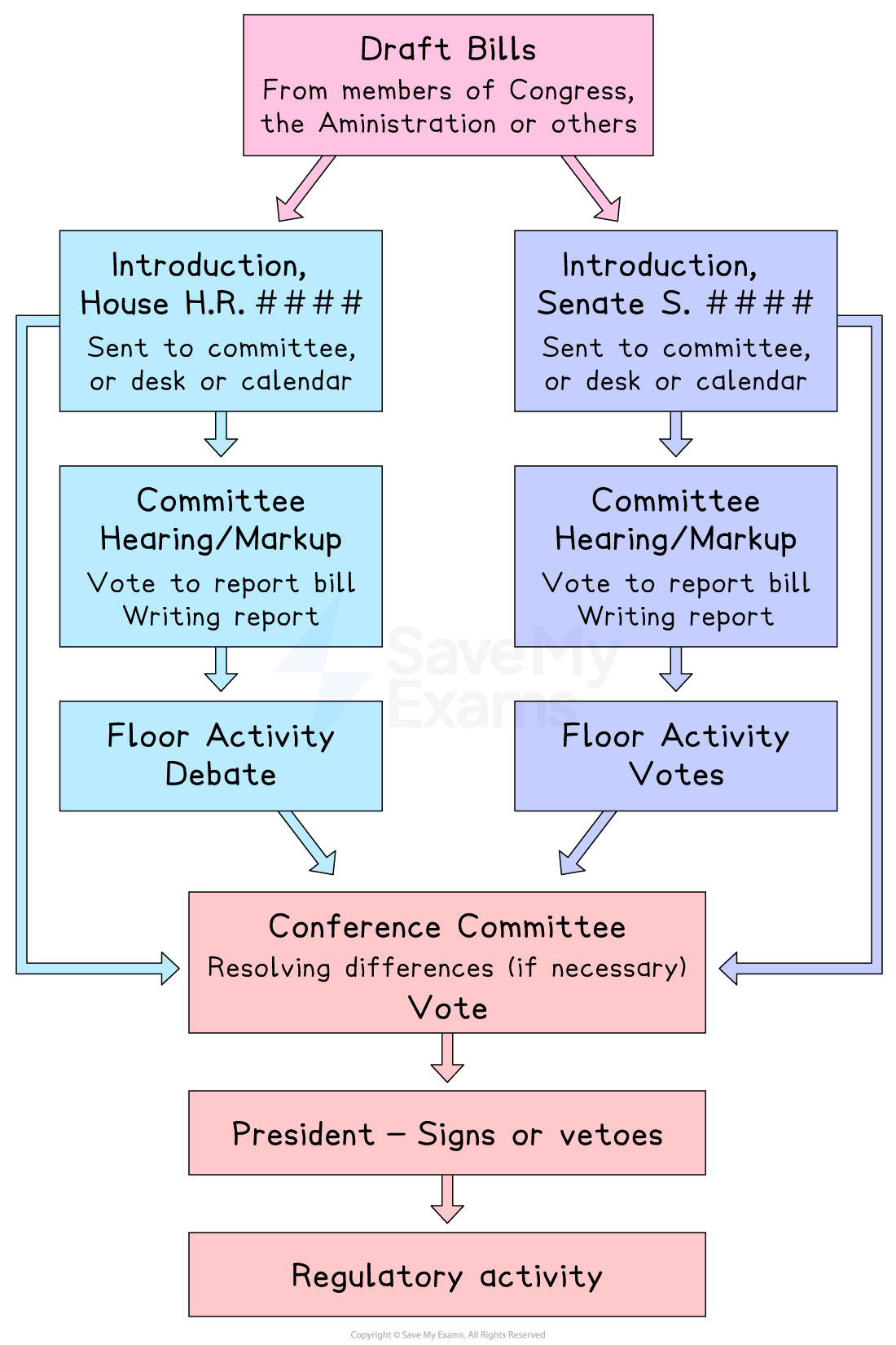
Introduction
A bill is introduced in either the House or the Senate
Committee stage
The bill is referred to a committee, where hearings and amendments occur
Unlike the UK, committees are standing committees rather than temporary bill committees
Floor debate and voting
In the Senate, senators may use the filibuster to try and stall legislation
Bicameral agreement
Both chambers must pass a version of the bill
A conference committee may resolve differences between versions
Presidential consideration
The President may sign the bill, veto it, or leave it unsigned for ten days (after which it automatically becomes law unless the congressional session ends)
If vetoed, Congress can override the veto with a two-thirds majority in both Houses
Case Study
TikTok ban / Israel bill
Context
The Protecting Americans from Foreign Adversary Controlled Applications Act (2024) was introduced in the House of Representatives in March 2024
The bill responded to concerns that TikTok’s Chinese parent company, ByteDance, posed a national security risk due to data-sharing fears
Actions taken
The bill originated in the House Energy and Commerce Committee, where it was rapidly reviewed
It passed the House by a large bipartisan majority (352–65), demonstrating how national security concerns can overcome party divisions
The bill then moved to the Senate, where it faced procedural delays due to concerns about free speech and youth voter backlash
After negotiations, the TikTok bill was attached to a broader foreign aid package, including aid to Israel and Ukraine
Outcomes
The Senate passed the combined package in April 2024
This demonstrated how logrolling and compromise shape legislative outcomes
Strengths and weaknesses of the legislative process
Strengths of the legislative process | Weaknesses of the legislative process |
|---|---|
|
|
|
|
|
|
|
|
|
|
Oversight
Congress holds extensive constitutional and informal powers to scrutinise the executive branch.
Direct oversight mechanisms
Committee hearings
Dr Anthony Fauci testified during COVID-19
Homeland Security Secretary Kristi Noem left a hearing in 2025 rather than answer questions
Investigative committees
The January 6th Select Committee (2021–23) held ten public hearings
Budgetary control
Congress blocked funding for Trump’s border wall and overturned his veto of the National Defense Authorization Act 2021
Confirmation hearings
Pete Hegseth was confirmed as Secretary of Defense after a 50–50 Senate vote and VP tie-break
Impeachment
Trump was impeached in 2019 and 2021, though the Senate did not reach the two-thirds threshold
Oversight of the Supreme Court
Confirmation of justices
Ketanji Brown Jackson was confirmed 53–47 in 2022
Budgetary oversight
Legislative override of court rulings
Attempts to codify abortion rights after Dobbs (2022)
Constitutional amendments
The 16th Amendment overturned Pollock v. Farmers’ Loan & Trust
Impeachment of justices
Calls to impeach Clarence Thomas in 2023 over ethics concerns
Arguments on the effectiveness of Congress at oversight
Congress is effective at oversight | Congress is not effective at oversight |
|---|---|
|
|
|
|
|
|
|
|
|
|

Unlock more, it's free!
Join the 100,000+ Students that ❤️ Save My Exams
the (exam) results speak for themselves:

Was this revision note helpful?
