The Structure of Congress (Edexcel A Level Politics): Revision Note
Exam code: 9PL0

Optional unit
Examiner Tips and Tricks
For Component 3, students only study ONE route: USA Politics (3A) or Global Politics (3B)
The bicameral nature of Congress
Congress is a bicameral legislature, meaning it is made up of two chambers: the House of Representatives and the Senate
This structure is designed to balance popular representation with state representation and to prevent the concentration of power in one branch of government
The House of Representatives
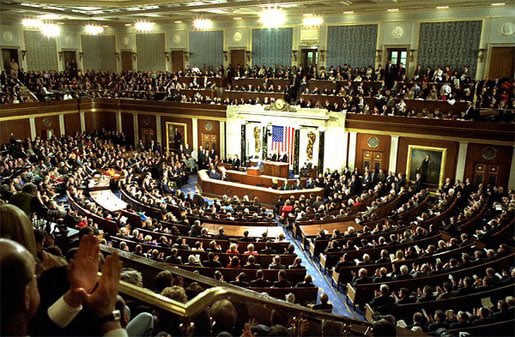
Contains 435 voting members
Also has non-voting members, such as the representative for Washington DC
These members can take part in debates but cannot vote
Each member represents a congressional district of roughly equal population
Every state must have at least one member
Constitutional requirements:
at least 25 years old
a US citizen for seven years
Holds exclusive powers, including:
initiating money bills (the power of the purse)
beginning impeachment proceedings
Intended to represent the people of the US
The Senate
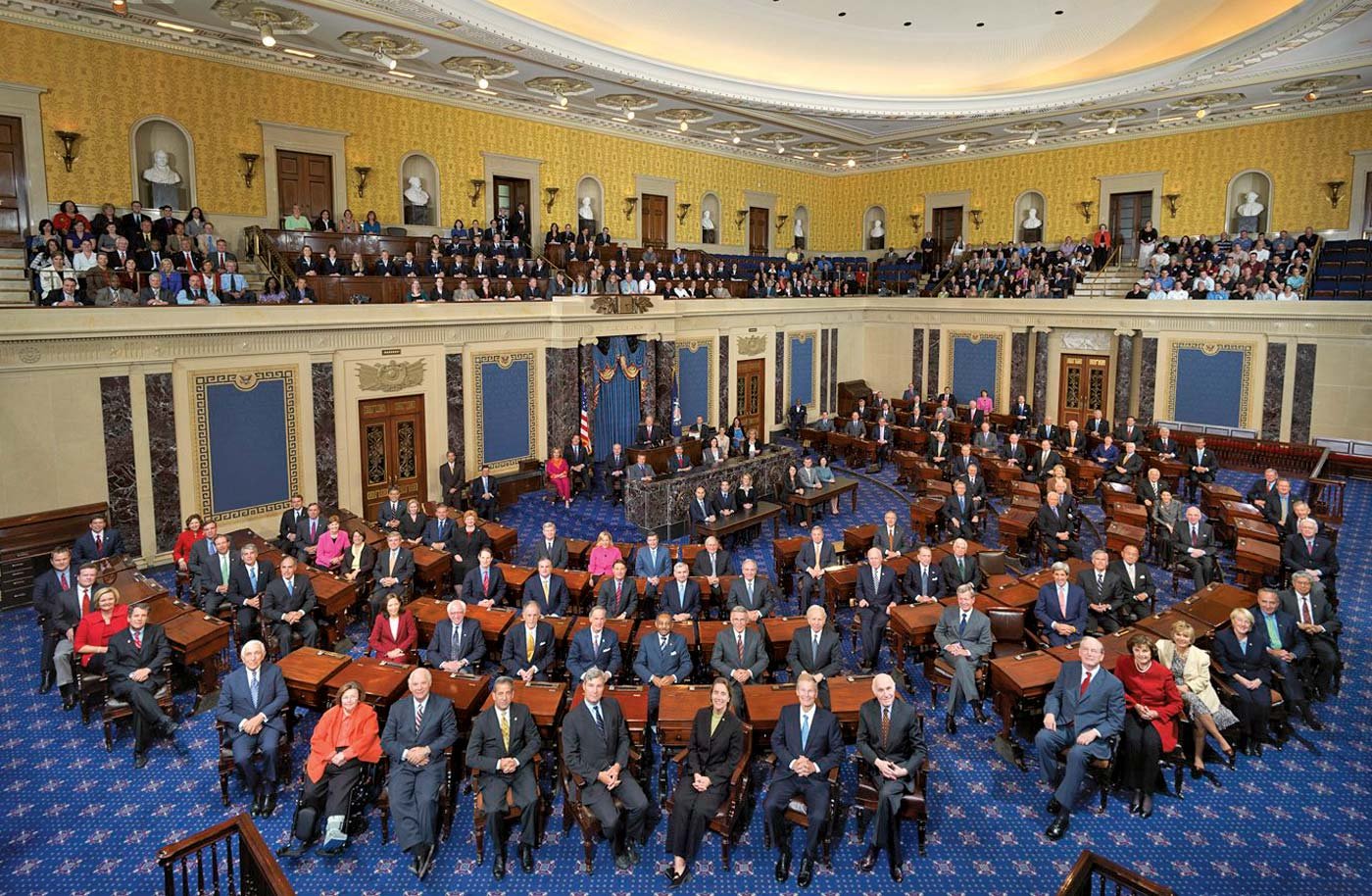
Contains 100 members
Each state has two senators, regardless of population
Constitutional requirements:
at least 30 years old
a US citizen for nine years
Holds exclusive powers, including:
ratifying treaties
confirming executive and judicial appointments
Intended to represent the wider interests of the states
Concurrent powers of Congress
Although Congress consists of two houses, many of its powers are concurrent, meaning they are exercised together
Both chambers:
pass, amend and suggest legislation
are required to overturn a presidential veto by a two-thirds vote
are required to propose a constitutional amendment by a two-thirds vote
Membership of Congress
Congress reflects two different democratic principles: proportional representation in the House and equal state representation in the Senate
Representation and composition
House of Representatives | Senate |
|---|---|
|
|
|
|
|
|
Demographically, Congress does not fully reflect the population. In the 119th Congress (2025–27):
96% of members had a four-year college degree, compared to around one-third of Americans
155 (29%) women held seats in Congress, compared to just over 50% of Americans
61 (11%) African Americans held seats in Congress, compared to 14% of Americans
56 Hispanics held 10% of seats in Congress, compared to 20% of Americans
Members of Congress may represent multiple interests simultaneously, including:
their constituents from their state or district
party leadership
ideological caucuses
personal beliefs
Case Study
Alexandria Ocasio-Cortez as a Representative

Alexandria Ocasio-Cortez (AOC) has represented New York’s 14th Congressional District since 2019, covering parts of the Bronx and Queens
Context
Represents a diverse, urban district
Exemplifies delegate-style representation
Prioritises the expressed views of her constituents
Uses her position in Congress to
Support Medicare for All, reflecting district-level support for universal healthcare
Engage in constituency service
In 2022, supported funding for New York public housing renovations
Use Congress as a platform for policy advocacy
Co-sponsored the Green New Deal resolution
Represent ideological interests
Leading figure in the Congressional Progressive Caucus
Outcomes
Secured federal funding for local infrastructure and housing projects
Shaped Democratic discourse on climate change despite proposals not becoming law
Demonstrated how representatives can influence policy debate beyond legislative success
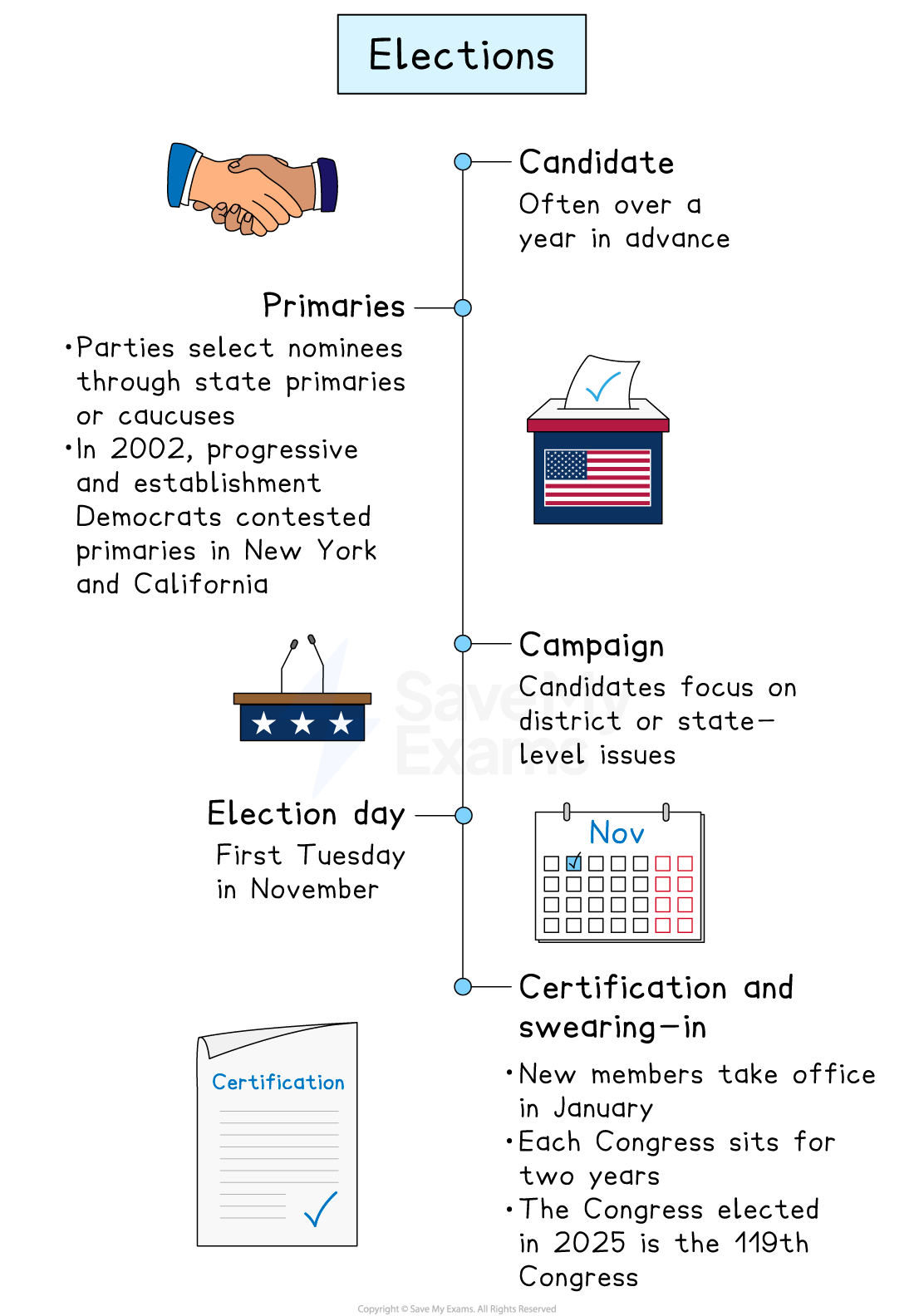
The Congress election cycle
Congressional elections use the First Past the Post electoral system and take place every two years
All House seats are contested every two years
One-third of Senate seats are contested every two years
Senators serve six-year terms
The election timeline
Fundraising and incumbency
Campaigns rely heavily on:
individual donations
PACs
Super PACs
In 2020 and 2022, candidates spent over $8 billion
Incumbents have significant advantages:
name recognition
stronger donor networks
access to official congressional resources
potential protection from gerrymandered districts
Turnout in congressional elections, especially midterms, is low
This further benefits incumbents
Distribution of powers in Congress
Congress has three key functions, which shape how power operates within the institution
Key functions of Congress
Function | Explanation and examples |
|---|---|
Legislation |
|
Representation |
|
Oversight |
|
There is debate over whether the House of Representatives or the Senate is the more powerful chamber, or whether power is balanced between them
Who is more powerful?
Arguments that the House of Representatives is more powerful | Arguments that the Senate is more powerful |
|---|---|
|
|
|
|
|
|
|
|
|
|
|
|
Arguments that the House and Senate are equal in power
Many of the powers of Congress are concurrent, meaning they are exercised jointly by both chambers
Both chambers must approve legislation before it can be sent to the President for signature
Both chambers must achieve a two-thirds majority to overturn a presidential veto
Both chambers use committees and investigations to conduct oversight of the executive branch
Both chambers must achieve a two-thirds majority to propose a constitutional amendment

Unlock more, it's free!
Join the 100,000+ Students that ❤️ Save My Exams
the (exam) results speak for themselves:

Was this revision note helpful?