Comparative Approaches: The UK and US Executive Branches (Edexcel A Level Politics): Revision Note

Exam code: 9PL0

Sarra Jenkins

Written by: Sarra Jenkins

Reviewed by: Steve Vorster

Updated on

The UK and US Executive Branches

Examiner Tips and Tricks

In each of the similarities and differences below, a suggestion is given as to which theory might explain this.

  • This does not mean this is the ‘right’ answer

    • In most cases, multiple theories can be used to explain a similarity or difference

  • For Question 1a and 1b, no theories are required

    • They are only required in Question 2

  • More information on the three theories – structural, rational and cultural – can be found on the page 'Introduction to Comparative Approaches'

The roles and powers of the US President and UK Prime Minister
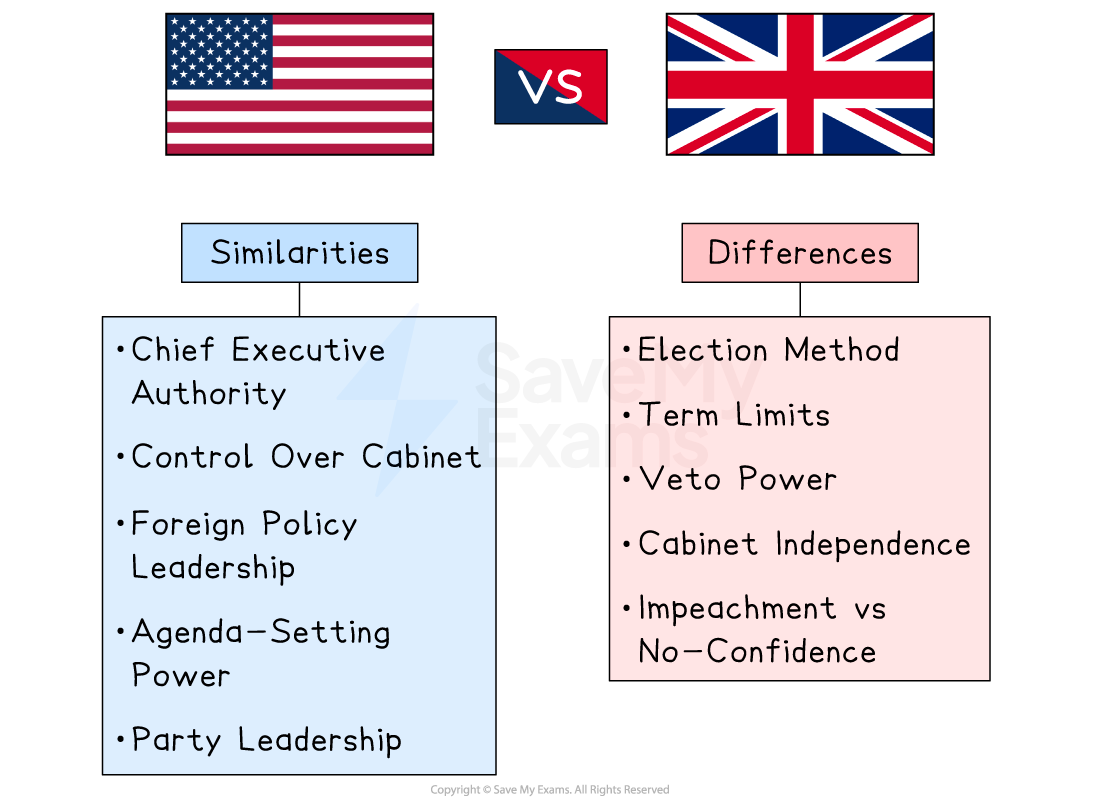
Similarities and differences of the Executive

Similarities

Similarity

Explanation and example

Theory explanation

Chief executive authority

  • Both are heads of government, responsible for implementing laws

  • President Biden oversaw the rollout of the Inflation Reduction Act (2022)

  • PM Sunak directed implementation of the Energy Price Guarantee (2022–23)

  • This could be explained by structural theory, as this is a role of the head of the government, who is also responsible for policy implementation

Control over cabinet appointments

  • Both select senior officials

  • President Trump selected Pete Hegseth as Secretary of Defense (2025)

  • PM Sunak appointed Jeremy Hunt as Chancellor (2022)

  • This could be explained by rational theory with appointments as strategic choices to advance policy

Foreign policy leadership

  • Both lead international relations

  • President Biden authorising military support to Ukraine (2022–23)

  • PM Sunak attending G7 summits influencing sanctions on Russia

  • This could be explained by structural theory reflecting both as fulfilling the role of head of state

Power of agenda-setting

  • Both can shape legislative priorities

  • Biden’s Build Back Better agenda (2021)

  • Sunak prioritised NHS funding reforms in 2022

  • This could be explained by rational theory, with each executive trying to fulfil their own policy priorities

Party leadership

  • Both essentially lead their parties

  • Biden steered Democrats in the 2022 midterms

  • Sunak managed Conservative policy and messaging during the 2024 local elections

  • This could be explained by cultural theory reflecting the norms of party-centric governance

Differences

Difference

Explanation and example

Theory explanation

Election method

  • The US president is directly elected via the Electoral College and therefore holds a direct electoral mandate

  • The UK PM is the leader of the party with a majority following general election results

  • This could be explained by structural theory, with the UK’s fused powers and US’ separation of powers explaining this difference

Term limits

  • Presidents can serve a maximum of two terms

  • PMs have no formal term limit

  • This could be explained by cultural theory, with historic precedent (and subsequently constitutional amendments) shaping this expected limit in the US, whilst cultural expectations in the UK being driven by electoral popularity

Veto power

  • The US President can veto legislation

  • The UK PM cannot directly veto bills but can control Commons via party majority

  • This could be explained by structural theory reflecting on the formal powers of each of these executives

Cabinet independence

  • UK PM controls Cabinet more tightly and there is an expectation of cabinet collective responsibility

  • US presidents often face more independent Senate-confirmed appointees

  • This could be explained by rational theory, with UK PM dependent on their cabinet to shore up their own power, whilst the US president can act in a more solitary fashion

Impeachment vs no-confidence

  • The president can only be removed via impeachment which is rare and requires the consent of both Houses

  • In the UK, the PM can be removed by a no-confidence vote in Commons alone

  • This could be explained by structural theory, with the PM lacking the direct electoral mandate that the US president holds

The accountability of the executive to the US and UK legislature
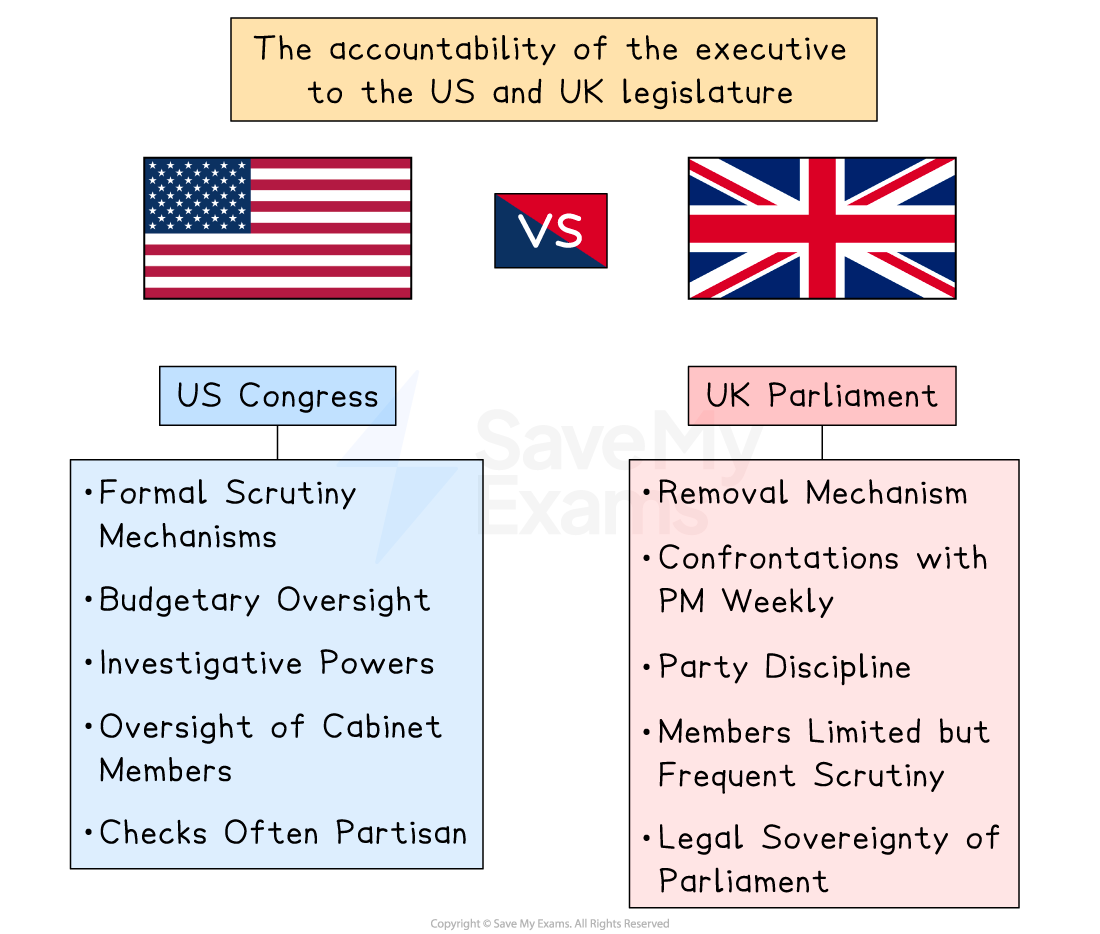
Accountability of the executive

Similarities

Similarity

Explanation and example

Theory explanation

Formal scrutiny mechanisms

  • Both systems provide structured ways for legislatures to question the executive

  • The US Senate Foreign Relations Committee scrutinised funding advocated for Ukraine

  • PMQs allow MPs to question the PM weekly

  • This could be explained by structural theory, as both legislatures are given powers to oversee and begin to limit the power of the executive branches, and to encourage transparency

Budgetary oversight

  • Both Congress and Parliament approve public spending

  • Congress authorised the Inflation Reduction Act (2022)

  • UK Parliament approved the Energy Price Guarantee (2022–23)

  • This could be explained by structural theory, as formal rules of budget approval constrain executive behaviour

Investigative powers

  • Legislatures can conduct inquiries into executive misconduct

  • Congress investigated the January 6th Capitol attack (2021)

  • UK Commons committees investigated Partygate (2022–23)

  • This could be explained by rational theory, as legislators can act strategically to check the executive for political and policy gains

Oversight of cabinet members

  • Both the US Congress and select committees in the Commons can question cabinet members

  • Kristi Noem questioned on immigration policy by the House Committee on Homeland Security

  • Priti Patel questioned over bullying by the Home Affairs Select Committee

  • This could be explained by rational theory, as legislators can act strategically to check the executive for political and policy gains

Legislative control

  • Both the President and the Prime Minister are reliant on their legislatures for legislative output, including amendments, debates and votes

  • This could be explained by structural theory, as the legislative process is laid out in the respective rules of each legislature and both require majority assent

Differences

Difference

Explanation and example

Theory explanation

Removal mechanisms

  • Presidents can only be removed via impeachment (Trump 2017, 2021) which is rare and requires the consent of both Houses of Congress

  • UK PM can be removed by a no-confidence vote in the Commons only, via a simple majority

  • This could be explained structural theory, as the President holds their own electoral mandate, whereas the PM holds a mandate as the leader of the winning party, and therefore requires their support

Frequency of confrontation

  • US oversight occurs continuously through hearings

  • UK PMQs are weekly, and formal investigations are less frequent and less public

  • This could be explained by structural theory, with Congress holding a mandate independent of that of the President, whereas both the PM and House of Commons share a mandate

Independence of legislature

  • US Congress has stronger independence

  • UK Parliament is often constrained by party discipline and stronger whips

  • This could be explained by cultural theory with an expectation that MPs act with their parties more than members of Congress who have greater responsibility to their constituents

Partisan checks

  • Divided government increases US oversight effectiveness and is very common

  • UK accountability depends on a chamber that usually has a government majority

  • This could be explained by structural theory due to the fused nature of the UK government as against the separated nature of the US government

Judicial review

  • US Congress actions can be reviewed by courts, which can limit their oversight capabilities

  • UK Parliament is sovereign, limiting judicial oversight and strengthening their powers

  • This could be explained by structural theory, as this difference stems from institutional design

Unlock more, it's free!

Join the 100,000+ Students that ❤️ Save My Exams

the (exam) results speak for themselves:

Sarra Jenkins

Author: Sarra Jenkins

Expertise: Content Writer

Sarra is a highly experienced A-Level Politics educator with over two decades of teaching and examining experience. She was part of the team that wrote the Edexcel 2017 Politics Specification and currently works as a Senior Examiner. A published author of 14 textbooks and revision guides, her expertise lies in UK and US politics, exam skills, and career guidance. She continues to teach, driven by her passion for this "evolving and dynamic subject".

Steve Vorster

Reviewer: Steve Vorster

Expertise: Economics & Business Subject Lead

Steve has taught A Level, GCSE, IGCSE Business and Economics - as well as IBDP Economics and Business Management. He is an IBDP Examiner and IGCSE textbook author. His students regularly achieve 90-100% in their final exams. Steve has been the Assistant Head of Sixth Form for a school in Devon, and Head of Economics at the world's largest International school in Singapore. He loves to create resources which speed up student learning and are easily accessible by all.