Limitations on Presidential Power (Edexcel A Level Politics): Revision Note

Exam code: 9PL0

Sarra Jenkins

Written by: Sarra Jenkins

Reviewed by: Steve Vorster

Updated on

An introduction to the limitations on presidential powers

  • Although the US President holds significant formal and informal powers, presidential authority is not unlimited

  • In practice, the extent of presidential power is shaped and constrained by a range of political and institutional factors
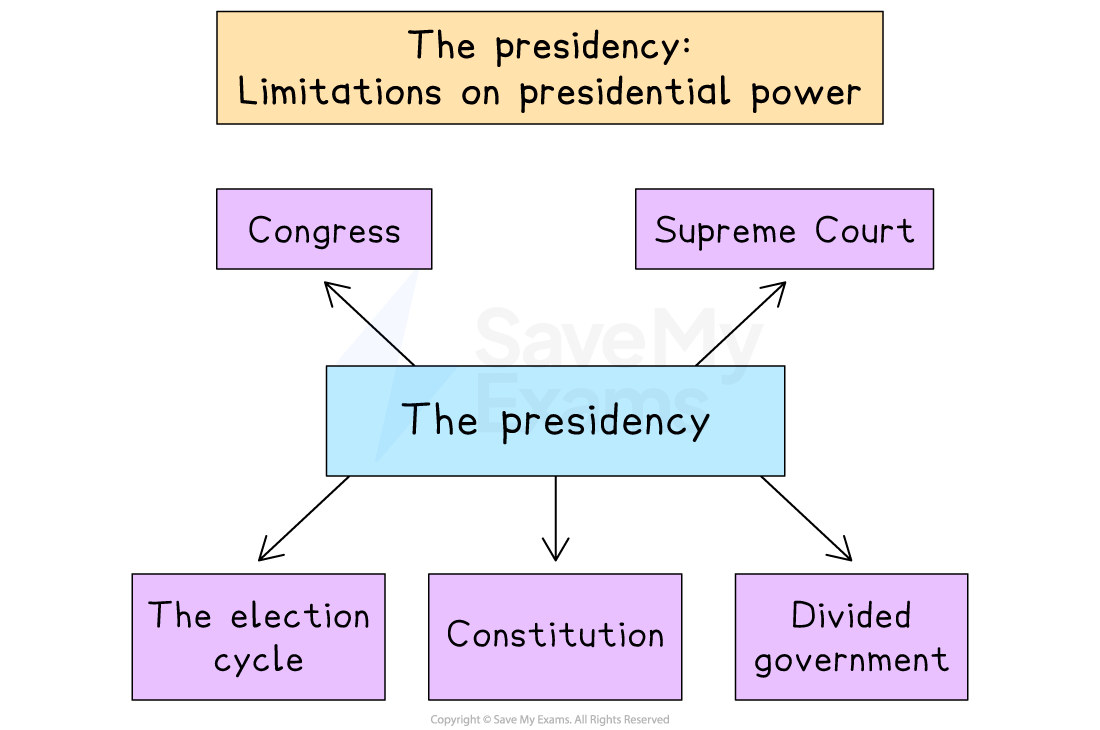
Diagram showing limitations on presidential power: Congress, Supreme Court, Constitution, divided government, and the election cycle, with arrows pointing to a president.
Limitations on presidential powers
  • This section examines how the President’s power is limited by:

    • Congress

    • the Supreme Court

    • the US Constitution

    • divided government

    • the election cycle

  • Together, these limitations help explain why presidential power can vary over time and why even strong presidents can struggle to achieve their policy goals

Power over the term of office

  • The power of a President can fluctuate over their term in office due to a number of factors

    • Control of Congress

      • If a president’s party controls both houses of Congress, they may face less congressional challenges and oversight

    • National circumstances

      • Wars and conflicts, national emergencies and financial crises can allow a president to expand their power, although poor handling of these can reduce presidential popularity and therefore their power

    • Opinion poll ratings

      • A popular president may find they have more power, as Congress is more willing to follow their constituents, therefore resulting in less opposition to the President

    • Party unity

      • A president who has a unified party behind them can rely more on their support

Congress, the Supreme Court and the Constitution

Congress

  • Congress controls the legislative process and budgets, and can override presidential vetoes

Limit by Congress

Failures of congressional limits

  • They can prevent the president from making unchecked policy decisions

    • E.g. President Biden’s Build Back Better proposal stalled in 2021 due to Democratic divisions and opposition in the Senate

  • When party alignment exists between the majority party in Congress and the President, Congress may rarely block or effectively scrutinise presidential policy

    • E.g. Trump’s tax reform (2017) passed quickly with a Republican-controlled Congress

Supreme Court

  • The Supreme Court can declare presidential actions unconstitutional through their power of judicial review

Limit by the Supreme Court

Failures of limits by the Supreme Court

  • Judicial review can rule executive actions unconstitutional 

    • E.g. The Supreme Court blocked President Trump’s attempt to end DACA (2020)

  • The ideological nature of some Supreme Court rulings could be seen to limit their willingness to challenge a president

    • E.g. President Trump’s confirmation of three conservative justices (2017–2020) allowed broader executive discretion through their favourable rulings in his second term

Constitution

  • Codified powers in the Constitution can prevent presidential overreach

Limit by the Constitution

Failures of the limits by the Constitution

  • The president’s authority is legally bound by the Constitution

  • This gives him only specifically enumerated power

    • E.g. President Trump was impeached in 2019 for obstruction of Congress and abuse of power, and in 2021 for incitement to insurrection (although he was found guilty on all charges)

  • The vagueness of the Constitution has allowed the president to expand their power considerably 

    • E.g. President Trump was able to conduct military interventions in Venezuela without Congressional approval and despite its heavy criticism

The election cycle

  • Presidents serve fixed terms and must consider re-election likelihood if they are in their first term, and consider the impact of mid-term elections

Limit by the election cycle

Failures of the limits by the election cycle

  • Focussing on the next election (presidential or congressional) reduces the likelihood of long-term policy initiatives, and increases the focus on policies that are popular with the public

    • E.g. President Trump experienced the only veto override of his first term during the lame duck period after he had lost the 2020 election

  • Presidents can still act, for example via executive orders

    • E.g. President Biden pardoned his son Hunter Biden after the election in 2024, which was won by President Trump

Divided government

  • A divided government is when the Presidency, House of Representatives and the Senate are not all controlled by the same party

Limit by a divided government

Failures of the limits by a divided government

  • A president who faces an opposition Congress can face challenges in achieving their legislative agenda and appointment confirmations

    • E.g. President Biden struggled to get the Build Back Better plan through a House of Representatives controlled by Republicans

  • Presidents may use persuasion or executive orders to get around Congress

    • E.g. President Trump used executive actions to advance environmental and immigration policies during his first term

Unlock more, it's free!

Join the 100,000+ Students that ❤️ Save My Exams

the (exam) results speak for themselves:

Sarra Jenkins

Author: Sarra Jenkins

Expertise: Content Writer

Sarra is a highly experienced A-Level Politics educator with over two decades of teaching and examining experience. She was part of the team that wrote the Edexcel 2017 Politics Specification and currently works as a Senior Examiner. A published author of 14 textbooks and revision guides, her expertise lies in UK and US politics, exam skills, and career guidance. She continues to teach, driven by her passion for this "evolving and dynamic subject".

Steve Vorster

Reviewer: Steve Vorster

Expertise: Economics & Business Subject Lead

Steve has taught A Level, GCSE, IGCSE Business and Economics - as well as IBDP Economics and Business Management. He is an IBDP Examiner and IGCSE textbook author. His students regularly achieve 90-100% in their final exams. Steve has been the Assistant Head of Sixth Form for a school in Devon, and Head of Economics at the world's largest International school in Singapore. He loves to create resources which speed up student learning and are easily accessible by all.